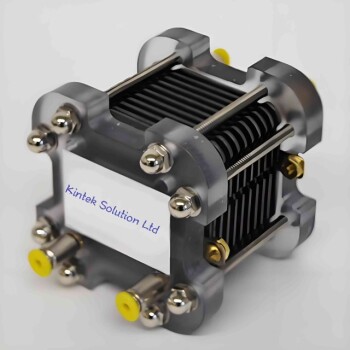
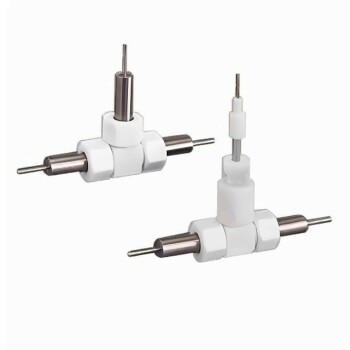
The primary benefit of a three-electrode flat electrochemical cell system is its ability to isolate the specific corrosion behavior of chromized steel within a highly controlled, standardized environment. By strictly separating the roles of current flow and potential measurement, this configuration allows for the precise quantification of critical parameters such as repassivation potential and localized pitting resistance.
Core Takeaway This system decouples the measurement process by using three distinct components to ensure that the data reflects only the intrinsic properties of the chromized layer. It provides the precision necessary to evaluate how well the coating inhibits localized corrosion mechanisms like pitting in aggressive media.
The Architecture of Precision
Separation of Electrical Duties
The fundamental advantage of this system lies in its division of labor. In a two-electrode system, one electrode must act as both the reference and the counter, leading to polarization errors.
The Role of the Reference Electrode
In the three-electrode setup, a Saturated Calomel Electrode (SCE) acts solely as the reference point. Because no significant current flows through it, its potential remains stable, ensuring that the voltage measurements applied to the chromized steel are highly accurate.
The Role of the Counter Electrode
A platinum mesh counter electrode handles the current loop. By providing a large surface area, it ensures that the current flowing through the system is not limited by the counter electrode itself, allowing the test to reflect the true electrochemical activity of the working sample.
Critical Metrics for Chromized Steel
Measuring Coating Stability
This configuration is essential for generating polarization curves and monitoring Open Circuit Potential (OCP). These metrics provide a baseline for how stable the chromized layer is when exposed to specific media, such as sodium chloride solutions.
Assessing Localized Corrosion
The most specific benefit for chromized steel is the ability to determine repassivation potential. This measures the material's ability to "heal" itself after the passive film is breached, which is the definitive test for resistance against pitting corrosion.
Analyzing Coating Porosity
Beyond basic potential measurements, this standardized environment supports Electrochemical Impedance Spectroscopy (EIS). This advanced technique allows you to measure charge transfer resistance and pore resistance, providing data on the active protection offered by the coating and the integrity of the layer.
Understanding the Prerequisites
Component Quality Matters
While this system offers superior accuracy, it relies heavily on the quality of its components. The reference electrode (SCE) must be perfectly maintained; if its potential drifts, all localized corrosion data becomes invalid.
Geometry Considerations
The "flat" cell designation is crucial for chromized steel, which often comes in sheet form. The cell geometry must ensure uniform current distribution across the flat surface of the working electrode to avoid edge effects that could mimic artificial pitting.
Making the Right Choice for Your Goal
To maximize the value of your testing data, match your specific objective to the correct measurement technique enabled by this system.
- If your primary focus is determining lifespan in harsh environments: Focus on repassivation potential to see how well the steel resists permanent pitting damage.
- If your primary focus is analyzing the coating quality: Utilize EIS metrics (pore resistance) to detect microscopic defects in the chromized layer before visible corrosion occurs.
By isolating the working electrode, this system transforms corrosion testing from a general observation into a precise, quantitative science.
Summary Table:
| Feature | Component/Metric | Benefit for Chromized Steel Evaluation |
|---|---|---|
| Reference Electrode | Saturated Calomel (SCE) | Eliminates polarization errors; ensures stable, accurate voltage measurement. |
| Counter Electrode | Platinum Mesh | Handles current loop without limiting electrochemical activity of the sample. |
| Flat Cell Geometry | Optimized for Sheets | Prevents edge effects and ensures uniform current distribution across the coating. |
| Key Metric | Repassivation Potential | Quantifies the ability of the chromized layer to "heal" and resist pitting. |
| Advanced Analysis | EIS (Impedance) | Measures pore resistance to detect microscopic coating defects and porosity. |
Elevate Your Electrochemical Research with KINTEK
Precision in corrosion analysis starts with superior cell design. KINTEK specializes in high-performance laboratory equipment, offering a comprehensive range of electrolytic cells and electrodes specifically engineered for accurate material characterization.
Whether you are evaluating the integrity of chromized layers or developing next-generation coatings, our specialized electrochemical systems—alongside our high-temperature furnaces, hydraulic presses, and advanced battery research tools—provide the reliability your data demands.
Ready to achieve more precise, quantitative results for your laboratory? Contact our technical experts today to find the perfect electrochemical cell solution for your application.
References
- K.D. Ralston, N. Birbilis. Achieving a chromium rich surface upon steels via FBR-CVD chromising treatments. DOI: 10.1016/j.corsci.2011.05.021
This article is also based on technical information from Kintek Solution Knowledge Base .
Related Products
- H Type Electrolytic Cell Triple Electrochemical Cell
- Flat Corrosion Electrolytic Electrochemical Cell
- PTFE Electrolytic Cell Electrochemical Cell Corrosion-Resistant Sealed and Non-Sealed
- Electrolytic Electrochemical Cell with Five-Port
- Electrolytic Electrochemical Cell Gas Diffusion Liquid Flow Reaction Cell
People Also Ask
- What is a H type cell? A Guide to Divided Electrochemical Cells for Accurate Experiments
- How should the electrolyte be prepared and added to the H-type electrolytic cell? Best Practices for Purity and Safety
- What is the technical necessity of using an H-type electrolytic cell for NO3RR tests? Protect Your Ammonia Yields
- How does the design of an H-type electrolytic cell benefit the neutral water electrolysis process for metal recovery?
- What is the primary function of an H-type electrolytic cell in NitRR? Ensure Accurate Product Yields