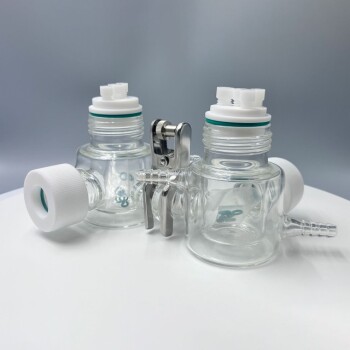
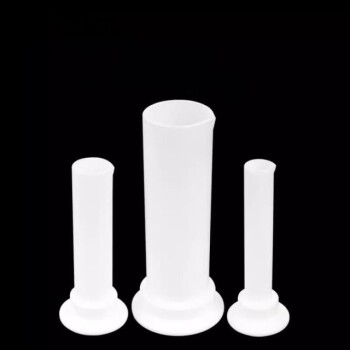
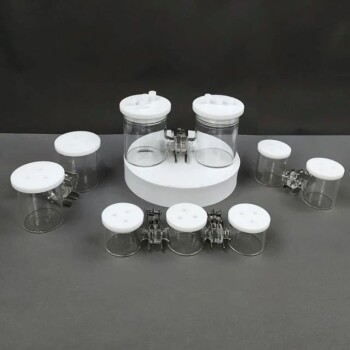
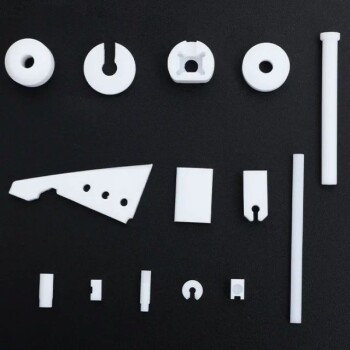
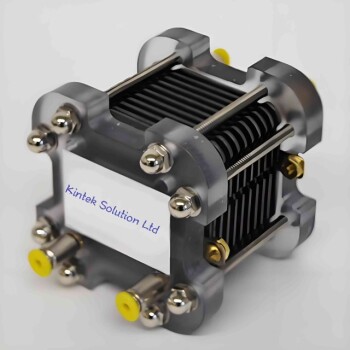
The primary design advantages of a custom Teflon electrochemical cell center on its material inertness and its ability to integrate complex mechanical and electrical components in a small footprint. By leveraging the chemical stability of Teflon, these cells withstand aggressive electrolytes while utilizing a specialized O-ring configuration to maintain a seal during dynamic friction testing.
The core value of this custom design is the reliable convergence of mechanics and electrochemistry. It allows you to run a full three-electrode system alongside a tribometer probe in a confined space, ensuring data integrity by preventing leaks and chemical contamination.
Ensuring Chemical Integrity
The Role of Chemical Inertness
The choice of Teflon (PTFE) as the construction material provides exceptional chemical stability.
In tribocorrosion experiments, the cell must often endure long-term exposure to aggressive electrolytes, such as sodium chloride solutions.
Preventing Sample Contamination
Because Teflon offers high corrosion resistance, the cell body does not react with the test solution.
This ensures that the electrochemical data recorded is purely a result of the sample's interaction with the environment, rather than a side reaction with the container itself.
Managing Mechanical Dynamics
Leak Prevention Under Stress
Tribocorrosion involves the application of friction, which introduces mechanical stress and vibration to the system.
A critical design feature is the inclusion of an O-ring seal at the base of the cell.
Maintaining Electrolyte Volume
This seal is specifically engineered to prevent liquid leakage during the mechanical operation of the tribometer.
By maintaining a consistent electrolyte volume, the cell ensures that the electrochemical conditions remain stable throughout the duration of the friction test.
Optimizing Spatial Configuration
Integrating Complex Systems
Conducting these experiments requires the simultaneous use of a three-electrode system (working, counter, and reference) and a mechanical loading probe.
The custom structural design addresses the challenge of fitting these four distinct components into a single unit.
overcoming Spatial Constraints
The geometry of the cell allows these components to operate within a "confined space" without interfering with one another.
This compact architecture is essential for maintaining the correct positioning of electrodes relative to the wear track created by the tribometer probe.
Operational Considerations and Trade-offs
Precision Assembly Requirements
While the compact design is an advantage, the confined space implies that assembly requires high precision.
Users must ensure that the three electrodes and the tribometer probe are aligned perfectly to avoid mechanical interference or electrical shorting within the small chamber.
Reliance on Seal Integrity
The success of the experiment is heavily dependent on the condition of the base O-ring.
Because the cell relies on this single point of failure to resist leaks during friction, the O-ring must be inspected regularly for wear or degradation before long-term tests.
Making the Right Choice for Your Experiment
To maximize the utility of a custom Teflon cell, consider your specific experimental parameters:
- If your primary focus is long-term chemical stability: Rely on the Teflon construction to prevent cell degradation during extended exposure to sodium chloride or other corrosive media.
- If your primary focus is dynamic friction testing: rigorous inspection of the base O-ring seal is required to ensure it can withstand the shear forces generated by the tribometer without leaking.
- If your primary focus is complex electrochemical analysis: Utilize the cell's specialized geometry to position the three-electrode system close to the friction zone without obstructing the mechanical probe.
The right cell design transforms the complexity of tribocorrosion into a controlled, repeatable process.
Summary Table:
| Feature | Design Advantage | Benefit for Tribocorrosion |
|---|---|---|
| Material: PTFE (Teflon) | High Chemical Inertness | Prevents sample contamination and resists aggressive electrolytes. |
| Sealing System | Specialized O-ring Configuration | Ensures leak-proof operation during dynamic mechanical friction. |
| Spatial Geometry | Compact Four-Component Integration | Fits 3-electrode systems and a mechanical probe in a confined space. |
| Structural Integrity | Mechanical Stability | Maintains consistent electrolyte volume and stable electrochemical data. |
Elevate Your Material Research with KINTEK Precision
Take control of your tribocorrosion and electrochemical experiments with KINTEK’s specialized laboratory solutions. From custom Teflon electrochemical cells and high-performance electrodes to our comprehensive range of crushing, milling, and high-temperature furnace systems, we provide the tools necessary for data integrity in the most demanding environments.
Why choose KINTEK?
- Superior Chemical Resistance: Our PTFE products and ceramic consumables are designed for longevity in aggressive media.
- Precision Engineering: Our cells and hydraulic presses ensure repeatable results under mechanical stress.
- Integrated Solutions: Whether you need battery research tools, cooling solutions, or advanced reactors, we support your entire workflow.
Ready to optimize your lab's performance? Contact our technical experts today to find the perfect fit for your application.
References
- Jia Chen, Wenjun Cai. Determining Tribocorrosion Rate and Wear-Corrosion Synergy of Bulk and Thin Film Aluminum Alloys. DOI: 10.3791/58235
This article is also based on technical information from Kintek Solution Knowledge Base .
Related Products
- PTFE Electrolytic Cell Electrochemical Cell Corrosion-Resistant Sealed and Non-Sealed
- Flat Corrosion Electrolytic Electrochemical Cell
- Double-Layer Water Bath Electrolytic Electrochemical Cell
- Optical Water Bath Electrolytic Electrochemical Cell
- Double Layer Five-Port Water Bath Electrolytic Electrochemical Cell
People Also Ask
- What is the necessity of selecting a PTFE electrolytic cell? Ensure Precise Graphene Corrosion Testing Accuracy
- What is the proper method for cleaning the surface of an all-PTFE electrolytic cell? Ensure Accurate Results with a Pristine Surface
- How should an all-PTFE electrolytic cell be stored after use? Expert Maintenance Tips for Long-Lasting Performance
- What is the proper cleaning method for an all-PTFE electrolytic cell? Essential Tips for Surface Integrity
- What are the standard opening specifications for all-PTFE electrolytic cells? A Guide to Sealed vs. Non-Sealed Ports