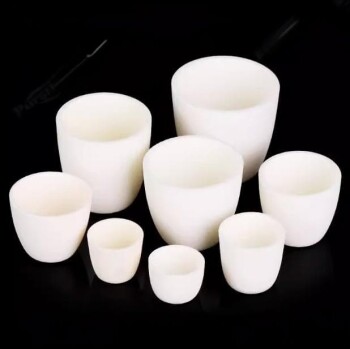
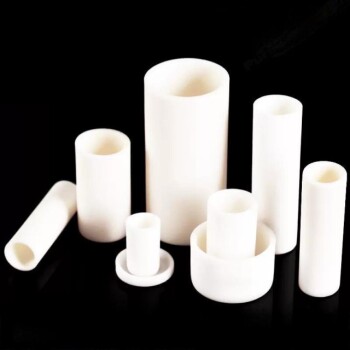
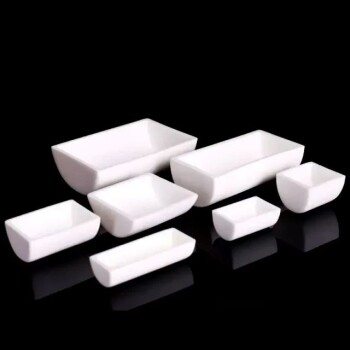
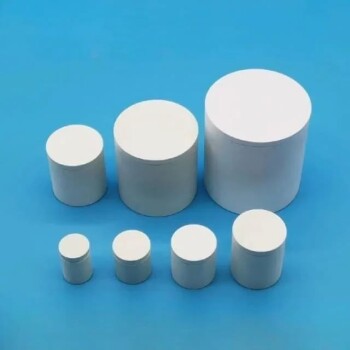
Porcelain crucibles are the preferred choice for 900°C carbon nanotube synthesis because they combine exceptional chemical inertness with the ability to withstand corrosive molten salts. At these extreme temperatures, the crucible maintains a stable environment for "molten salt-assisted" reactions, ensuring the resulting carbon structure is both pure and precisely porous.
The technical advantage of a porcelain crucible lies in its dual role as a chemically resistant barrier and a pressure-regulating vessel. It enables the controlled evaporation of catalysts like zinc chloride, which is fundamental to forming the dense, porous architecture of high-quality carbon nanotubes.
Superior Chemical Resistance to Molten Salts
Resilience Against Zinc Chloride (ZnCl2)
At 900°C, many standard lab containers would succumb to the highly corrosive nature of molten salts. Porcelain possesses unique chemical stability that allows it to hold molten ZnCl2 without degrading or reacting with the salt.
Prevention of Metallic Contamination
Maintaining the high purity of carbon nanotubes is critical for their electrical and mechanical performance. Porcelain crucibles act as an inert shield, ensuring that no metallic ion impurities are leached from the container into the sample during the carbonization process.
Atmospheric Control and Pore Formation
Maintaining Local Vapor Pressure
In a semi-closed molten salt-assisted synthesis, the crucible serves as a localized reaction chamber. It helps maintain internal vapor pressure, which is necessary for the salt to interact correctly with the carbon precursor before it evaporates.
Facilitating the Pore-Forming Mechanism
As the temperature reaches 900°C, the zinc chloride within the crucible begins to evaporate. The geometry and material properties of the porcelain crucible ensure this evaporation occurs in a way that templates the dense, porous structure characteristic of advanced carbon nanotubes.
Thermal Integrity and Heat Distribution
High-Temperature Structural Stability
Unlike metals that might soften or plastics that would incinerate, porcelain maintains its physical structural integrity at 900°C. This ensures the sample remains in a consistent shape and volume throughout the entire thermal cycle.
Uniform Thermal Field Management
The material properties of high-quality ceramics allow for a uniform thermal field within the crucible. This prevents localized "hot spots," which can lead to non-uniform carbonization and defective nanotube growth.
Understanding the Trade-offs
While porcelain is excellent for chemical inertness, it is susceptible to thermal shock if heated or cooled too rapidly. Unlike graphite crucibles, which offer superior thermal conductivity for rapid preheating, porcelain requires gradual temperature ramping to prevent cracking.
Additionally, while porcelain is more cost-effective than high-purity alumina or zirconia, it may have slightly lower maximum temperature thresholds. For processes exceeding 1200°C, more specialized technical ceramics may be required to prevent the material from becoming slightly porous to gases.
How to Apply This to Your Project
When selecting a vessel for high-temperature carbon nanotube synthesis, your choice should be dictated by the specific chemistry of your catalysts and the desired purity of your output.
- If your primary focus is molten salt-assisted synthesis (e.g., using ZnCl2): Use a porcelain crucible to ensure chemical resistance and proper vapor pressure management for pore formation.
- If your primary focus is maximum material purity and avoiding metallic ions: Select high-purity alumina or porcelain crucibles to prevent side reactions between the container and the reactants.
- If your primary focus is rapid isothermal reduction: Consider a graphite crucible instead, as its high thermal conductivity allows for faster preheating and more uniform rapid cooling.
By leveraging the chemical stability and vapor-trapping capabilities of porcelain, you can achieve the precise environmental conditions required for high-performance carbon nanotube production.
Summary Table:
| Feature | Technical Advantage | Impact on Carbon Nanotubes |
|---|---|---|
| Chemical Inertness | Resists corrosive molten salts (ZnCl2) | Prevents metallic contamination and ensures high purity. |
| Pressure Regulation | Maintains localized internal vapor pressure | Enables precise templating of the porous architecture. |
| Thermal Stability | Maintains structural integrity at 900°C | Ensures consistent sample shape and uniform growth. |
| Heat Distribution | Provides a uniform thermal field | Prevents localized hot spots and non-uniform carbonization. |
Elevate Your Material Synthesis with KINTEK Expertise
Achieving high-performance carbon nanotubes requires more than just high temperatures—it demands a stable, contaminant-free environment. KINTEK specializes in premium laboratory equipment and consumables designed for the most rigorous thermal processes. From our high-purity porcelain and ceramic crucibles that resist corrosive molten salts to our precision muffle and tube furnaces that provide the perfect thermal field, we provide the tools you need for reproducible results.
Whether you are scaling up CNT production or optimizing laboratory research, our comprehensive range—including crushing and milling systems, high-temperature reactors, and vacuum furnaces—is engineered to meet your specific technical requirements.
Ready to optimize your carbonization process? Contact KINTEK today for tailored solutions and high-quality consumables that drive innovation.
References
- Jianghai Deng, Qiuyun Zhou. The Semi-Closed Molten Salt-Assisted One-Step Synthesis of N-P-Fe Tridoped Porous Carbon Nanotubes for an Efficient Oxygen Reduction Reaction. DOI: 10.3390/catal13050824
This article is also based on technical information from Kintek Solution Knowledge Base .
Related Products
- Arc-Shaped Alumina Ceramic Crucible High Temperature Resistant for Engineering Advanced Fine Ceramics
- High Purity Pure Graphite Crucible for Electron Beam Evaporation
- Electron Beam Evaporation Coating Tungsten Crucible and Molybdenum Crucible for High Temperature Applications
- High Purity Pure Graphite Crucible for Evaporation
- Engineering Advanced Fine Alumina Al2O3 Ceramic Crucible for Laboratory Muffle Furnace
People Also Ask
- Why Use Alumina Crucibles & Powder Burial for NaSICON? Ensure Phase Purity and Prevent Elemental Volatilization
- What is the primary purpose of using alumina crucibles for LLTO ceramics? Optimize Your High-Temperature Sintering
- Why are alumina crucibles and mother powder essential for LATP sintering? Optimize Your Solid Electrolyte Performance
- Why are high-purity alumina crucibles used for liquid lead corrosion experiments? Ensure Data Accuracy at 550°C
- Primary considerations for choosing alumina crucibles and quartz tubes in indium intercalation: Ensure Material Purity