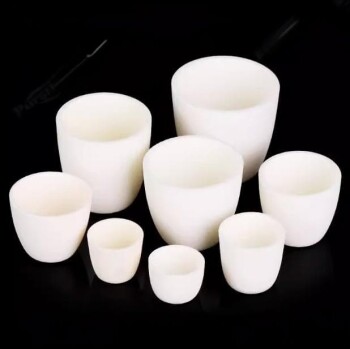
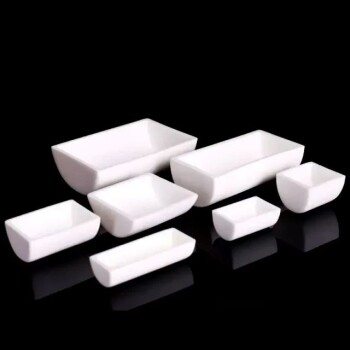
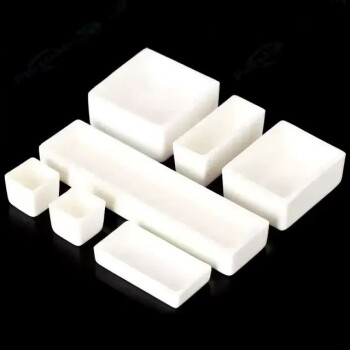
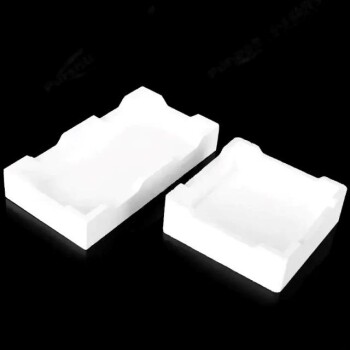
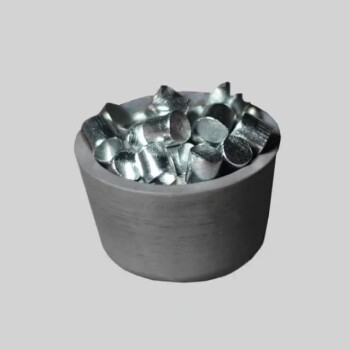
Alumina crucibles function as more than just passive vessels during the high-temperature sintering of Lithium Lanthanum Zirconium Oxide (LLZO); they act as active participants in the material's chemical evolution. While their fundamental role is to serve as high-temperature resistant containers that protect the furnace lining, they specifically provide a source of aluminum that is crucial for stabilizing the material's crystal structure and maintaining high ionic conductivity.
Core Takeaway In LLZO synthesis, the alumina crucible often doubles as a chemical reagent, introducing aluminum into the sample to stabilize the highly conductive cubic phase. However, this interaction must be balanced with atmosphere control measures to prevent lithium loss, ensuring the final electrolyte achieves the correct stoichiometry and performance.
The Chemical and Structural Roles of Alumina
Active Aluminum Doping
The most distinct function of an alumina crucible in this specific context is acting as an aluminum source.
During high-temperature sintering, aluminum atoms can migrate from the crucible interface into the LLZO powder.
This unintentional doping is often beneficial, as aluminum acts as a stabilizer for the cubic phase structure of LLZO.
Preventing Phase Degradation
Without the stabilization provided by aluminum, LLZO tends to revert to a tetragonal phase during the cooling process.
The tetragonal phase possesses significantly lower ionic conductivity compared to the cubic phase.
By facilitating an aluminum-doped environment, the crucible helps ensure the final material retains the high-conductivity structure necessary for effective solid electrolytes.
Thermal Containment and Isolation
Physically, the crucible serves as a robust barrier between the reactants and the furnace environment.
It possesses excellent chemical stability and thermal shock resistance, allowing it to withstand temperatures often exceeding 1100°C without structural failure.
This isolation prevents the corrosive molten salts or reactive powders from damaging the furnace lining or interacting with heating elements.
Managing the Sintering Atmosphere
Mitigating Lithium Volatility
A critical challenge in sintering LLZO is the high volatility of lithium at elevated temperatures.
If lithium evaporates, the material suffers from phase transitions at the surface and a sharp drop in conductivity.
Using a sealed alumina crucible allows for the creation of a controlled micro-environment.
The Role of Mother Powder
To further protect the sample within the crucible, technicians often cover the pressed green bodies with "mother powder" (powder of the same composition).
The crucible contains this powder, which creates a local lithium-rich atmosphere.
This setup compensates for any lithium loss from the sample itself, preserving the phase purity and electrochemical performance of the ceramic membrane.
Understanding the Trade-offs
The Risk of Uncontrolled Impurities
While aluminum doping stabilizes the cubic phase, it alters the chemical stoichiometry of the original powder.
If your specific application requires pure, undoped LLZO, an alumina crucible may introduce excess aluminum impurities.
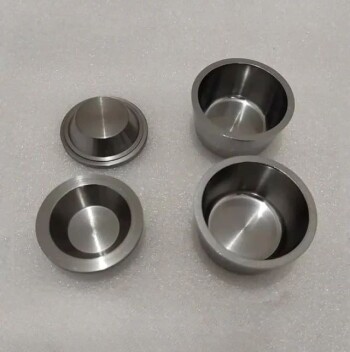
In such cases, a zirconia (ZrO2) crucible is preferred because it is chemically inert regarding aluminum and maintains strict stoichiometry.
Reaction and Sticking Issues
At extremely high temperatures, there is a risk of pellets sticking to the crucible walls or reacting excessively.
While alumina is generally stable, direct contact can sometimes lead to localized degradation or adhesion.
Using a bed of mother powder inside the crucible acts as a physical buffer, preventing direct contact between the sample and the crucible floor.
Making the Right Choice for Your Goal
To select the correct sintering setup, you must define your tolerance for chemical interaction:
- If your primary focus is maximizing conductivity via the cubic phase: Utilize alumina crucibles to leverage their ability to act as an aluminum dopant source, which stabilizes the desired crystal structure.
- If your primary focus is strict chemical purity and stoichiometry: Avoid alumina and choose zirconia crucibles to prevent the introduction of aluminum impurities into your LLZO powder.
- If your primary focus is preventing surface degradation: Ensure the crucible is sealed and utilize a mother powder covering to maintain a lithium-rich atmosphere and prevent lithium volatilization.
Correctly leveraging the reactivity of your crucible turns a simple container into a tool for precise material engineering.
Summary Table:
| Function | Description | Benefit to LLZO |
|---|---|---|
| Active Doping | Source of Al atoms migrating into the sample | Stabilizes the high-conductivity cubic phase |
| Phase Prevention | Inhibits transition to tetragonal phase during cooling | Maintains superior lithium-ion conductivity |
| Atmosphere Control | Enables micro-environment containment | Mitigates lithium loss when used with mother powder |
| Thermal Isolation | High-temp barrier (>1100°C) | Protects furnace lining from corrosive reactants |
Elevate Your Solid-State Battery Research with KINTEK
Precise material synthesis requires more than just high temperatures—it demands the right environment. At KINTEK, we understand that whether you need the active stabilization of an alumina crucible for cubic-phase LLZO or the chemical neutrality of zirconia for pure stoichiometry, the quality of your consumables defines your results.
From high-temperature muffle and vacuum furnaces to precision-engineered ceramics and crucibles, KINTEK provides the comprehensive tools necessary for advanced battery research and materials science. Contact us today to discuss your sintering requirements and discover how our high-performance laboratory equipment and specialized consumables can optimize your laboratory’s efficiency and electrolyte performance.
Related Products
- Arc-Shaped Alumina Ceramic Crucible High Temperature Resistant for Engineering Advanced Fine Ceramics
- Alumina Al2O3 Ceramic Crucible Semicircle Boat with Lid for Engineering Advanced Fine Ceramics
- Engineering Advanced Fine Ceramics Alumina Crucibles (Al2O3) for Thermal Analysis TGA DTA
- Engineering Advanced Fine Ceramics Alumina Al2O3 Crucible With Lid Cylindrical Laboratory Crucible
- Engineering Advanced Fine Alumina Al2O3 Ceramic Crucible for Laboratory Muffle Furnace
People Also Ask
- Why Use Alumina Crucibles & Powder Burial for NaSICON? Ensure Phase Purity and Prevent Elemental Volatilization
- What is the primary purpose of using alumina crucibles for LLTO ceramics? Optimize Your High-Temperature Sintering
- Why are alumina crucibles and mother powder essential for LATP sintering? Optimize Your Solid Electrolyte Performance
- Why are high-purity alumina crucibles used for liquid lead corrosion experiments? Ensure Data Accuracy at 550°C
- Primary considerations for choosing alumina crucibles and quartz tubes in indium intercalation: Ensure Material Purity