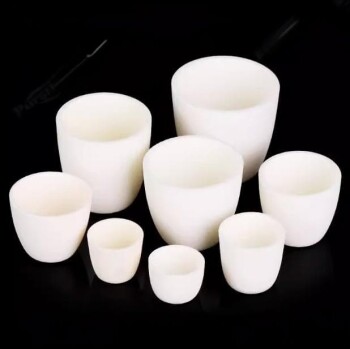
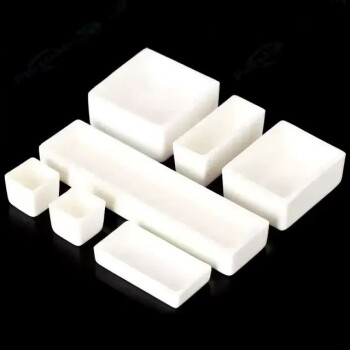
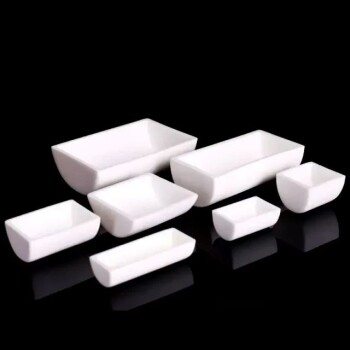
High-purity alumina is the industry standard for these experiments because of its exceptional combination of thermal stability and chemical inertness. It maintains its structural integrity at temperatures exceeding 1273 K while remaining non-reactive to both the sample material and the oxidizing atmosphere. This neutrality is essential for isolating the variables of your experiment, ensuring that the container itself does not become a participant in the chemical reaction.
The core value of high-purity alumina is the guarantee of data integrity. By resisting reaction with samples or oxygen, it ensures that any measured mass change is derived solely from the specimen's oxidation, eliminating false positives caused by container impurities or degradation.
Preserving Chemical Integrity
Absolute Chemical Inertness
The defining feature of high-purity alumina is its refusal to react with common sample materials. Whether testing graphite or metal specimens, alumina remains neutral even in oxygen-rich environments.
Preventing Sample Contamination
At high temperatures, lesser materials can leach impurities into a sample. Alumina’s stability ensures that no foreign elements are introduced into the reaction zone. This prevents cross-contamination and ensures the chemical composition of your sample remains pure throughout the heating cycle.
Resistance to Atmospheric Reaction
Ideally, a crucible must ignore the environment it sits in. Alumina does not react with oxygen or water vapor at high temperatures. This prevents the generation of secondary compounds that could skew results in sensitive kinetic studies.
Ensuring Gravimetric Accuracy
Isolating Mass Loss
In oxidation experiments, data is often derived from measuring weight change (gravimetry). Because alumina does not degrade or gain weight via reaction, you can be certain that measured mass loss originates solely from the sample.
Precision in Kinetic Data
To calculate accurate conversion rates, the baseline mass of the container must remain constant. Alumina provides the stable baseline required to track the oxidation of graphite or the spallation of oxide scales on metals without mathematical noise.
Understanding the Trade-offs
Alumina vs. Quartz
While quartz is a common laboratory material, it is unsuitable for the most extreme oxidation conditions. Unlike quartz, alumina does not undergo crystallization or deformation at temperatures approaching 1773 K.
Structural Rigidity vs. Erosion
In environments involving high-pressure steam or corrosive vapors, weaker ceramics can suffer from erosion. Alumina offers superior structural strength, resisting steam attack that would otherwise compromise the container and the reaction atmosphere.
Making the Right Choice for Your Goal
Selecting the correct crucible is about matching the material properties to your specific data requirements.
- If your primary focus is Kinetic Accuracy: Choose high-purity alumina to ensure that mass loss data reflects only the oxidation of your sample, not container degradation.
- If your primary focus is Extreme Temperature (>1273 K): Rely on alumina to prevent structural deformation and crystallization that typically occurs with quartz containers.
- If your primary focus is Preventing Contamination: Use alumina to physically separate samples and prevent chemical leaching in hydrothermal or high-pressure environments.
High-purity alumina transforms the sample container from a potential variable into a reliable constant, securing the validity of your experimental results.
Summary Table:
| Feature | High-Purity Alumina | Quartz / Low-Grade Ceramics |
|---|---|---|
| Temperature Limit | Exceeds 1773 K | Risk of deformation/crystallization > 1273 K |
| Chemical Inertness | Exceptional (Non-reactive) | Potential for leaching or sample reaction |
| Atmospheric Resistance | High (Resists O2, steam, vapors) | Susceptible to erosion in high-pressure steam |
| Gravimetric Accuracy | Stable baseline (No mass change) | Possible weight gain/loss from container degradation |
| Primary Benefit | Precise kinetic data & purity | Low-cost for lower temperature applications |
Elevate Your Research Precision with KINTEK
Don’t let container contamination compromise your experimental results. KINTEK specializes in high-performance laboratory solutions, providing premium high-purity alumina crucibles and ceramics designed to withstand the most rigorous high-temperature environments.
Whether you are conducting oxidation studies, battery research, or material synthesis, our comprehensive portfolio—from high-temperature furnaces (muffle, vacuum, CVD) to high-pressure reactors and PTFE consumables—ensures your data remains accurate and reproducible.
Ready to upgrade your lab efficiency? Contact us today to consult with our experts on the perfect equipment and consumables for your specific application.
References
- S. Ariharan, Kantesh Balani. High-temperature oxidation of graphite. DOI: 10.1680/jnaen.18.00008
This article is also based on technical information from Kintek Solution Knowledge Base .
Related Products
- Arc-Shaped Alumina Ceramic Crucible High Temperature Resistant for Engineering Advanced Fine Ceramics
- Engineering Advanced Fine Alumina Al2O3 Ceramic Crucible for Laboratory Muffle Furnace
- Engineering Advanced Fine Ceramics Alumina Al2O3 Crucible With Lid Cylindrical Laboratory Crucible
- High Purity Pure Graphite Crucible for Evaporation
- High Purity Alumina Granulated Powder for Engineering Advanced Fine Ceramics
People Also Ask
- Why Use Alumina Crucibles & Powder Burial for NaSICON? Ensure Phase Purity and Prevent Elemental Volatilization
- What is the primary purpose of using alumina crucibles for LLTO ceramics? Optimize Your High-Temperature Sintering
- Why are alumina crucibles and mother powder essential for LATP sintering? Optimize Your Solid Electrolyte Performance
- Why are high-purity alumina crucibles used for liquid lead corrosion experiments? Ensure Data Accuracy at 550°C
- Primary considerations for choosing alumina crucibles and quartz tubes in indium intercalation: Ensure Material Purity