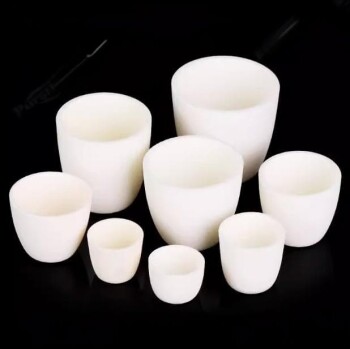
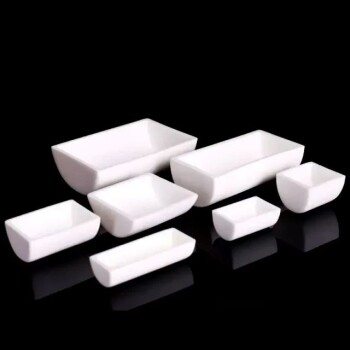
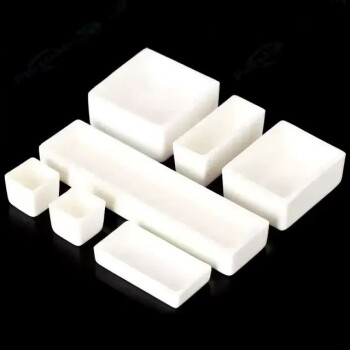
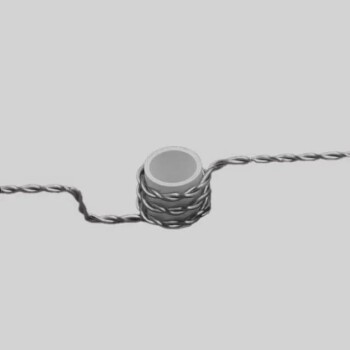
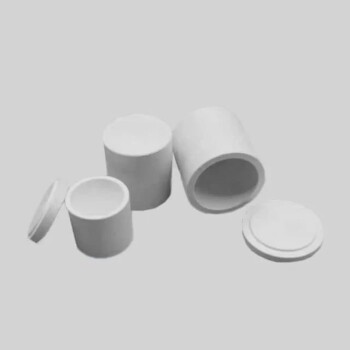
Alumina crucibles are the industry standard for liquid lead corrosion experiments primarily due to their exceptional combination of high thermal stability and chemical inertness. Even when subjected to liquid lead environments reaching temperatures as high as 800°C, these crucibles resist reaction with the molten metal, ensuring the container remains a neutral component in the testing system.
Core Insight: The value of alumina lies in its ability to remain "invisible" during the experiment. By preventing the container material from dissolving into the liquid lead, alumina ensures that any observed corrosion is exclusively a result of the interaction between the lead and the test specimen, guaranteeing data accuracy.
The Critical Role of Chemical Inertness
Preventing Contamination
The primary danger in corrosion testing is the introduction of foreign elements that alter the chemistry of the environment.
Alumina (aluminum oxide) possesses extremely low solubility in liquid lead. This prevents the crucible material from leaching into the molten bath, which keeps the liquid lead pure throughout the duration of the experiment.
Isolating the Corrosion Mechanism
To generate valid data, researchers must be certain that the corrosion observed is strictly between the liquid lead and the alloy specimen (such as FeCrAl).
Because alumina is inert, it prevents secondary reactions. This isolation ensures that phenomena like selective leaching or mass transfer are derived solely from the test samples, rather than being artifacts caused by the container walls.
Thermal Stability at Extreme Temperatures
Withstanding High Heat
Liquid lead experiments often operate at aggressive temperatures ranging from 500°C to 800°C.
Alumina crucibles maintain their structural integrity and chemical bond stability under these conditions. Unlike metallic containers, they do not soften or degrade chemically when exposed to this specific thermal stress.
Protecting External Equipment
In complex setups, high-purity alumina crucibles often serve as liners inside static experimental cells.
By acting as a barrier, they isolate the corrosive liquid metal from external steel pressure vessels. This prevents the liquid lead from corroding the outer vessel, which preserves the safety of the equipment and prevents iron from the vessel walls from contaminating the melt.
Ensuring Accurate Surface Analysis
Preserving Oxide Film Formation
A key aspect of testing alloys in liquid lead is evaluating their "self-healing" properties—specifically, their ability to form protective oxide films.
If a crucible releases impurities, these contaminants can interfere with the nucleation and growth of this oxide layer. Alumina’s stability ensures the chemical environment remains consistent, allowing for an accurate evaluation of how the alloy's surface naturally responds to the corrosive environment.
Critical Considerations: The Importance of Purity
While alumina is the material of choice, not all alumina ceramics are equal.
Purity Levels Matter The references explicitly highlight the need for high-purity alumina (typically >99% or >99.7%). Lower-grade alumina may contain binders or impurities (such as silica) that could react with liquid lead or dissolve at high temperatures.
The "Liner" Limitation While chemically superior, ceramics are brittle and cannot withstand high internal pressure on their own. Therefore, in high-pressure experiments, alumina is used strictly as a liner to hold the liquid, while a metallic outer vessel provides the necessary mechanical strength.
Making the Right Choice for Your Experiment
To ensure the validity of your corrosion data, apply the following guidelines:
- If your primary focus is determining accurate corrosion rates: Use high-purity (>99%) alumina to prevent container leaching that would skew mass loss measurements.
- If your primary focus is studying oxide film mechanisms: Rely on alumina to maintain a contaminant-free environment, ensuring observed surface formations are intrinsic to the alloy.
Summary: Alumina crucibles are selected not just to hold the liquid lead, but to guarantee that the chemical environment remains pristine, ensuring that experimental results reflect the true behavior of the materials being tested.
Summary Table:
| Feature | Benefit in Liquid Lead Experiments |
|---|---|
| Chemical Inertness | Prevents container leaching and molten lead contamination. |
| Thermal Stability | Maintains structural integrity up to 800°C without softening. |
| High Purity (>99%) | Eliminates secondary reactions from binders or silica impurities. |
| Isolation Role | Protects external vessels from corrosion as a protective liner. |
| Analysis Accuracy | Ensures oxide film formation is intrinsic to the test specimen. |
Elevate Your Research Precision with KINTEK
Don't let container contamination compromise your critical corrosion data. KINTEK specializes in high-performance laboratory equipment and consumables, providing high-purity alumina crucibles and ceramic liners specifically designed for extreme thermal environments.
Whether you are conducting lead-alloy studies or high-pressure testing, our portfolio—ranging from high-temperature furnaces and high-pressure reactors to precision ceramics and crucibles—is engineered to meet the rigorous demands of material science.
Ensure the integrity of your next experiment. Contact KINTEK today to discuss your custom laboratory needs and discover how our expertise can drive your research forward.
References
- Kristina Lindgren, Mattias Thuvander. The Nanostructure of the Oxide Formed on Fe–10Cr–4Al Exposed in Liquid Pb. DOI: 10.1017/s1431927621000337
This article is also based on technical information from Kintek Solution Knowledge Base .
Related Products
- Arc-Shaped Alumina Ceramic Crucible High Temperature Resistant for Engineering Advanced Fine Ceramics
- Alumina Al2O3 Ceramic Crucible Semicircle Boat with Lid for Engineering Advanced Fine Ceramics
- Engineering Advanced Fine Ceramics Alumina Crucibles (Al2O3) for Thermal Analysis TGA DTA
- Engineering Advanced Fine Ceramics Alumina Al2O3 Crucible With Lid Cylindrical Laboratory Crucible
- Engineering Advanced Fine Alumina Al2O3 Ceramic Crucible for Laboratory Muffle Furnace
People Also Ask
- Why Use Alumina Crucibles & Powder Burial for NaSICON? Ensure Phase Purity and Prevent Elemental Volatilization
- What is the primary purpose of using alumina crucibles for LLTO ceramics? Optimize Your High-Temperature Sintering
- Why are alumina crucibles and mother powder essential for LATP sintering? Optimize Your Solid Electrolyte Performance
- Why are high-purity alumina crucibles used for liquid lead corrosion experiments? Ensure Data Accuracy at 550°C
- Primary considerations for choosing alumina crucibles and quartz tubes in indium intercalation: Ensure Material Purity