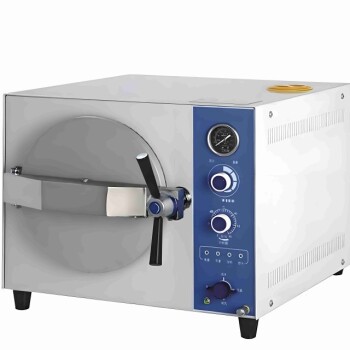
The core reaction conditions provided by a high-pressure hydrothermal reactor for the co-hydrothermal carbonization (co-HTC) of coal waste and sludge are defined by a subcritical water environment maintained between 150 °C and 270 °C with autogenous pressures reaching up to 27 bar. This sealed, high-pressure state ensures that water remains in a liquid phase, allowing it to function simultaneously as a solvent, reactant, and catalyst. These specific conditions facilitate the conversion of high-moisture waste into a carbon-dense hydrochar without the need for energy-intensive pre-drying.
A hydrothermal reactor transforms wet waste into energy-dense fuel by maintaining water in a subcritical state. This environment lowers the activation energy for carbonization while using liquid water to trigger the chemical breakdown and restructuring of organic matter.
The Physical Foundation: Subcritical Water Environment
Maintaining the Liquid Phase
The primary function of the reactor is to withstand the saturated steam pressure required to keep water liquid at temperatures well above its boiling point. By preventing evaporation, the system allows for the direct processing of wet sewage sludge and coal waste, eliminating the high costs of thermal drying.
Precision Temperature and Pressure Control
The reactor typically operates within a temperature window of 150 °C to 270 °C, though specialized processes may reach up to 350 °C for liquefaction. Internal pressures, often ranging from 1.38 to 10 MPa (13.8 to 100 bar), are autogenously generated or externally controlled to ensure the water remains in a subcritical state.
The Chemical Mechanisms of Carbonization
Water as a Reactive Catalyst and Solvent
Under high pressure, the dielectric constant of water significantly decreases, causing it to behave more like a non-polar solvent. This transition allows water to effectively dissolve organic compounds and trigger essential reactions such as hydrolysis, dehydration, and decarboxylation.
Modification of the Ion Product
The hydrothermal environment increases the ion product (pKw) of water, which enhances its catalytic activity. This change facilitates the breakdown of macromolecular organic matter in sludge and coal waste, converting it into active intermediates like bicarbonate and facilitating the removal of alkali metal impurities.
Structural and Content Transformation
Concentration of Carbon Components
The sealed nature of the autoclave effectively suppresses the loss of volatile components that would otherwise escape during traditional dry pyrolysis. This leads to the formation of hydrochar with a significantly higher carbon density and a higher heating value than the raw feedstocks.
Initial Pore Structure Development
The high-pressure environment promotes the initial formation of pore structures within the solid matrix. This physical transformation is critical for the resulting hydrochar's utility as a fuel or as a precursor for activated carbon materials.
Understanding the Trade-offs
Equipment Integrity and Corrosion
Operating at high temperatures and pressures in the presence of water and sulfur-rich coal waste creates a highly corrosive environment. Reactors must be constructed from specialized alloys to prevent stress corrosion cracking and ensure long-term structural integrity.
The Energy Balance of Water Heating
While co-HTC avoids the energy cost of drying, it requires heating the entire mass of water within the reactor to high temperatures. If the moisture content of the sludge is excessively high, the sensible heat required to reach reaction temperatures may diminish the overall energy efficiency of the process.
How to Apply This to Your Project
Selecting Conditions Based on Your Goal
The optimal reactor settings depend heavily on whether your priority is the quality of the solid fuel or the efficiency of the waste reduction.
- If your primary focus is Maximum Carbon Density: Operate at the higher end of the temperature range (240–270 °C) to maximize decarboxylation and carbon concentration.
- If your primary focus is Process Energy Efficiency: Target lower temperatures (180–200 °C) to minimize the energy required to heat the water while still achieving basic carbonization and dehydration.
- If your primary focus is Impurity Removal: Maintain conditions consistent with wet torrefaction (180–260 °C) to maximize the leaching of alkali metals into the liquid phase.
By precisely controlling the subcritical state of water, you can effectively transform problematic wet wastes into a valuable, energy-dense solid resource.
Summary Table:
| Parameter | Operating Range | Core Function & Impact |
|---|---|---|
| Temperature | 150°C – 270°C | Facilitates hydrolysis and decarboxylation; concentrations carbon content. |
| Pressure | 1.38 – 10 MPa | Ensures water remains in liquid phase; triggers chemical breakdown. |
| Water State | Subcritical | Acts as a solvent, reactant, and catalyst; eliminates need for pre-drying. |
| End Product | Solid Hydrochar | High heating value fuel with developed initial pore structures. |
Maximize Your Co-HTC Research with KINTEK
Ready to transform wet waste into high-value carbon resources? KINTEK specializes in precision laboratory equipment, offering high-performance high-temperature high-pressure reactors and autoclaves specifically designed to handle the corrosive environments of hydrothermal carbonization.
Whether you are refining hydrochar density for energy applications or optimizing impurity removal from coal waste, our reactors provide the structural integrity and precision control your research demands. Beyond reactors, KINTEK offers a comprehensive portfolio including crushing and milling systems, PTFE products, and ceramic crucibles to support every stage of your material processing.
Contact our experts today to discuss your specific reaction requirements and discover how KINTEK can enhance your lab's efficiency and innovation.
References
- Gentil Mwengula Kahilu, Jean Mulopo. Systematic physicochemical characterization, carbon balance and cost of production analyses of activated carbons derived from (Co)-HTC of coal discards and sewage sludge for hydrogen storage applications. DOI: 10.1007/s42768-023-00136-4
This article is also based on technical information from Kintek Solution Knowledge Base .
Related Products
- High Pressure Laboratory Autoclave Reactor for Hydrothermal Synthesis
- Stainless High Pressure Autoclave Reactor Laboratory Pressure Reactor
- Mini SS High Pressure Autoclave Reactor for Laboratory Use
- Customizable High Pressure Reactors for Advanced Scientific and Industrial Applications
- Customizable Laboratory High Temperature High Pressure Reactors for Diverse Scientific Applications
People Also Ask
- What role does a high-pressure reactor (autoclave) play in the synthesis of NiCuFe-LDH? Master Hydrothermal Growth
- What Role Does a High-Pressure Reactor or Autoclave Play in HA Catalyst Synthesis? Achieve High Surface Area Materials
- What equipment is required for hydrothermal synthesis of Ga0.25Zn4.67S5.08? Optimize Your Semiconductor Production
- What is the function of a high-pressure reactor in the hydrothermal synthesis of boehmite? Expert Process Insights
- What role does an autoclave play in the synthesis of MnO2 nanofibers? Mastering Hydrothermal Growth