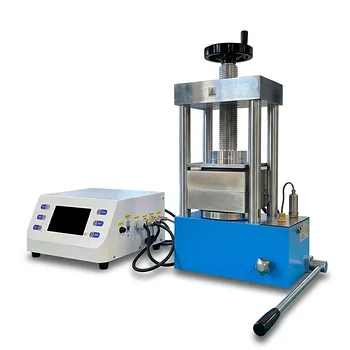
In the hydrothermal synthesis of boehmite and ammonium alum, the high-pressure reactor serves as a sealed vessel that generates a critical high-temperature and high-pressure environment. By maintaining these conditions, the reactor forces the dissolution of typically insoluble solid powders and drives their subsequent recrystallization. This process is essential for converting unstable chemical intermediates into stable boehmite and defining the material's specific microscopic structure.
The reactor’s primary function is to enable a "dissolution-recrystallization" mechanism that cannot occur under standard conditions. By creating a sealed hydrothermal environment, it facilitates the phase transition of precursors into crystalline boehmite and ammonium alum while precisely controlling their final physical morphology.
The Mechanics of Reactive Crystallization
The synthesis of boehmite and ammonium alum relies on overcoming the natural resistance of solid reactants to dissolve and react. The high-pressure reactor overcomes this barrier through three specific functions.
Creating a Solvation Environment
Under standard atmospheric conditions, the solid powders used in this synthesis are often insoluble or dissolve too slowly to be effective.
The high-pressure reactor utilizes sealed heating to drastically alter the properties of the liquid medium. This hydrothermal environment increases the solubility of the solid powders, allowing them to dissolve fully and participate in the reaction.
Driving Critical Phase Transitions
The formation of boehmite is not merely a mixing process; it requires a specific chemical transformation.
The reactor provides the thermodynamic energy required to drive phase transitions. It facilitates the conversion of unstable chemical intermediates into the desired, stable boehmite phase. Without the sustained high pressure and temperature provided by the reactor, the reaction might stall at an intermediate stage or produce impurities.
Controlling Microscopic Morphology
The utility of boehmite and ammonium alum is often dictated by the shape and structure of their particles.
The reactor controls the recrystallization process. By regulating the environment in which the dissolved materials precipitate back into solids, the reactor ensures the formation of specific microscopic morphologies. This prevents the formation of random aggregates and promotes ordered crystal growth.
Understanding the Operational Trade-offs
While the high-pressure reactor is essential for this synthesis, it introduces distinct operational challenges that must be managed.
Sealing and Safety Demands
To maintain the necessary hydrothermal conditions, the reactor requires superior sealing performance.
Any leakage not only leads to process failure by dropping the pressure but also poses significant safety hazards due to the release of superheated steam. The equipment must be robust enough to withstand the internal saturated steam pressure generated during heating.
Process Visibility
Because the system functions as a "black box" during operation, real-time monitoring is difficult.
The sealed nature of the reactor means you cannot easily adjust the mixture once the cycle begins. This places a premium on precise initial calculations and setup, as the "dissolution-recrystallization" mechanism relies entirely on the pre-set conditions within the vessel.
Making the Right Choice for Your Goal
To maximize the effectiveness of a high-pressure reactor in this synthesis, align your operational parameters with your specific material requirements.
- If your primary focus is Phase Purity: Ensure the reactor creates sufficient pressure to fully drive the conversion of unstable intermediates, preventing residual precursors in the final product.
- If your primary focus is Particle Morphology: Prioritize the stability of the temperature maintenance, as fluctuations during the recrystallization phase can lead to irregular crystal shapes.
The high-pressure reactor is not just a heating vessel; it is a precision tool that forces nature to dissolve the insoluble and organize the chaotic into crystalline order.
Summary Table:
| Function | Mechanism | Impact on Material |
|---|---|---|
| Solvation | Sealed heating increases liquid solubility | Dissolves insoluble solid precursors |
| Phase Transition | Thermodynamic energy supply | Converts unstable intermediates into stable boehmite |
| Morphology Control | Regulated recrystallization environment | Ensures specific microscopic crystal structure |
| Process Integrity | Sustained high-pressure containment | Prevents impurity formation and ensures phase purity |
Elevate Your Material Synthesis with KINTEK Precision
Achieving the perfect crystalline morphology in hydrothermal synthesis requires equipment that can withstand the rigors of extreme pressure and temperature. KINTEK specializes in advanced laboratory solutions, offering a premier range of high-temperature high-pressure reactors and autoclaves specifically designed for demanding chemical transformations.
Whether you are synthesizing boehmite, ammonium alum, or conducting complex battery research, our robust reactor systems ensure superior sealing performance and precise thermal stability. Beyond reactors, explore our comprehensive portfolio, including crushing and milling systems, high-temperature furnaces (muffle, vacuum, CVD), and essential ceramic crucibles.
Ready to optimize your dissolution-recrystallization process? Contact KINTEK today to discover how our high-performance laboratory tools can drive your research forward.
References
- Junkai Wang, Yuzheng Wang. The Influence of Hydrothermal Temperature on Alumina Hydrate and Ammonioalunite Synthesis by Reaction Crystallization. DOI: 10.3390/cryst13050763
This article is also based on technical information from Kintek Solution Knowledge Base .
Related Products
- High Pressure Laboratory Autoclave Reactor for Hydrothermal Synthesis
- Customizable Laboratory High Temperature High Pressure Reactors for Diverse Scientific Applications
- Stainless High Pressure Autoclave Reactor Laboratory Pressure Reactor
- Customizable High Pressure Reactors for Advanced Scientific and Industrial Applications
- Mini SS High Pressure Autoclave Reactor for Laboratory Use
People Also Ask
- What role does a high-pressure reactor (autoclave) play in the synthesis of NiCuFe-LDH? Master Hydrothermal Growth
- What Role Does a High-Pressure Reactor or Autoclave Play in HA Catalyst Synthesis? Achieve High Surface Area Materials
- What equipment is required for hydrothermal synthesis of Ga0.25Zn4.67S5.08? Optimize Your Semiconductor Production
- What role does an autoclave play in the synthesis of MnO2 nanofibers? Mastering Hydrothermal Growth
- Why is a 24-hour hydrothermal treatment in an autoclave necessary for BMO nanosheets? Unlock Superior Photocatalysis