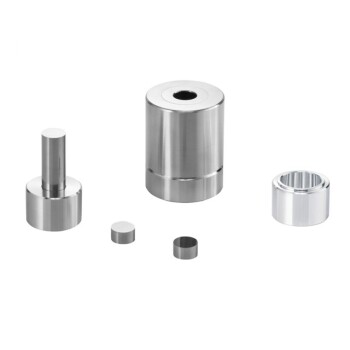
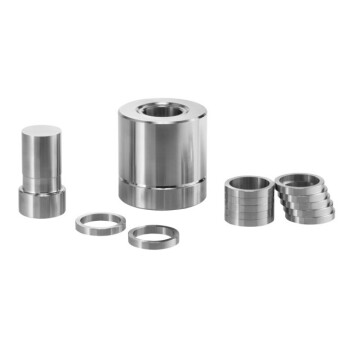
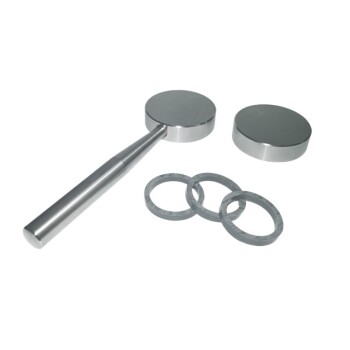
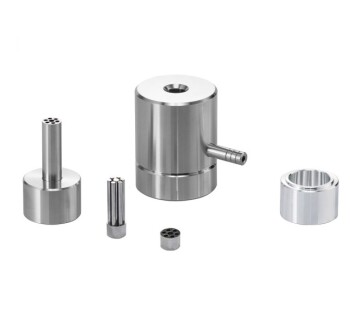
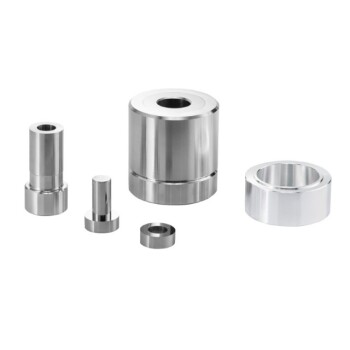
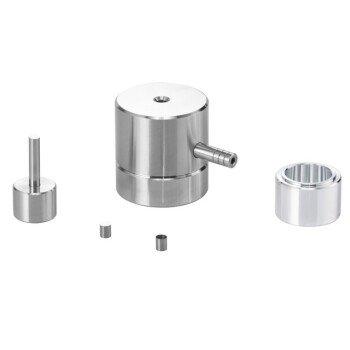
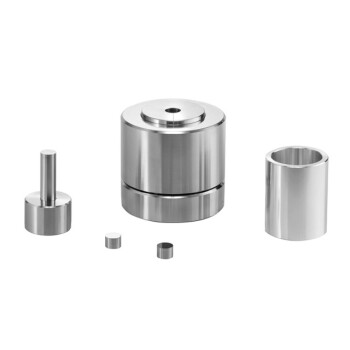
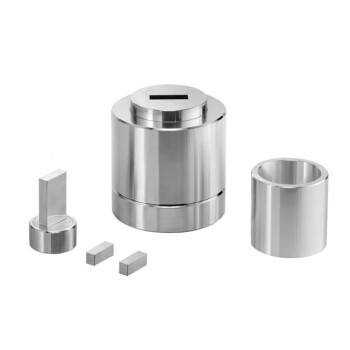
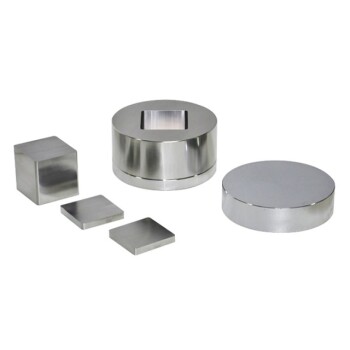
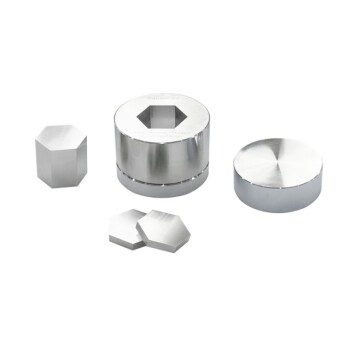
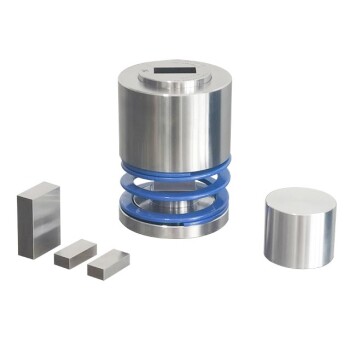
Carbon steel molds serve as the essential geometric scaffolding for BZY20 ceramic powder during the fabrication of green bodies. They function primarily to confine the loose mixture of ceramic powder, binders, and water within a precise cylindrical cavity, providing the necessary rigidity to withstand high-force compression. This containment allows a hydraulic press to transform the loose mixture into a solid, shaped pellet with specific dimensions, such as a 12.7 mm diameter.
By providing a rigid, high-strength boundary, carbon steel molds enable the application of significant hydraulic pressure to BZY20 powder. This process minimizes inter-particle voids and maximizes packing density, creating a geometrically consistent and mechanically stable "green" pellet ready for sintering.
The Role of Containment and Geometry
Precise Geometric Definition
The primary function of the carbon steel mold is to impose a specific shape onto the amorphous powder mixture.
By securing the BZY20 powder within a defined cavity, the mold ensures the resulting green body achieves a consistent diameter (e.g., 0.5 inch or 12.7 mm).
Securing the Powder Mixture
Before pressure is applied, the mold acts as a vessel for the uniformly mixed raw materials.
It holds the combination of ceramic powder, binders, and water in place, ensuring the mixture remains homogenous and stratified correctly according to the design layers prior to compaction.
Enabling Densification via Hydraulic Pressure
Facilitating Uniaxial Compression
The mold is designed to work in conjunction with hydraulic equipment, which applies controlled uniaxial pressure.
Because carbon steel is highly rigid, it resists the outward force exerted by the powder as it is compressed, forcing the energy of the press—ranging from lower pressures like 11.3 MPa to high pressures up to 250 MPa—directly into the powder.
Reducing Particle Voids
The constraint provided by the mold allows the applied pressure to effectively reduce the empty spaces (voids) between powder particles.
This reduction in void volume significantly increases the packing density, transforming the loose powder into a dense, cohesive unit.
Establishing Mechanical Strength
The interaction between the mold's walls and the compressive force ensures the powder layers bond tightly together.
This results in a green body that possesses sufficient mechanical strength to be handled and transferred to a vacuum hot pressing furnace or cold sintering setup without crumbling.
Understanding Process Constraints
The Dependency on Pressure Magnitude
While the mold defines the shape, the quality of the green body is heavily dependent on the pressure applied by the hydraulic equipment.
A mold is only a passive tool; achieving the correct packing density requires selecting the specific pressure (e.g., 250 MPa for high density vs. 11.3 MPa for initial shaping) appropriate for the desired material properties.
The "Green" State Limitation
It is important to recognize that the mold produces a "green body," which is a pre-sintered, relatively fragile object.
The mold provides the shape and initial density, but the pellet is not yet the final ceramic product; it is merely a prepared precursor ready for cold sintering pretreatment or hot pressing.
Making the Right Choice for Your Goal
Selecting the correct molding parameters is critical for the success of your final ceramic component.
- If your primary focus is maximizing density: Ensure your carbon steel mold is rated to withstand high hydraulic pressures (up to 250 MPa) to minimize voids and ensure tight layer bonding.
- If your primary focus is geometric consistency: Verify that the mold cavity is machined to the exact diameter required (e.g., 12.7 mm) to minimize post-sintering machining.
- If your primary focus is handling strength: utilize the mold to apply stable, controlled pressure to ensure the green body has sufficient mechanical integrity for transfer to the sintering furnace.
The carbon steel mold is the critical interface that translates raw hydraulic force into a structured, high-density ceramic precursor.
Summary Table:
| Function | Description | Key Benefit |
|---|---|---|
| Geometric Scaffolding | Defines precise cylindrical dimensions (e.g., 12.7 mm) | Consistent pellet size and shape |
| Powder Containment | Secures powder, binders, and water mixture | Maintains homogeneity before compression |
| Uniaxial Compression | Resists outward force during hydraulic pressing | Directs pressure (up to 250 MPa) into powder |
| Densification | Eliminates inter-particle voids | Maximizes packing density for sintering |
| Mechanical Stability | Facilitates bonding between powder layers | Creates a handleable "green" body |
Elevate Your Material Research with KINTEK Precision Solutions
High-quality ceramic green bodies require the perfect synergy between precision molding and powerful compaction. KINTEK specializes in providing the specialized laboratory equipment you need to achieve maximum packing density and mechanical stability in your samples.
From high-strength carbon steel molds and pellet/hot/isostatic hydraulic presses to advanced high-temperature vacuum furnaces and crushing systems, we offer a comprehensive range of tools for every stage of your material synthesis.
Ready to optimize your ceramic fabrication process?
Contact KINTEK Experts Today to discover how our high-performance equipment and consumables—including PTFE products, ceramics, and crucibles—can enhance your lab's efficiency and results.
Related Products
- Carbide Lab Press Mold for Laboratory Applications
- XRF & KBR steel ring lab Powder Pellet Pressing Mold for FTIR
- Carbon Graphite Plate Manufactured by Isostatic Pressing Method
- XRF & KBR plastic ring lab Powder Pellet Pressing Mold for FTIR
- XRF Boric Acid Lab Powder Pellet Pressing Mold for Laboratory Use
People Also Ask
- How to use a press mold? Master the Art of Creating Consistent Ceramic Forms
- What is the press mould method? A Guide to Consistent, Detailed Ceramic Forms
- What is the function of press molds during the preparation of SiCf/Ti-43Al-9V composites? Achieve Structural Precision
- What is a press mold used for? Achieve Repeatable Precision and Efficiency
- What is the purpose of specialized pressure devices in sulfide solid-state batteries? Ensure Chemo-Mechanical Stability