Knowledge What is the primary purpose of using alumina sintering plates? Ensure Purity for R1/3Zr2(PO4)3 Samples
Author avatar

Tech Team · Kintek Solution

Updated 3 days ago

What is the primary purpose of using alumina sintering plates? Ensure Purity for R1/3Zr2(PO4)3 Samples


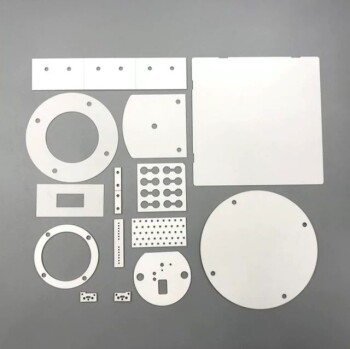
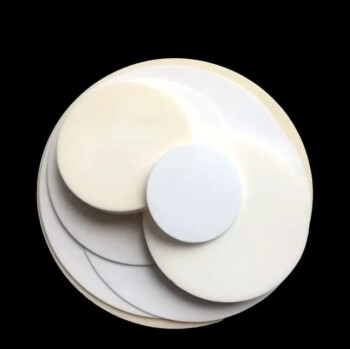
The primary purpose of alumina sintering plates is to serve as a chemically inert, high-temperature barrier between your samples and the furnace environment. Specifically, when processing R1/3Zr2(PO4)3 at 950°C, these plates prevent the solid electrolyte pellets from reacting with or sticking to the furnace floor.

By leveraging excellent high-temperature chemical stability, alumina plates ensure the geometric integrity and chemical purity of solid electrolyte pellets during the critical sintering phase.

Ensuring Sample Integrity and Purity

High-Temperature Refractoriness

Alumina is utilized specifically for its ability to maintain structural integrity under intense heat. This refractoriness is essential when subjecting samples to sintering temperatures of 950°C, ensuring the carrier does not deform or degrade.

Acting as an Inert Carrier

The plate functions as a neutral support system for the R1/3Zr2(PO4)3 samples. By chemically isolating the pellets, the plate prevents impurities from the furnace floor from diffusing into the sample and altering its composition.

Preventing Physical Adhesion

Direct contact between a sample and the furnace hearth can lead to high-temperature adhesion. Alumina plates eliminate this risk, ensuring the "green" (unfired) pellet does not fuse to the floor during the densification process.

The Context of Sintering R1/3Zr2(PO4)3

Supporting Densification

The sintering process aims to bind the compressed powder into a unified mass without melting it. The alumina plate provides a stable, flat surface that supports the pellet as it increases in relative density and reduces porosity.

Preserving Geometric Form

To construct continuous three-dimensional ion conduction channels, the pellet must maintain its shape. The rigid support of the alumina plate ensures the sample retains its intended geometry throughout the heating cycle.

Critical Considerations for Sintering Setup

The Risk of Direct Contact

Attempting to sinter without an intermediate plate often results in catastrophic sample loss. The chemical interaction between the sample and the furnace lining can destroy the sample's purity and damage expensive laboratory equipment.

Material Compatibility

While alumina is highly stable at 950°C, it is chosen specifically because it is inert relative to R1/3Zr2(PO4)3. In material science, one must always ensure the carrier plate material does not react with the specific chemistry of the sample being fired.

Optimizing Your Sintering Protocol

To ensure the best results for your solid electrolyte samples, apply the following principles:

  • If your primary focus is Chemical Purity: Rely on the inert nature of the alumina plate to prevent cross-contamination between the furnace environment and your sample.
  • If your primary focus is Structural Integrity: Utilize the rigidity of the plate to prevent physical adhesion and deformation of the pellet during the 950°C heat treatment.

Using the correct carrier plate is not merely a precautionary step; it is a fundamental requirement for achieving the material properties necessary for effective ion conduction.

Summary Table:

Feature Benefit for R1/3Zr2(PO4)3 Sintering
Chemical Inertness Prevents cross-contamination and maintains sample purity
High Refractoriness Maintains structural stability at 950°C without deformation
Anti-Adhesion Prevents pellets from fusing to the furnace floor
Flat Surface Support Ensures geometric integrity and uniform densification

Elevate Your Materials Research with KINTEK Precision

Achieving the perfect sinter requires more than just heat; it requires the right environment. KINTEK specializes in high-performance laboratory equipment and consumables designed for the most demanding material science applications. Whether you are developing solid electrolytes or advanced ceramics, our range of high-temperature furnaces (muffle, vacuum, and tube) and premium alumina ceramics and crucibles ensure your samples maintain peak purity and structural integrity.

From high-pressure reactors to precision crushing and milling systems, we provide the tools you need to optimize your sintering protocol. Contact KINTEK today to discuss your specific laboratory requirements and discover how our expert solutions can enhance your research outcomes.

Related Products

People Also Ask

Related Products

High Temperature Wear-Resistant Alumina Al2O3 Plate for Engineering Advanced Fine Ceramics

High Temperature Wear-Resistant Alumina Al2O3 Plate for Engineering Advanced Fine Ceramics

High temperature wear-resistant insulating alumina plate has excellent insulation performance and high temperature resistance.

Custom-Made Alumina Zirconia Special-Shaped Ceramic Plates for Engineering Advanced Fine Ceramics Processing

Custom-Made Alumina Zirconia Special-Shaped Ceramic Plates for Engineering Advanced Fine Ceramics Processing

Alumina ceramics have good electrical conductivity, mechanical strength and high temperature resistance, while zirconia ceramics are known for their high strength and high toughness and are widely used.

Ultra-High Temperature Graphite Vacuum Graphitization Furnace

Ultra-High Temperature Graphite Vacuum Graphitization Furnace

The ultra-high temperature graphitization furnace utilizes medium frequency induction heating in a vacuum or inert gas environment. The induction coil generates an alternating magnetic field, inducing eddy currents in the graphite crucible, which heats up and radiates heat to the workpiece, bringing it to the desired temperature. This furnace is primarily used for graphitization and sintering of carbon materials, carbon fiber materials, and other composite materials.

Graphite Vacuum Continuous Graphitization Furnace

Graphite Vacuum Continuous Graphitization Furnace

High-temperature graphitization furnace is a professional equipment for graphitization treatment of carbon materials. It is a key equipment for the production of high-quality graphite products. It has high temperature, high efficiency and uniform heating. It is suitable for various high-temperature treatments and graphitization treatments. It is widely used in metallurgy, electronics, aerospace, etc. industry.

Advanced Engineering Fine Ceramics Aluminum Nitride (AlN) Ceramic Sheet

Advanced Engineering Fine Ceramics Aluminum Nitride (AlN) Ceramic Sheet

Aluminum nitride (AlN) has the characteristics of good compatibility with silicon. It is not only used as a sintering aid or reinforcing phase for structural ceramics, but its performance far exceeds that of alumina.

Small Vacuum Heat Treat and Tungsten Wire Sintering Furnace

Small Vacuum Heat Treat and Tungsten Wire Sintering Furnace

The small vacuum tungsten wire sintering furnace is a compact experimental vacuum furnace specially designed for universities and scientific research institutes. The furnace features a CNC welded shell and vacuum piping to ensure leak-free operation. Quick-connect electrical connections facilitate relocation and debugging, and the standard electrical control cabinet is safe and convenient to operate.

Optical Window Glass Substrate Wafer Quartz Plate JGS1 JGS2 JGS3

Optical Window Glass Substrate Wafer Quartz Plate JGS1 JGS2 JGS3

The quartz plate is a transparent, durable, and versatile component widely used in various industries. Made from high-purity quartz crystal, it exhibits excellent thermal and chemical resistance.

Silicon Carbide (SIC) Ceramic Plate for Engineering Advanced Fine Ceramics

Silicon Carbide (SIC) Ceramic Plate for Engineering Advanced Fine Ceramics

Silicon nitride (sic) ceramic is an inorganic material ceramic that does not shrink during sintering. It is a high-strength, low-density, high-temperature-resistant covalent bond compound.

Precision Machined Yttria Stabilized Zirconia Ceramic Plate for Engineering Advanced Fine Ceramics

Precision Machined Yttria Stabilized Zirconia Ceramic Plate for Engineering Advanced Fine Ceramics

Yttrium-stabilized zirconia has the characteristics of high hardness and high temperature resistance, and has become an important material in the field of refractories and special ceramics.

Thermally Evaporated Tungsten Wire for High Temperature Applications

Thermally Evaporated Tungsten Wire for High Temperature Applications

It has a high melting point, thermal and electrical conductivity, and corrosion resistance. It is a valuable material for high temperature, vacuum and other industries.

Laboratory Small Constant Temperature Heated Magnetic Stirrer Heater and Stirrer

Laboratory Small Constant Temperature Heated Magnetic Stirrer Heater and Stirrer

The Laboratory Small Constant Temperature Heating Magnetic Stirrer is a versatile tool designed for precise temperature control and efficient mixing in various laboratory applications.

Custom PTFE Teflon Parts Manufacturer Laboratory High Temperature Mixing Paddle Mixer

Custom PTFE Teflon Parts Manufacturer Laboratory High Temperature Mixing Paddle Mixer

The PTFE mixing paddle mixer is a versatile and robust tool designed for laboratory use, particularly in environments requiring high resistance to chemicals and extreme temperatures. Crafted from high-quality PTFE, this mixer boasts several key features that enhance its functionality and durability.

Vacuum Hot Press Furnace Machine for Lamination and Heating

Vacuum Hot Press Furnace Machine for Lamination and Heating

Experience clean and precise lamination with Vacuum Lamination Press. Perfect for wafer bonding, thin-film transformations, and LCP lamination. Order now!

Warm Isostatic Press WIP Workstation 300Mpa for High Pressure Applications

Warm Isostatic Press WIP Workstation 300Mpa for High Pressure Applications

Discover Warm Isostatic Pressing (WIP) - A cutting-edge technology that enables uniform pressure to shape and press powdered products at a precise temperature. Ideal for complex parts and components in manufacturing.

Precision Machined Zirconia Ceramic Ball for Engineering Advanced Fine Ceramics

Precision Machined Zirconia Ceramic Ball for Engineering Advanced Fine Ceramics

zirconia ceramic ball have the characteristics of high strength, high hardness, PPM wear level, high fracture toughness, good wear resistance, and high specific gravity.

Heated Hydraulic Press Machine with Heated Plates for Vacuum Box Laboratory Hot Press

Heated Hydraulic Press Machine with Heated Plates for Vacuum Box Laboratory Hot Press

The lab press for vacuum box is a specialized piece of equipment designed for laboratory use. Its main purpose is to press pills and powders according to specific requirements.

Proton Exchange Membrane for Batteries Lab Applications

Proton Exchange Membrane for Batteries Lab Applications

Thin proton exchange membrane with low resistivity; high proton conductivity; low hydrogen permeation current density; long life; suitable for electrolyte separators in hydrogen fuel cells and electrochemical sensors.

Automatic Laboratory Hydraulic Pellet Press Machine for Lab Use

Automatic Laboratory Hydraulic Pellet Press Machine for Lab Use

Experience efficient sample preparation with our Automatic Lab Press Machine. Ideal for material research, pharmacy, ceramics, and more. Features a compact size and hydraulic press functionality with heating plates. Available in various sizes.

Infrared Heating Quantitative Flat Plate Press Mold

Infrared Heating Quantitative Flat Plate Press Mold

Discover advanced infrared heating solutions with high-density insulation and precise PID control for uniform thermal performance in various applications.


Leave Your Message