Knowledge laboratory mill What is the advantage of ball milling method? Achieve Cost-Effective Particle Size Reduction & Material Modification
Author avatar

Tech Team · Kintek Solution

Updated 2 months ago

What is the advantage of ball milling method? Achieve Cost-Effective Particle Size Reduction & Material Modification


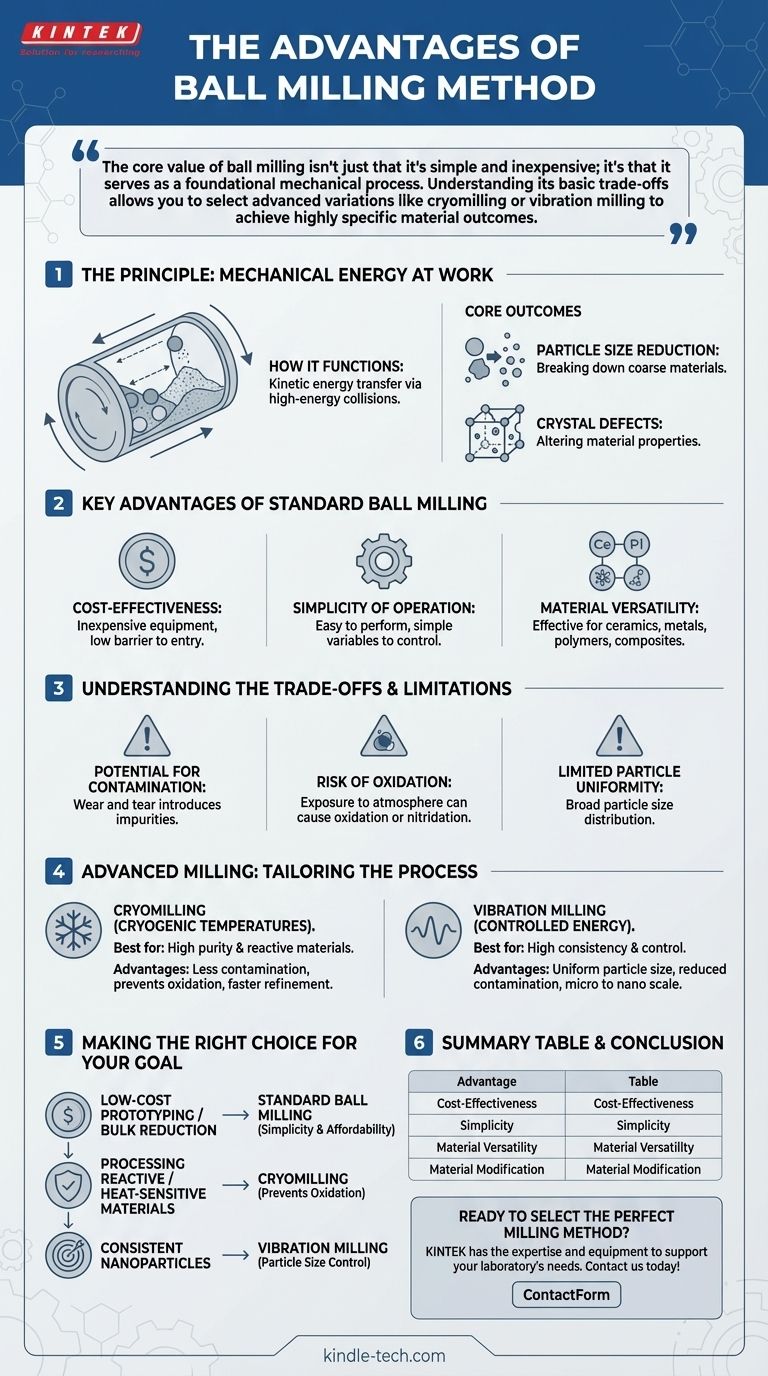
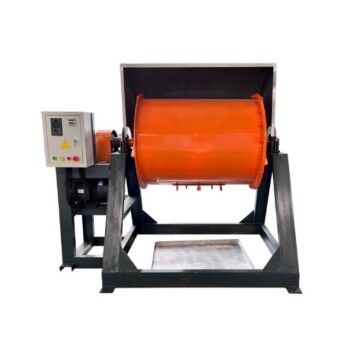
The primary advantage of the ball milling method lies in its simplicity and low cost, making it a highly accessible technique for reducing particle size. It is a purely mechanical process that uses physical force to alter materials, which can also be leveraged to intentionally introduce structural changes like crystal defects for specific applications.

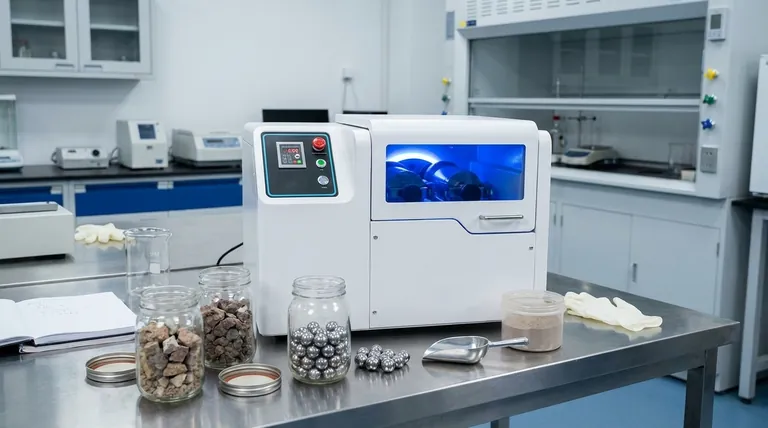
The core value of ball milling isn't just that it's simple and inexpensive; it's that it serves as a foundational mechanical process. Understanding its basic trade-offs allows you to select advanced variations like cryomilling or vibration milling to achieve highly specific material outcomes.
What is the advantage of ball milling method? Achieve Cost-Effective Particle Size Reduction & Material Modification

The Principle: Mechanical Energy at Work

How It Functions

Ball milling is a mechanical process where all structural and chemical changes are produced by the direct transfer of kinetic energy. Materials placed in a container with grinding media (balls) are subjected to high-energy collisions as the container rotates.

The Core Outcomes

This repeated impact and shearing force primarily results in particle size reduction, breaking down coarse materials into finer powders. A secondary, and often desirable, outcome is the creation of crystal defects, which can alter the material's electronic or catalytic properties.

Key Advantages of Standard Ball Milling

Cost-Effectiveness

The equipment required for basic ball milling is relatively inexpensive and straightforward compared to more sophisticated material processing technologies. This lowers the barrier to entry for research and small-scale production.

Simplicity of Operation

The method is easy to perform without requiring extensive specialized training. The core variables—milling time, speed, and ball-to-powder ratio—are simple to control and adjust.

Material Versatility

Ball milling can be applied to a vast range of materials. It is effective for grinding hard substances like ceramics and metals as well as softer materials like polymers and composites.

Understanding the Trade-offs and Limitations

Potential for Contamination

A significant drawback of standard ball milling is the risk of contamination. Wear and tear on the milling balls and container walls can introduce impurities into the sample material.

Risk of Oxidation

The process can generate heat and continuously expose fresh, unoxidized surfaces to the atmosphere inside the vial. This can lead to unwanted oxidation or nitridation, especially with reactive materials.

Limited Particle Uniformity

While effective at size reduction, standard ball milling may produce a broad particle size distribution. Achieving a highly uniform, narrow distribution often requires more advanced techniques.

Advanced Milling: Tailoring the Process to Your Needs

For High Purity and Reactive Materials: Cryomilling

Cryomilling is a specialized form of ball milling conducted at cryogenic temperatures (below –150°C). This offers distinct advantages for sensitive applications.

The extreme cold makes materials more brittle, leading to faster refinement and less contamination from the milling tools. It also creates an inert environment that prevents oxidation.

For High Consistency and Control: Vibration Milling

Vibration milling provides more efficient and uniform particle size reduction. By using a closed container and controlled vibrational energy, it ensures a more consistent final product.

This method also significantly reduces contamination from external sources and offers exceptional control, capable of producing particles from the micrometer down to the nanometer scale.

Making the Right Choice for Your Goal

Selecting the appropriate milling technique requires a clear understanding of your material and your desired end-state.

  • If your primary focus is low-cost prototyping or bulk size reduction: Standard ball milling offers an unmatched combination of simplicity and affordability.
  • If your primary focus is processing reactive metals or heat-sensitive polymers: Cryomilling is the superior choice for preventing oxidation and preserving material integrity.
  • If your primary focus is producing highly consistent nanoparticles for advanced applications: Vibration milling provides the necessary control over particle size distribution and purity.

Ultimately, choosing the right milling method is about matching the tool to the specific demands of your project.

Summary Table:

Advantage Description
Cost-Effectiveness Inexpensive equipment lowers the barrier for research and small-scale production.
Simplicity Easy to operate with simple variables to control (time, speed, ball-to-powder ratio).
Material Versatility Effective for a wide range of materials, from hard ceramics/metals to softer polymers/composites.
Material Modification Mechanical energy can create crystal defects to alter electronic or catalytic properties.

Ready to Select the Perfect Milling Method for Your Project?

Whether your goal is simple particle size reduction with standard ball milling, processing reactive materials with cryomilling, or achieving high consistency with vibration milling, KINTEK has the expertise and equipment to support your laboratory's needs.

Contact us today using the form below to discuss your specific material and application requirements. Let our specialists help you achieve superior results with the right lab equipment solution.

#ContactForm

Visual Guide

What is the advantage of ball milling method? Achieve Cost-Effective Particle Size Reduction & Material Modification Visual Guide

Related Products

People Also Ask

Related Products

High-Energy Omnidirectional Planetary Ball Mill Milling Machine for Laboratory

High-Energy Omnidirectional Planetary Ball Mill Milling Machine for Laboratory

The KT-P4000E is a new product derived from the vertical high-energy planetary ball mill with a 360° swivel function. Experience faster, uniform, and smaller sample output results with 4 ≤1000ml ball mill jars.

High-Energy Omnidirectional Planetary Ball Mill Machine for Laboratory

High-Energy Omnidirectional Planetary Ball Mill Machine for Laboratory

The KT-P2000E is a new product derived from the vertical high-energy planetary ball mill with a 360°rotation function. The product not only has the characteristics of the vertical high-energy ball mill, but also has a unique 360°rotation function for the planetary body.

Stainless Steel Laboratory Ball Mill for Dry Powder and Liquid with Ceramic Polyurethane Lining

Stainless Steel Laboratory Ball Mill for Dry Powder and Liquid with Ceramic Polyurethane Lining

Discover the versatile stainless steel dry powder/liquid horizontal ball mill with ceramic/polyurethane lining. Ideal for ceramic, chemical, metallurgical, and building materials industries. High grinding efficiency and uniform particle size.

Laboratory Planetary Ball Mill Rotating Ball Milling Machine

Laboratory Planetary Ball Mill Rotating Ball Milling Machine

KT-P400E is a desktop multi-directional planetary ball mill with unique grinding and mixing capabilities. It offers continuous and intermittent operation, timing, and overload protection, making it ideal for various applications.

Hybrid High Energy Vibratory Ball Mill for Lab Use

Hybrid High Energy Vibratory Ball Mill for Lab Use

KT-BM400 is used for rapid grinding or mixing of dry, wet and frozen small amount of samples in the laboratory. It can be configured with two 50ml ball mill jars

Laboratory Ball Mill Jar Mill with Metal Alloy Grinding Jar and Balls

Laboratory Ball Mill Jar Mill with Metal Alloy Grinding Jar and Balls

Grind and mill with ease using metal alloy grinding jars with balls. Choose from 304/316L stainless steel or tungsten carbide and optional liner materials. Compatible with various mills and features optional functions.

High Energy Planetary Ball Mill for Laboratory Horizontal Tank Type Milling Machine

High Energy Planetary Ball Mill for Laboratory Horizontal Tank Type Milling Machine

KT-P4000H uses the unique Y-axis planetary motion trajectory, and utilizes the collision, friction and gravity between the sample and the grinding ball to have a certain anti-sinking ability, which can obtain better grinding or mixing effects and further improve the sample output.

High Energy Planetary Ball Mill Milling Machine for Laboratory

High Energy Planetary Ball Mill Milling Machine for Laboratory

Experience fast and effective sample processing with the F-P2000 high-energy planetary ball mill. This versatile equipment offers precise control and excellent grinding capabilities. Perfect for laboratories, it features multiple grinding bowls for simultaneous testing and high output. Achieve optimal results with its ergonomic design, compact structure, and advanced features. Ideal for a wide range of materials, it ensures consistent particle size reduction and low maintenance.

High Energy Planetary Ball Mill Machine for Laboratory Horizontal Tank Type

High Energy Planetary Ball Mill Machine for Laboratory Horizontal Tank Type

The KT-P2000H uses a unique Y-axis planetary trajectory, and utilizes the collision, friction and gravity between the sample and the grinding ball.

Laboratory Planetary Ball Mill Cabinet Planetary Ball Milling Machine

Laboratory Planetary Ball Mill Cabinet Planetary Ball Milling Machine

The vertical cabinet structure combined with ergonomic design enables users to obtain the best comfortable experience in standing operation. The maximum processing capacity is 2000ml, and the speed is 1200 revolutions per minute.

High Energy Vibratory Laboratory Ball Mill Double Tank Type

High Energy Vibratory Laboratory Ball Mill Double Tank Type

High-energy vibration ball mill is a small desktop laboratory grinding instrument. It uses 1700r/min high-frequency three-dimensional vibration to make the sample achieve the result of grinding or mixing.

Mini Planetary Ball Mill Machine for Laboratory Milling

Mini Planetary Ball Mill Machine for Laboratory Milling

Discover the KT-P400 desktop planetary ball mill, ideal for grinding and mixing small samples in the lab. Enjoy stable performance, long service life, and practicality. Functions include timing and overload protection.

Laboratory Horizontal Planetary Ball Mill Milling Machine

Laboratory Horizontal Planetary Ball Mill Milling Machine

Improve sample uniformity with our Horizontal Planetary Ball Mills. KT-P400H reduces sample deposition and KT-P400E has multi-directional capabilities. Safe, convenient and efficient with overload protection.

High Energy Planetary Ball Mill Milling Machine for Laboratory

High Energy Planetary Ball Mill Milling Machine for Laboratory

The biggest feature is that the high energy planetary ball mill can not only perform fast and effective grinding, but also has good crushing ability

High Energy Vibratory Ball Mill for Lab Use

High Energy Vibratory Ball Mill for Lab Use

The high-energy vibrating ball mill is a high-energy oscillating and impacting multifunctional laboratory ball mill. The table-top type is easy to operate, small in size, comfortable and safe.

High Energy Vibratory Laboratory Ball Mill Grinding Mill Single Tank Type

High Energy Vibratory Laboratory Ball Mill Grinding Mill Single Tank Type

High-energy vibration ball mill is a small desktop laboratory grinding instrument.It can be ball-milled or mixed with different particle sizes and materials by dry and wet methods.

Laboratory Jar Ball Mill with Alumina Zirconia Grinding Jar and Balls

Laboratory Jar Ball Mill with Alumina Zirconia Grinding Jar and Balls

Grind to perfection with alumina/zirconia grinding jars and balls. Available in volume sizes from 50ml to 2500ml, compatible with various mills.

Laboratory Micro Tissue Grinding Mill Grinder

Laboratory Micro Tissue Grinding Mill Grinder

KT-MT10 is a miniature ball mill with a compact structure design. The width and depth are only 15X21 cm, and the total weight is only 8 kg. It can be used with a minimum 0.2ml centrifuge tube or a maximum 15ml ball mill jar.

Laboratory Four-Body Horizontal Jar Mill

Laboratory Four-Body Horizontal Jar Mill

The four-body horizontal tank mill ball mill can be used with four horizontal ball mill tanks with a volume of 3000ml. It is mostly used for mixing and grinding laboratory samples.

Laboratory Single Horizontal Jar Mill

Laboratory Single Horizontal Jar Mill

KT-JM3000 is a mixing and grinding instrument for placing a ball milling tank with a volume of 3000ml or less. It adopts frequency conversion control to realize timing, constant speed, direction change, overload protection and other functions.


Leave Your Message