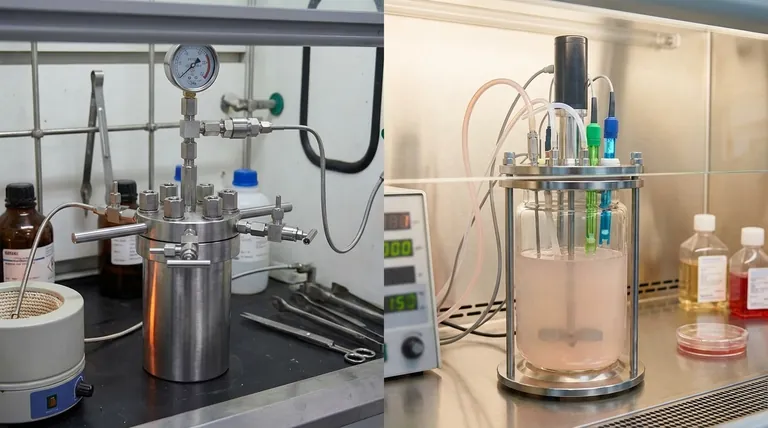
At their core, the difference between a chemical reactor and a bioreactor lies in the catalyst used to drive the transformation. A chemical reactor utilizes synthetic catalysts (like metals) or raw energy (heat and pressure) to facilitate a reaction, whereas a bioreactor employs biological agents—such as living cells, microorganisms, or enzymes—to achieve the desired chemical conversion.
The fundamental distinction is not the vessel itself, but the nature of the process it contains. A chemical reactor is designed to withstand harsh, non-living processes, while a bioreactor is engineered to be a life-support system for a sensitive biological process.
The Defining Difference: The Nature of the Catalyst
The choice of catalyst is the single most important factor, dictating every subsequent design and operational decision.
Chemical Reactors: Synthetic Catalysts and Energy
In a chemical reactor, reactions are driven by physical means. This typically involves high temperatures, high pressures, and non-biological catalysts.
These catalysts, such as platinum, nickel, or various zeolites, are often robust and can tolerate extreme operating conditions. The primary goal is to maximize reaction rate and yield by manipulating these physical parameters.
Bioreactors: Living Biological Agents
A bioreactor is a vessel designed to sustain and control a biological process. The "catalysts" are living systems.
These can be microorganisms like bacteria or yeast, more sensitive mammalian cells, or purified enzymes isolated from these organisms. The entire reactor environment must be tailored to keep these biological agents alive, healthy, and productive.
How This Difference Shapes Reactor Design and Operation
Because one system handles inert chemicals and the other nurtures living organisms, their design principles diverge significantly.
Operating Conditions: Harsh vs. Gentle
A chemical reactor might operate at 500°C and 150 atmospheres of pressure to produce ammonia. These conditions are chosen purely for thermodynamic and kinetic efficiency.
A bioreactor producing a therapeutic antibody using mammalian cells must maintain strict, life-sustaining conditions: a precise 37°C, a neutral pH of ~7.2, and a steady supply of dissolved oxygen. Any deviation can kill the cells and terminate the process.
The Critical Role of Sterility
Bioreactors demand absolute sterility. Any contamination by foreign microbes can be catastrophic, as they might outcompete the production cells or secrete toxins that ruin the product. Therefore, bioreactors are designed for easy and repeated sterilization (using high-pressure steam) or are built as single-use, pre-sterilized plastic systems.
Chemical reactors are primarily concerned with chemical purity, not microbial contamination. Sterilization is rarely a design consideration.
Agitation and Mass Transfer
Both reactor types require mixing to ensure reactants are distributed evenly. However, the methods differ drastically.
Chemical reactors can use powerful, high-shear impellers to aggressively mix fluids. In contrast, bioreactors—especially those for animal cells which lack a protective cell wall—must use low-shear impellers or gentler mixing methods (like rocking platforms) to avoid damaging or killing the cells.
Materials of Construction
A chemical reactor handling corrosive acids at high temperatures may be built from exotic glass-lined steel or alloys like Hastelloy.
A bioreactor is typically constructed from highly polished, non-toxic 316L stainless steel or medical-grade plastics. The primary material requirement is that it be non-toxic to the cells and capable of withstanding sterilization procedures.
Understanding the Trade-offs
Choosing between a chemical and biological process involves evaluating a series of critical trade-offs.
Speed vs. Specificity
Chemical synthesis is often significantly faster. Reactions can be driven hard with heat and pressure to achieve high throughput.
Biological processes, governed by the metabolic rate of cells, are typically slower. However, biocatalysts (enzymes) offer unparalleled specificity, often producing a single desired isomer with virtually no byproducts, drastically simplifying downstream purification.
Operating Cost vs. Purification Cost
Chemical reactors may have high energy costs due to extreme operating conditions. They can also produce a mixture of products and byproducts, leading to complex and expensive separation and purification steps.
Bioreactors have high costs associated with maintaining sterility and preparing complex, sterile nutrient media. However, their high specificity can lead to a purer product stream that is much cheaper to refine.
Environmental Impact
Many chemical processes rely on fossil-fuel-derived feedstocks and solvents and can produce hazardous waste.
Bioprocesses often use renewable feedstocks (like sugars or biomass), operate in water under mild conditions, and are generally considered more sustainable or "green."
Making the Right Choice for Your Process
The decision to use a chemical or bioreactor is dictated entirely by the desired product and the chosen synthetic pathway.
- If your primary focus is producing bulk commodities like ammonia or polyethylene: A chemical reactor designed for high temperature, pressure, and throughput is your only viable option.
- If your primary focus is creating complex biologics like vaccines, antibodies, or insulin: A bioreactor with strict sterility and precise environmental control is non-negotiable.
- If your primary focus is fermenting sugar into ethanol for biofuels: A large-scale bioreactor (a fermenter) is essential to house the yeast or bacteria performing the conversion.
- If your primary focus is synthesizing a high-value chiral molecule with perfect purity: An enzymatic reactor, a type of bioreactor using isolated enzymes, will provide specificity that is nearly impossible to achieve chemically.
Ultimately, the choice between a chemical reactor and a bioreactor is determined by the fundamental nature of the transformation you need to achieve.
Summary Table:
| Feature | Chemical Reactor | Bioreactor |
|---|---|---|
| Catalyst | Synthetic (e.g., metals) or energy (heat/pressure) | Biological (cells, microorganisms, enzymes) |
| Operating Conditions | Harsh (high temp/pressure) | Gentle (precise temp, pH, sterile) |
| Sterility Requirement | Low (chemical purity focus) | High (absolute sterility critical) |
| Agitation/Mixing | High-shear impellers | Low-shear, gentle mixing |
| Primary Application | Bulk commodities (e.g., ammonia, plastics) | Biologics, vaccines, fermentation, chiral molecules |
Unsure which reactor is right for your application?
Choosing between a chemical reactor and a bioreactor is a critical decision that impacts your entire process efficiency, yield, and cost. The right equipment is foundational to your success.
KINTEK specializes in providing high-quality lab equipment and consumables tailored to your specific laboratory needs. Whether you are developing a new chemical synthesis pathway or scaling up a sensitive bioprocess, we have the expertise and products to support you.
- For Chemical Processes: We offer robust reactors built to withstand extreme conditions, ensuring safety and reliability for your high-throughput demands.
- For Biological Processes: Our bioreactors and fermenters are designed with precision control and sterility in mind, protecting your valuable cell cultures and enzymes.
Let our experts help you select the perfect vessel to optimize your reactions, improve purity, and accelerate your research and development.
Contact KINTEK today for a personalized consultation! We'll help you navigate the trade-offs and identify the ideal solution for your project.
Visual Guide

Related Products
- Microwave Plasma Chemical Vapor Deposition MPCVD Machine System Reactor for Lab and Diamond Growth
- Customer Made Versatile CVD Tube Furnace Chemical Vapor Deposition Chamber System Equipment
- Customizable Laboratory High Temperature High Pressure Reactors for Diverse Scientific Applications
- Custom PTFE Teflon Parts Manufacturer for Hydrothermal Synthesis Reactor Polytetrafluoroethylene Carbon Paper and Carbon Cloth Nano-growth
- Stainless High Pressure Autoclave Reactor Laboratory Pressure Reactor
People Also Ask
- How does MPCVD work? A Guide to Low-Temperature, High-Quality Film Deposition
- Why is MW-CVD preferred for high-purity diamond optical windows? Achieve Zero-Contamination Material Growth
- How are CVD diamonds created? Discover the Science of Lab-Grown Diamond Precision
- What is microwave plasma chemical vapor deposition? A Guide to High-Purity Diamond Film Growth
- How does a microwave plasma reactor facilitate the synthesis of diamond? Master MPCVD with Precision Technology