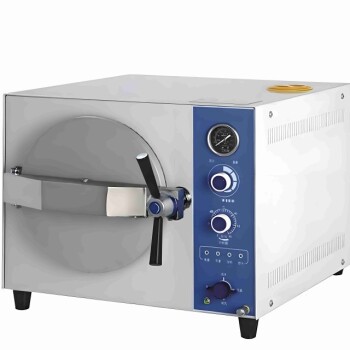
A high-pressure stainless steel autoclave functions as a robust containment vessel designed to isolate and intensify chemical synthesis. In the specific context of Open Framework Material (OFM) films, acts as a sealed reactor that allows solvents to be heated well beyond their standard boiling points, generating significant internal pressure to drive the formation of materials.
Core Takeaway By sustaining temperatures and pressures exceeding atmospheric levels, the autoclave dramatically increases reactant solubility and reactivity. This unique environment is essential for facilitating the heterogeneous nucleation and controlled crystal growth of OFM precursors onto substrates modified with self-assembled monolayers (SAMs).
Creating the Critical Reaction Environment
The Role of the Sealed Chamber
The primary physical function of the stainless steel autoclave is to provide a hermetically sealed environment.
This isolation prevents the escape of solvents as vapor, which is critical for maintaining the stoichiometry of the reaction mixture over long synthesis periods.
Exceeding Atmospheric Limits
Under standard conditions, a liquid solvent is limited by its boiling point. The autoclave removes this ceiling.
By confining the solvent, the vessel allows temperatures to rise significantly above the atmospheric boiling point, creating an autogenous pressure environment essential for solvothermal synthesis.
Enhancing Chemical Dynamics
Boosting Precursor Solubility
High pressure and temperature fundamentally alter the properties of the solvent.
This environment significantly enhances the solubility of reactants, allowing precursors to dissolve that would otherwise remain insoluble or precipitate prematurely at lower temperatures.
Increasing Reactivity
The elevated thermal energy and pressure do more than just dissolve materials; they increase the kinetic energy of the system.
This leads to enhanced reactivity among the precursors, accelerating reaction rates and enabling chemical pathways that are thermodynamically inaccessible under ambient conditions.
Facilitating Film Growth on SAMs
Promoting Heterogeneous Nucleation
The ultimate goal of using an autoclave in this context is to control where the crystals form.
The high-solubility environment prevents uncontrolled crashing out of solids, instead encouraging heterogeneous nucleation—where crystals begin to form specifically on the surface of the substrate rather than in the bulk liquid.
Interaction with Modified Substrates
The process is specifically tuned for substrates modified with self-assembled monolayers (SAMs).
The autoclave environment ensures that the OFM precursors are sufficiently mobile and reactive to interact with the SAMs, resulting in an oriented and uniform film growth directly on the substrate surface.
Understanding the Trade-offs
Safety and Operation Limits
While effective, these autoclaves introduce significant safety considerations due to the high stored energy of compressed gases and superheated liquids.
Operators must stay strictly within the rated pressure and temperature limits of the stainless steel vessel to prevent catastrophic failure.
"Black Box" Synthesis
A functional limitation of standard stainless steel autoclaves is the inability to observe the reaction in real-time.
Because the vessel is opaque and sealed, you cannot visually monitor the film growth or adjust parameters mid-reaction without depressurizing the system and halting the process.
Making the Right Choice for Your Goal
To maximize the quality of your OFM films, consider how you manage the autoclave's parameters:
- If your primary focus is Film Uniformity: Prioritize precise temperature control to maintain steady pressure, ensuring consistent nucleation across the SAM-modified surface.
- If your primary focus is Precursor Utilization: Ensure the operating temperature is sufficiently high to fully leverage the pressure-induced solubility, preventing waste from undissolved reactants.
Success in solvothermal synthesis relies on using the autoclave not just as a heater, but as a tool to manipulate the physical state of your solvents.
Summary Table:
| Feature | Function in OFM Film Synthesis |
|---|---|
| Sealed Environment | Prevents solvent evaporation; maintains stoichiometric balance. |
| Autogenous Pressure | Enables heating solvents above boiling points to drive reactions. |
| Solubility Enhancement | Dissolves precursors that are insoluble under ambient conditions. |
| Heterogeneous Nucleation | Encourages crystal growth on SAM-modified substrates vs. bulk liquid. |
| Kinetic Energy Boost | Accelerates reaction rates through high thermal and pressure energy. |
Elevate Your Advanced Material Synthesis with KINTEK
Precise control over temperature and pressure is the cornerstone of high-quality Open Framework Material (OFM) films. KINTEK provides industry-leading laboratory solutions, including high-performance high-temperature high-pressure reactors and autoclaves specifically designed to handle the rigorous demands of solvothermal synthesis.
Whether you are focusing on battery research, heterogeneous nucleation, or complex chemical vapor deposition, our comprehensive range of equipment—from vacuum and tube furnaces to PTFE-lined reactors and crucibles—ensures your lab achieves repeatable, superior results.
Ready to optimize your synthesis environment? Contact our laboratory specialists today to discover the perfect equipment for your research goals.
References
- Weijin Li, Roland A. Fischer. Open Framework Material Based Thin Films: Electrochemical Catalysis and State‐of‐the‐art Technologies. DOI: 10.1002/aenm.202003499
This article is also based on technical information from Kintek Solution Knowledge Base .
Related Products
- Stainless High Pressure Autoclave Reactor Laboratory Pressure Reactor
- High Pressure Laboratory Autoclave Reactor for Hydrothermal Synthesis
- Mini SS High Pressure Autoclave Reactor for Laboratory Use
- Portable High Pressure Laboratory Autoclave Steam Sterilizer for Lab Use
- Desktop Fast High Pressure Laboratory Autoclave Sterilizer 16L 24L for Lab Use
People Also Ask
- Why is a laboratory high-pressure reactor used in the hydrothermal synthesis of hydroxyapatite catalysts?
- What role does a laboratory high-pressure reactor play in the leaching process of spent cathode materials? Optimize Recovery
- Why is a laboratory high-pressure reactor necessary for synthesizing fly ash-based zeolite? Achieve Pure Crystallization
- What conditions do laboratory high-pressure reactors provide for HTC? Optimize Your Biochar Production Processes
- What is the function of a high-pressure reactor autoclave? Enhancing Cu/N Co-Doped Carbon Catalyst Synthesis