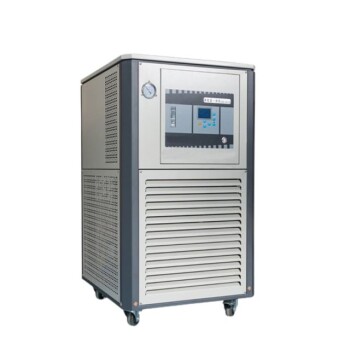
The primary function of a high-temperature and high-pressure reactor in this context is to create a sealed, pressurized environment that drives the chemical reduction and crystallization of iron precursors. By containing the reaction within an ethylene glycol solvent under these intense conditions, the reactor facilitates a thorough transformation that would not occur at atmospheric pressure. This specific environment is engineered to produce Fe3O4 nanoparticles with the precise physical and magnetic characteristics required for effective boron adsorption.
The reactor’s sealed environment forces the complete reduction of reactants, ensuring the formation of Fe3O4 cores with high crystallinity and uniform size—properties that are non-negotiable for magnetic separation efficiency.
The Mechanics of the Solvothermal Environment
Facilitating Reduction and Crystallization
The reactor operates as a closed system, which traps expanding gases and significantly raises the internal pressure.
This elevated pressure increases the boiling point of the ethylene glycol solvent, allowing the solution to reach temperatures required for thorough chemical reduction.
Without this high-pressure containment, the reduction of reactants would likely be incomplete, leading to impurities or weak structural integrity.
Controlling Nucleation and Growth
The reactor provides a stable thermal environment that regulates how crystals originate (nucleation) and how they expand (growth).
By maintaining consistent high heat and pressure, the system promotes stable crystal growth rather than chaotic precipitation.
This control is essential for ensuring that the resulting material is highly crystalline rather than amorphous.
Impact on Material Properties
Achieving Uniform Particle Size
A key output of the high-pressure environment is the uniformity of the particle size distribution.
When pressure and temperature are uniform throughout the vessel, the nanoparticles grow at a similar rate.
This uniformity is critical for the subsequent coating of the magnetic cores, ensuring consistent adsorbent performance across the entire batch.
Enhancing Magnetic Performance
The magnetic strength of the Fe3O4 core is directly tied to its crystal structure.
The high-temperature reactor ensures the formation of a well-defined crystal lattice, which maximizes the material's magnetic saturation.
Strong magnetism is vital for the practical application of boron adsorbents, as it allows for rapid recovery of the material from water using external magnets.
Understanding the Trade-offs
Process Complexity vs. Material Quality
While standard reflux methods (atmospheric pressure) are safer and easier to scale, they often fail to produce the high crystallinity needed for robust magnetic cores.
The high-pressure reactor introduces safety risks and higher equipment costs due to the need for rated pressure vessels.
However, this complexity is a necessary trade-off; skipping the high-pressure step typically results in particles with weak magnetic response and irregular shapes.
Making the Right Choice for Your Synthesis
To optimize the quality of your magnetic cores, consider how the reactor parameters align with your specific goals:
- If your primary focus is magnetic recovery: Prioritize maintaining high pressure to maximize crystallinity, which directly correlates to magnetic saturation strength.
- If your primary focus is downstream functionalization: Focus on the stability of the heating profile to ensure uniform particle size, providing a consistent surface area for coating.
The reactor is not merely a vessel; it is the active control mechanism that defines the structural integrity and functional success of your magnetic adsorbent.
Summary Table:
| Feature | Impact on Fe3O4 Synthesis | Benefit for Boron Adsorbents |
|---|---|---|
| High Pressure | Raises solvent boiling point & forces reduction | High crystallinity and structural integrity |
| Stable Thermal Profile | Regulates nucleation and crystal growth | Uniform particle size for consistent coating |
| Sealed Environment | Prevents escape of reagents/gases | Complete chemical transformation and purity |
| Controlled Cooling | Influences final magnetic domains | Maximized magnetic saturation for easy recovery |
Elevate Your Material Synthesis with KINTEK Precision
Achieving the perfect Fe3O4 magnetic core requires more than just heat; it demands the uncompromising pressure control and thermal stability found in KINTEK’s high-temperature and high-pressure reactors.
Whether you are developing advanced boron adsorbents or pioneering new magnetic nanoparticles, our specialized laboratory equipment—including autoclaves, high-pressure reactors, and ultra-precise crushing and milling systems—is engineered to meet the rigorous demands of modern material science.
Why choose KINTEK for your research?
- Unmatched Durability: Rated pressure vessels designed for safe, long-term solvothermal synthesis.
- Precision Engineering: Ensure uniform particle size and high magnetic saturation every time.
- Comprehensive Support: From dental and vacuum furnaces to battery research tools, we provide the full ecosystem for your lab.
Ready to optimize your synthesis results? Contact us today to find the ideal reactor solution for your lab!
References
- Qinglong Luo, Jun Li. Magnetic Separation of Oxoacid of Boron from Salt-Lake Brine by Synergistically Enhanced Boron Adsorbents of Glucose-Functionalized SiO2 and Graphene. DOI: 10.3390/ijms231911356
This article is also based on technical information from Kintek Solution Knowledge Base .
Related Products
- Customizable Laboratory High Temperature High Pressure Reactors for Diverse Scientific Applications
- High Pressure Laboratory Autoclave Reactor for Hydrothermal Synthesis
- Stainless High Pressure Autoclave Reactor Laboratory Pressure Reactor
- Customizable High Pressure Reactors for Advanced Scientific and Industrial Applications
- Mini SS High Pressure Autoclave Reactor for Laboratory Use
People Also Ask
- How do high-pressure and high-temperature reactors ensure the effective treatment of lignocellulosic wastewater in WAO?
- What equipment is required for high-pressure high-temperature reactions? Master Extreme Chemistry Safely
- How do you control high pressure in a reactor? A Guide to Safe & Stable Operation
- How does initial oxygen pressure affect the wet oxidation of pharmaceutical sludge? Master Your Oxidation Depth
- Why is argon better than nitrogen for inert atmosphere? Ensure Absolute Reactivity & Stability