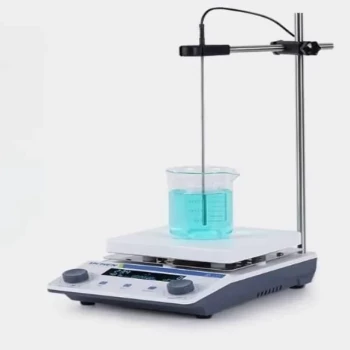
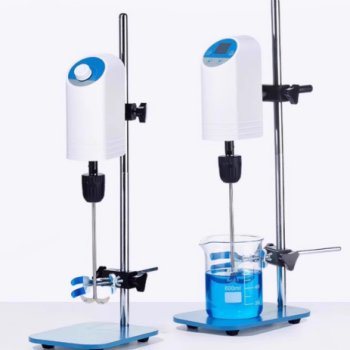
In the context of simulating industrial sulfolane environments, a magnetic stirrer acts as the engine of forced convection. It drives a stirring bar at high speeds to replicate the aggressive fluid dynamics characteristic of industrial extraction towers. This mechanical agitation is essential for ensuring that laboratory observations accurately reflect the conditions inside full-scale operational vessels.
Core Takeaway: The magnetic stirrer transforms a static reactor into a dynamic environment. By inducing forced convection, it simulates the physical scouring and chemical mass transfer rates of an industrial facility, ensuring that corrosion and thermal data gathered in the lab translate reliably to the field.
Creating a Representative Environment
To trust laboratory data, the conditions within the reactor must mirror the physical realities of industrial infrastructure.
Replicating Industrial Fluid Dynamics
Industrial extraction towers define a high-energy environment where fluids are in constant motion. A static beaker cannot simulate this.
The magnetic stirrer solves this by generating forced convection, artificially creating the high-velocity flow found in actual processing plants.
Establishing Thermodynamic Consistency
Accurate data requires a stable baseline. Without agitation, a sulfolane solvent can develop thermal gradients, leading to inconsistent test results.
The stirrer ensures temperature uniformity throughout the reactor, guaranteeing that every part of the solution remains at the target temperature.
The Mechanics of Corrosion Simulation
Beyond simple mixing, the stirrer plays a critical role in modeling how the solvent interacts with physical materials, such as pipe walls and electrodes.
Promoting Mass Transfer
Corrosion is not just chemical; it is kinetic. For corrosion to occur, corrosive impurities must physically reach the metal surface.
The stirrer actively promotes the mass transfer of these impurities to the electrode surfaces, mimicking the rate at which they would contact vessel walls in an operating plant.
Mimicking Physical Scouring
Fluids moving at high speeds exert physical stress on containment walls, a process known as scouring.
By driving the stir bar at high speeds, the setup approximates this chemical and physical scouring, ensuring the electrode experiences the same wear and tear as industrial piping.
Understanding the Trade-offs
While magnetic stirring is the industry standard for these simulations, it is vital to understand the limitations of the method to ensure data integrity.
The Risk of Under-Agitation
If the stirring speed is insufficient, the environment reverts to a static state.
This leads to reduced mass transfer rates and a lack of physical scouring, resulting in data that underestimates the severity of industrial corrosion.
The Limitation of Approximation
A magnetic stir bar creates a specific type of turbulence that may not perfectly match the flow profile of every industrial geometry.
It provides a high-fidelity approximation, but one must always account for the differences between a spinning bar and the linear or turbulent flow of a specific industrial tower.
Making the Right Choice for Your Goal
To maximize the value of your simulation, align your stirring parameters with your specific testing objectives.
- If your primary focus is Thermal Stability: Ensure the stirrer is set to a speed that guarantees rapid mixing to eliminate hot spots, acting similarly to kinetic uniformity controls in aqueous baths.
- If your primary focus is Corrosion Rate Analysis: Prioritize high-speed agitation to maximize mass transfer, ensuring the electrode is subjected to the full aggressive potential of the impurities.
The magnetic stirrer is the critical variable that allows a small-scale reactor to predict large-scale industrial outcomes.
Summary Table:
| Feature | Function in Sulfolane Simulation | Industrial Equivalent |
|---|---|---|
| Forced Convection | Drives high-speed fluid motion | Extraction tower flow dynamics |
| Thermal Uniformity | Eliminates temperature gradients | Stable process baselines |
| Mass Transfer | Moves impurities to metal surfaces | Real-world corrosion kinetics |
| Physical Scouring | Simulates mechanical fluid stress | High-velocity pipe/vessel wear |
Elevate Your Material Research with KINTEK Precision
To bridge the gap between laboratory data and industrial reality, you need high-performance equipment that delivers consistent results. KINTEK specializes in advanced laboratory solutions, including high-temperature high-pressure reactors, magnetic stirrers, and specialized electrolytic cells designed for the most demanding chemical simulations.
Whether you are analyzing corrosion rates in sulfolane environments or exploring thermal stability, our comprehensive range of high-temperature furnaces, hydraulic presses, and crushing systems ensures your lab operates at peak efficiency. Trust KINTEK for the reliable consumables and tools your research deserves.
Ready to optimize your industrial simulations? Contact us today to find the perfect equipment for your facility!
References
- Andrzej Bąk, Josef Jampílek. Sulfolane: Magic Extractor or Bad Actor? Pilot-Scale Study on Solvent Corrosion Potential. DOI: 10.3390/su10103677
This article is also based on technical information from Kintek Solution Knowledge Base .
Related Products
- Laboratory Small Constant Temperature Heated Magnetic Stirrer Heater and Stirrer
- Custom PTFE Teflon Parts Manufacturer for Magnetic Stirring Bar
- Three-dimensional electromagnetic sieving instrument
- High Performance Laboratory Stirrers for Diverse Applications
- Custom PTFE Teflon Parts Manufacturer for PTFE Stirring Bar Recovery Rod
People Also Ask
- What role does a magnetic stirrer with heating play in ZnO nanoparticle synthesis? Precision Control for Quality Results
- What role does a constant temperature heating magnetic stirrer play in MFC-HAp synthesis? Achieve Material Homogeneity
- What is the function of a laboratory magnetic stirrer in Ni–Cr–P electrodeposition? Optimize Ion Transport & Coating
- Why is a laboratory magnetic stirrer required for benzoic acid esters? Boost Reaction Speed & Yield with High RPM
- What role does a laboratory magnetic stirrer play in TiO2 and TiO2-Ag sol preparation? Master Chemical Kinetics