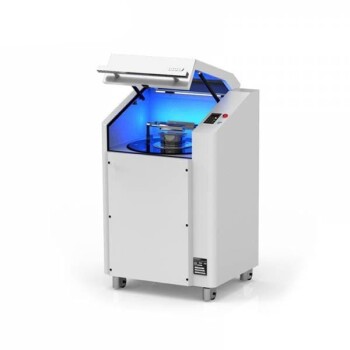
The planetary ball mill serves as a critical high-energy grinding tool for disassembled cathode material powders during the pre-treatment phase of lithium-ion battery recycling. By operating at high rotational speeds—typically around 500 rpm—it significantly reduces the particle size of the material and expands its specific surface area. This mechanical transformation is essential for accelerating the reaction kinetics in subsequent recovery steps, such as reduction roasting and electrolytic leaching.
The primary function of a planetary ball mill in recycling is to provide high-energy mechanochemical activation of battery materials. This process increases the reactivity of the powders, ensuring that downstream chemical and thermal recovery processes are faster, more efficient, and more thorough.
Enhancing Downstream Recovery Kinetics
Acceleration of Chemical Reactions
The reduction in particle size directly impacts the speed at which chemicals can interact with the spent battery material. By increasing the specific surface area, the mill provides more contact points for reagents during the leaching process. This results in higher recovery rates of valuable metals like lithium, cobalt, and nickel.
Facilitating Reduction Roasting
High-energy grinding pre-activates the cathode powder before it enters high-temperature furnaces. The mechanical energy stored in the refined particles lowers the energy barrier for reduction roasting. This allows the transition metals to be converted into more soluble forms at lower temperatures or in shorter timeframes.
Improving Leaching Efficiency
In the electrolytic leaching stage, the uniformity achieved by the planetary ball mill is vital. By breaking down material agglomerates, the mill ensures that the leaching solution can penetrate the powder evenly. This prevents the "shielding" effect where the core of a large particle remains unreacted.
Modification of Recycled Graphite Anodes
Restoration of Particle Morphology
Beyond cathode recovery, planetary ball mills are used to process acid-leached graphite powder. High-energy mechanochemical action helps in modifying particle morphology, rounding out irregular shapes that may have formed during the battery's lifespan. This structural adjustment is necessary for restoring the material's original performance characteristics.
Removal of Surface Defects
Spent graphite often contains surface defects and lattice distortions that hinder electrochemical performance. Moderate ball milling treatments, often lasting several hours, can effectively remove defects and enhance the structural order of the graphite. This process significantly improves the discharge capacity of the graphite for its secondary use in new batteries.
Precise Particle Size Distribution
The planetary ball mill allows for the precise adjustment of particle size distribution in recycled materials. By controlling milling time and speed, operators can achieve a consistent powder grade. This consistency is a prerequisite for the high-quality coating of new electrode sheets.
Understanding the Trade-offs and Pitfalls
Risk of Excessive Milling
While high energy is beneficial, excessive milling can lead to unwanted nanostructuring or complete amorphization of the material. If the milling time is too long, the particles may re-agglomerate due to increased surface energy. This can actually decrease the effective surface area and complicate the leaching process.
Temperature Control and Contamination
The intense friction and impact within the mill generate significant heat, which can trigger premature chemical reactions or degrade binders. Additionally, the wear and tear on the grinding media (balls and jars) can introduce impurities into the recycled material. Selecting compatible materials, such as zirconia or stainless steel, is critical to maintain purity.
How to Optimize Milling for Recycling Goals
To achieve the best results in a battery recycling workflow, the milling parameters must be aligned with the specific material being recovered and the intended downstream process.
- If your primary focus is maximizing metal extraction yields: Prioritize high rotational speeds (e.g., 500 rpm) to maximize specific surface area and enhance leaching kinetics.
- If your primary focus is the regeneration of anode graphite: Use moderate milling times and speeds to focus on structural restoration and defect removal rather than extreme size reduction.
- If your primary focus is preparing precursors for solid-state synthesis: Ensure stoichiometric uniformity by using the mill for intense mixing of lithium, manganese, and silicon sources in a liquid medium like ethanol.
Integrating high-energy planetary ball milling into the pre-treatment stage ensures that spent battery components are mechanically "primed" for highly efficient chemical and thermal recovery.
Summary Table:
| Key Function | Impact on Battery Recycling Process |
|---|---|
| Particle Size Reduction | Increases specific surface area to accelerate chemical leaching kinetics. |
| Mechanochemical Activation | Lowers the energy barrier for reduction roasting and thermal recovery. |
| Morphology Modification | Rounds irregular graphite particles and removes surface defects for reuse. |
| Uniform Distribution | Eliminates agglomerates, ensuring even penetration of leaching solutions. |
| Structural Restoration | Enhances the structural order and discharge capacity of recycled anodes. |
Elevate Your Battery Recycling Efficiency with KINTEK
At KINTEK, we specialize in providing high-performance laboratory equipment designed to meet the rigorous demands of lithium-ion battery research and recycling. Whether you need high-energy planetary ball mills and crushing systems for pre-treatment, or advanced high-temperature furnaces (muffle, tube, rotary, atmosphere) for precise reduction roasting, our comprehensive portfolio is built for excellence.
We also offer high-temperature high-pressure reactors, hydraulic presses, and essential consumables like PTFE products, ceramics, and crucibles to ensure your recovery processes are efficient, scalable, and contamination-free.
Ready to optimize your recovery yields and material quality? Contact KINTEK today to discover how our precision tools can empower your laboratory or industrial recycling workflow.
References
- Jiayin Zhou, Xiaofei Guan. The critical role of H <sub>2</sub> reduction roasting for enhancing the recycling of spent Li-ion battery cathodes in the subsequent neutral water electrolysis. DOI: 10.1039/d3su00201b
This article is also based on technical information from Kintek Solution Knowledge Base .
Related Products
- High Energy Planetary Ball Mill for Laboratory Horizontal Tank Type Milling Machine
- Laboratory Planetary Ball Mill Rotating Ball Milling Machine
- High-Energy Omnidirectional Planetary Ball Mill Milling Machine for Laboratory
- High Energy Planetary Ball Mill Milling Machine for Laboratory
- Laboratory Horizontal Planetary Ball Mill Milling Machine
People Also Ask
- What is the role of a planetary ball mill in sulfide-based solid-state batteries? Engineer High-Performance Cathodes
- What are the parameters of a planetary ball mill? Master Speed, Time, and Media for Perfect Grinding
- What is the function of a planetary ball mill for nanostructured eutectic steel? Essential Prep for High-Strength Alloys
- What role does a planetary ball mill play in the preparation of NASICON-type solid electrolytes like LATP and LAGP?
- What is the function of a planetary ball mill in solid-state electrolyte prep? Milling vs. SDS Methods Explained