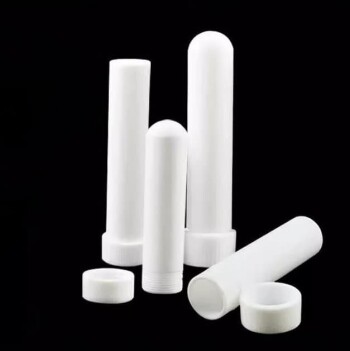
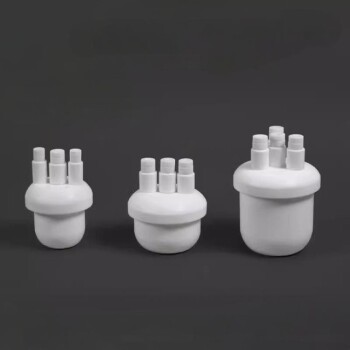
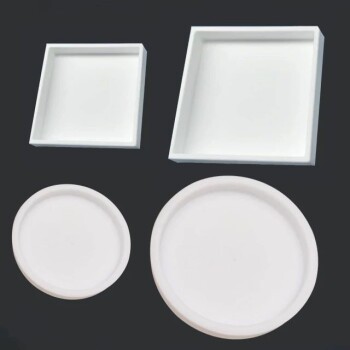
The PTFE-lined high-pressure reactor serves as the critical reaction vessel for the hydrothermal synthesis of cerium oxide ($CeO_2$) catalyst supports. It provides a sealed environment that facilitates chemical reactions and crystallization under autogenous pressure at temperatures typically ranging from 120°C to 180°C. The PTFE (Polytetrafluoroethylene) liner specifically ensures the purity of the $CeO_2$ support by acting as a chemically inert barrier between the corrosive reaction solution and the reactor's metallic walls.
The primary function of this reactor system is to create a controlled, high-pressure environment that enables the crystallization of $CeO_2$ at temperatures above the solvent's boiling point. This setup ensures high material purity and allows for the precise engineering of nanocrystal morphologies, such as nanorods and nanocubes, which are essential for catalytic performance.
The Role of the Sealed Hydrothermal Environment
Achieving Subcritical Conditions
The reactor creates a sealed environment where water or organic solvents can reach temperatures and pressures well above their normal boiling points. This state increases the solubility of cerium precursors, allowing them to dissolve and then recrystallize into stable oxide structures that would be difficult to form under ambient pressure.
Accelerating Reaction Kinetics
Operating under high pressure significantly enhances chemical reaction kinetics. This allows $CeO_2$ crystallization to occur at much lower temperatures than traditional solid-state methods, resulting in supports with higher surface areas and more active sites.
Chemical Inertness and Purity Control
The Importance of the PTFE Liner
The PTFE liner is chosen for its exceptional chemical stability and resistance to corrosion, particularly in the strong alkaline or acidic conditions common in hydrothermal synthesis. It prevents the reaction liquid from eroding the internal surfaces of the reactor during the long dwell times required for crystal growth.
Preventing Metallic Contamination
By serving as an internal reaction vessel, the liner ensures the solution never comes into direct contact with the metal shell (usually stainless steel). This eliminates the risk of leaching iron, nickel, or chromium ions into the catalyst support, which is vital for maintaining the strict purity levels required for catalytic applications.
Morphological Engineering of $CeO_2$
Directing Crystal Growth
The stable hydrothermal environment within the reactor allows for anisotropic growth, where crystals grow faster along certain axes than others. By precisely controlling the temperature (e.g., 160°C) and the concentration of precursors, researchers can produce specific morphologies like nanowires, nanorods, or nanocubes.
Facet Control and Surface Area
The reactor's ability to maintain constant pressure and temperature is essential for directional control over crystal facets. Exposing specific planes, such as the ${100}$ or ${110}$ facets of $CeO_2$, is a primary goal in catalyst support synthesis because these planes often exhibit higher oxygen storage capacity and catalytic activity.
Understanding the Trade-offs
Temperature and Pressure Limitations
While PTFE is highly inert, it has a thermal limit (typically around 220°C–250°C), above which it may soften or release toxic fumes. For synthesis requiring extreme temperatures or pressures exceeding $1\text{ GPa}$, alternative liners like PPL (Polyphenylene polymers) or gold-plated vessels must be considered.
Heat Transfer Inefficiency
The PTFE liner acts as an insulator, which can cause a lag between the temperature recorded by the external heater and the actual temperature of the internal reaction solution. This requires careful calibration and "soak times" to ensure the precursors reach the target crystallization temperature uniformly.
Making the Right Choice for Your Goal
When utilizing a PTFE-lined reactor for $CeO_2$ synthesis, your operational parameters should align with your specific material requirements:
- If your primary focus is High Purity: Ensure the PTFE liner is thoroughly cleaned with dilute acid between runs to prevent cross-contamination of cerium precursors.
- If your primary focus is Specific Morphology (Nanorods/Cubes): Maintain strict control over the hydrothermal temperature and duration, as even a 10°C variance can shift the growth from rods to spherical nanoparticles.
- If your primary focus is Structural Safety: Always pair the PTFE liner with a high-strength stainless steel outer shell to manage the autogenous pressure generated during the heating cycle.
The integration of chemical inertness and pressurized thermal control makes the PTFE-lined reactor an indispensable tool for producing high-performance $CeO_2$ catalyst supports.
Summary Table:
| Feature | Primary Function | Key Benefit |
|---|---|---|
| PTFE Liner | Chemical inertness and corrosion resistance | Prevents metallic leaching and ensures material purity |
| Sealed Environment | Creates autogenous pressure | Enables crystallization at temperatures above boiling point |
| Thermal Control | Regulates crystal growth kinetics | Precise engineering of nanocrystal morphology (rods, cubes) |
| Stainless Steel Shell | Structural containment | Safely manages high pressure during hydrothermal cycles |
Elevate Your Synthesis Precision with KINTEK
Achieve uncompromising purity and precise morphological control in your material research. KINTEK specializes in high-performance laboratory equipment, providing researchers with the robust tools needed for advanced hydrothermal synthesis.
Whether you require high-temperature high-pressure reactors and autoclaves, specialized PTFE-lined vessels, or precision muffle and tube furnaces, our solutions are designed to withstand corrosive environments and extreme conditions. Beyond reactors, we offer a comprehensive range of crushing systems, hydraulic presses, and battery research tools to streamline your entire workflow.
Ready to optimize your $CeO_2$ support production? Contact KINTEK today to find the perfect reactor configuration for your laboratory's needs!
References
- Lidai Zhou, Ziyin Zhang. Catalytic activity and mechanism of selective catalytic oxidation of ammonia by Ag–CeO<sub>2</sub> under different preparation conditions. DOI: 10.1039/d2ra06381f
This article is also based on technical information from Kintek Solution Knowledge Base .
Related Products
- Custom PTFE Teflon Parts Manufacturer for Hydrothermal Synthesis Reactor Polytetrafluoroethylene Carbon Paper and Carbon Cloth Nano-growth
- Custom PTFE Teflon Parts Manufacturer for Reagent Wide Mouth Fine Mouth Sample High Temperature Bottles
- Stainless High Pressure Autoclave Reactor Laboratory Pressure Reactor
- Customizable High Pressure Reactors for Advanced Scientific and Industrial Applications
- Custom PTFE Teflon Parts Manufacturer for Microwave Digestion Tank
People Also Ask
- What is the function of a PTFE reactor in MXene etching? Ensure Safe, High-Purity MAX Phase Conversion
- Why is a PTFE reactor required for titanium-based nano-ceramic coating solutions? Ensure Chemical Inertness & Purity
- Why must a Polytetrafluoroethylene (PTFE) reactor be used for Ti3C2TX MXene etching? Ensure Safety and Purity
- Why are PTFE reactors preferred for silver phosphate glass testing? Ensure Purity and Kinetic Accuracy
- What are the advantages of using polytetrafluoroethylene (PTFE) liners in hydrothermal synthesis reactors? High Purity