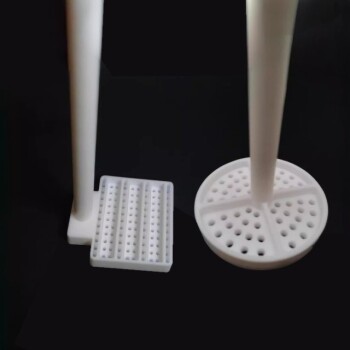
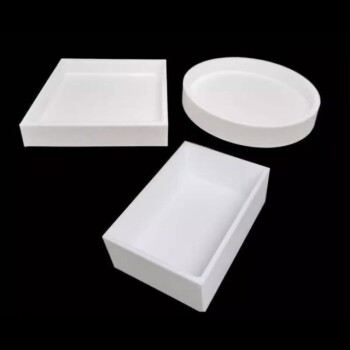
The Teflon-lined high-pressure reactor is the critical vessel that enables hydrothermal synthesis by creating a sealed, subcritical environment. In the production of $Fe_3O_4$ nanospheres, it maintains high temperatures (typically $200 ^\circ C$) and generates autogenous pressure to promote the reaction of precursor solutions. This specific environment ensures that iron oxide particles nucleate uniformly and grow into highly regular nanosphere structures that are unattainable at atmospheric pressure.
The reactor acts as a controlled micro-environment that combines extreme chemical inertness with high-pressure thermal stability. It is essential for overcoming energy barriers required to transform precursors into uniform, high-purity $Fe_3O_4$ nanostructures.
Creating Subcritical Conditions for Synthesis
Generating Autogenous Pressure
As the precursor solution is heated inside the sealed reactor, it generates internal autogenous pressure. This pressure allows the liquid phase to reach temperatures significantly above its atmospheric boiling point, such as the $200 ^\circ C$ required for $Fe_3O_4$.
Facilitating Physicochemical Transformation
Under these subcritical conditions, the reactants can overcome energy barriers that would otherwise prevent the reaction. This facilitates the deep transformation of colloidal substances into a specific crystalline structure.
Promoting Dissolution and Recrystallization
The high-pressure environment promotes the dissolution and recrystallization of components within the liquid phase. This process is vital for establishing the critical structural foundation needed for the nanospheres to reach their final form.
Ensuring Material Purity and Chemical Stability
The Role of the PTFE Liner
The Polytetrafluoroethylene (PTFE), or Teflon, lining is chosen for its exceptional chemical inertness. It effectively resists corrosion from the potentially aggressive chemical environments present during the reaction.
Preventing Metallic Contamination
By acting as a barrier, the liner prevents the reaction solution from corroding the external stainless steel reactor body. This isolation eliminates the risk of introducing metallic impurities, which is essential for the high-purity growth of $Fe_3O_4$.
Maintaining Structural Safety
While the Teflon liner handles chemical stability, the external stainless steel shell ensures the structural integrity of the system. This combination allows the reactor to safely contain the high pressures generated over long durations, such as 12 to 24 hours.
Managing Crystal Growth and Morphology
Uniform Nucleation
The stable, pressurized environment inside the reactor facilitates uniform nucleation throughout the solution. When nucleation occurs at the same rate across the medium, it prevents the formation of irregular aggregates.
Growth into Regular Nanospheres
Consistent heat and pressure allow the $Fe_3O_4$ particles to grow into regular, spherical shapes. This morphological evolution is controlled by the reactor’s ability to maintain a constant environment during the growth phase.
Achieving High Aspect Ratios
In similar hydrothermal processes, this pressurized aqueous medium ensures that nanostructures achieve superior structural integrity. This allows for the oriented growth of crystals along specific planes, which is necessary for achieving precise nanosphere dimensions.
Understanding the Trade-offs
Temperature and Pressure Limits
Teflon liners have strict thermal limitations and typically should not be used above $250 ^\circ C$. Exceeding these limits can cause the liner to soften or deform, leading to seal failure or contamination of the sample.
Cooling Rate Sensitivities
The rate at which the reactor cools can significantly impact the final crystal structure. Sudden changes in pressure or temperature during cooling can lead to cracks in the nanostructures or unintended phase changes.
Scalability Constraints
Hydrothermal synthesis in these reactors is often limited by the volume of the vessel. Achieving the same level of uniformity in larger reactors requires much more complex thermal management to avoid temperature gradients.
How to Apply This to Your Project
When utilizing a Teflon-lined reactor for nanoparticle synthesis, your specific goals will dictate your operational parameters.
- If your primary focus is phase purity: Ensure the PTFE liner is thoroughly cleaned and free of scratches to prevent the carryover of impurities from previous reactions.
- If your primary focus is uniform particle size: Maintain a strictly constant temperature for the full duration of the reaction to ensure a consistent nucleation rate.
- If your primary focus is safety and longevity: Never fill the liner more than 80% to allow sufficient headspace for autogenous pressure expansion.
Mastery of the high-pressure reactor environment is the defining factor in achieving the precise morphology and purity required for high-performance $Fe_3O_4$ nanospheres.
Summary Table:
| Feature | Function in Fe3O4 Synthesis | Key Benefit |
|---|---|---|
| PTFE (Teflon) Liner | Provides extreme chemical inertness | Prevents metallic contamination; ensures high purity |
| Stainless Steel Shell | Maintains structural integrity under pressure | Ensures safety during long-duration (12-24h) reactions |
| Autogenous Pressure | Enables subcritical liquid phase conditions | Overcomes energy barriers for crystal transformation |
| Thermal Stability | Maintains constant high temperature (e.g., 200°C) | Promotes uniform nucleation and regular spherical growth |
Elevate Your Nanoparticle Synthesis with KINTEK
Precision in hydrothermal synthesis requires equipment that can withstand extreme conditions without compromising purity. KINTEK specializes in high-performance laboratory equipment, offering a premium range of high-temperature high-pressure reactors and autoclaves specifically designed for demanding applications like $Fe_3O_4$ nanosphere production.
Whether you need robust PTFE-lined vessels, advanced cooling solutions, or specialized battery research tools, our team provides the reliable technology and technical support necessary to achieve consistent, high-quality results.
Contact KINTEK today to find the perfect reactor solution for your lab and ensure your research meets the highest standards of excellence.
References
- Chunxia Qi, Yuhua Shen. Multifunctional Hollow Porous Fe3O4@N-C Nanocomposites as Anodes of Lithium-Ion Battery, Adsorbents and Surface-Enhanced Raman Scattering Substrates. DOI: 10.3390/molecules28135183
This article is also based on technical information from Kintek Solution Knowledge Base .
Related Products
- Custom PTFE Teflon Parts Manufacturer for Reagent Wide Mouth Fine Mouth Sample High Temperature Bottles
- Custom PTFE Teflon Parts Manufacturer for Hydrothermal Synthesis Reactor Polytetrafluoroethylene Carbon Paper and Carbon Cloth Nano-growth
- Custom PTFE Teflon Parts Manufacturer for Microwave Digestion Tank
- Stainless High Pressure Autoclave Reactor Laboratory Pressure Reactor
- Customizable High Pressure Reactors for Advanced Scientific and Industrial Applications
People Also Ask
- What makes PTFE bottles suitable for static leaching? Ensure Zero-Contamination for Glass Testing
- Why Use PTFE Sample Bottles for Coal Demineralization? Ensure Chemical Stability and Data Integrity
- Why are PTFE containers necessary for selective HF etching of MAX phases? Ensure Safe & Pure MXene Synthesis
- Why use high-quality PTFE containers for CO2 reduction electrolytes? Eliminate silicon contamination and ensure data.
- Why is a PTFE container required for acid leaching of silicon nanosheets? Ensure High Purity and Safety