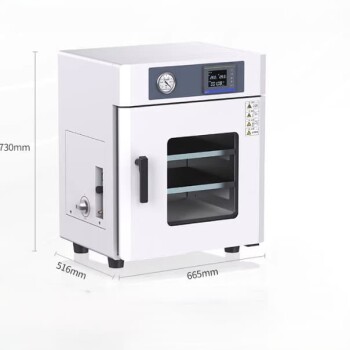
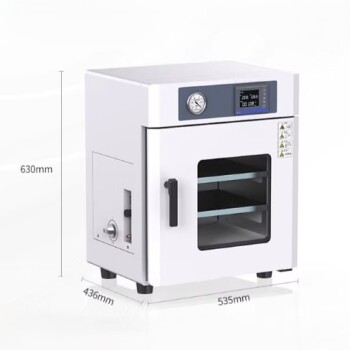
A vacuum drying oven serves as the essential stabilization step in the laboratory-scale synthesis of boehmite. It is specifically employed after the centrifugal separation and washing stages to remove residual moisture from the powder, utilizing reduced pressure to drive evaporation at significantly lower temperatures than standard heating methods.
Core Insight: The primary value of vacuum drying lies in its ability to dry materials without thermal damage. By lowering the boiling point of the solvent, the oven accelerates drying while preventing the boehmite particles from oxidizing or fusing together (agglomeration), thereby preserving the material's original microscopic morphology and high reactivity.
Preserving Material Integrity Through Physics
To understand why a standard convection oven is insufficient for high-quality boehmite synthesis, one must look at the specific physical advantages provided by the vacuum environment.
Lowering the Thermal Threshold
The vacuum oven reduces the internal pressure of the chamber. This physical change significantly lowers the boiling point of water and other residual solvents.
This allows the boehmite to undergo deep drying at moderate temperatures. You avoid the high thermal stress that typically leads to structural collapse or unwanted phase transitions in sensitive nanomaterials.
Preventing Agglomeration
One of the greatest risks during the drying of synthetic powders is agglomeration—where individual particles clump together to form larger, hard masses.
Vacuum drying accelerates the removal of moisture from the particle surface. This rapid, low-temperature evaporation prevents the formation of strong liquid bridges that draw particles together, helping maintain the boehmite as a fine, discrete powder.
Protecting Against Oxidation
Boehmite synthesis often aims to produce particles with high surface reactivity.
High-temperature air drying exposes the material to oxygen, which can alter surface chemistry. The vacuum environment removes air from the chamber, effectively shielding the powder from oxidation while it dries.
Operational Considerations and Trade-offs
While vacuum drying is superior for maintaining quality, it introduces specific variables that must be managed to ensure success.
Batch Process Limitations
Unlike some industrial drying methods, laboratory vacuum ovens are typically batch-processing units.
This limits throughput. You must carefully control the amount of wet cake loaded into the oven; overloading the trays can lead to uneven drying gradients where the outer layer dries but traps moisture inside the core.
The "Bumping" Risk
Because the vacuum lowers the boiling point rapidly, solvents can flash-boil if the pressure is reduced too quickly.
This can cause the powder to "bump" or splatter inside the chamber. To avoid material loss or cross-contamination, the pressure must be ramped down gradually, or the temperature increased slowly.
Optimizing the Synthesis Workflow
The vacuum oven is not just a heater; it is a tool for morphological control. Your approach to using it should depend on the specific requirements of your final application.
- If your primary focus is High Reactivity: Prioritize the lowest possible temperature setting that still achieves drying; the vacuum allows you to trade heat for pressure to protect active sites.
- If your primary focus is Particle Size Uniformity: Ensure the wet cake is spread thinly and evenly to prevent the formation of hard aggregates during the drying phase.
By controlling the atmosphere and temperature simultaneously, the vacuum drying oven ensures the boehmite powder you synthesize retains the delicate structural properties created during the chemical reaction.
Summary Table:
| Feature | Advantage in Boehmite Synthesis |
|---|---|
| Reduced Pressure | Lowers solvent boiling point to prevent thermal degradation. |
| Oxygen-Free Environment | Protects high-surface-reactivity particles from unwanted oxidation. |
| Low-Temp Evaporation | Minimizes liquid bridges to prevent particle clumping (agglomeration). |
| Morphological Control | Preserves microscopic structure and ensures fine, discrete powder output. |
Elevate Your Nanomaterial Synthesis with KINTEK Precision
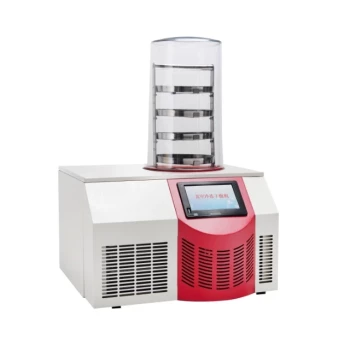
High-quality boehmite synthesis requires more than just heat—it requires precise atmospheric control to protect your material’s delicate morphology. KINTEK specializes in advanced laboratory solutions, offering high-performance vacuum drying ovens and freeze dryers designed to eliminate moisture without compromising particle integrity.
From crushing and milling systems for precursor preparation to high-temperature furnaces and vacuum reactors for material transformation, KINTEK provides the comprehensive toolkit needed for cutting-edge research. Whether you are scaling up battery research or optimizing ceramic catalysts, our team is ready to provide the high-precision equipment your lab demands.
Ready to preserve your material's reactivity? Contact KINTEK today for a customized solution!
References
- Junkai Wang, Yuzheng Wang. The Influence of Hydrothermal Temperature on Alumina Hydrate and Ammonioalunite Synthesis by Reaction Crystallization. DOI: 10.3390/cryst13050763
This article is also based on technical information from Kintek Solution Knowledge Base .
Related Products
- 56L Vertical Laboratory Vacuum Drying Oven
- 23L Laboratory Vacuum Drying Oven
- Laboratory Scientific Electric Heating Blast Drying Oven
- Benchtop Laboratory Vacuum Freeze Dryer
- Dental Porcelain Zirconia Sintering Ceramic Vacuum Press Furnace
People Also Ask
- Why is a laboratory vacuum drying oven recommended for rice straw residues? Protect Your Biomass Integrity
- What role does a laboratory vacuum drying oven play in the preparation of modified multi-walled carbon nanotubes?
- What is the importance of using a laboratory vacuum drying oven? Preserving Slow-Release Microcapsule Integrity
- Why is a Laboratory Vacuum Drying Oven recommended for PBAT microspheres? Protect Sensitive Polymer Integrity
- What role does a laboratory vacuum drying oven play in processing nanoparticle powder samples? Protect Sample Integrity