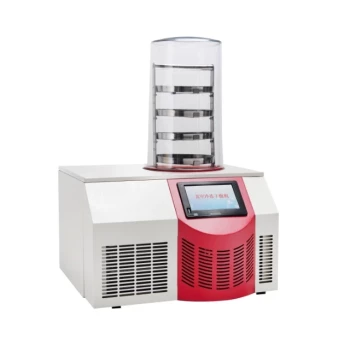
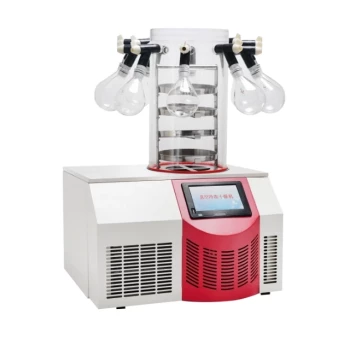
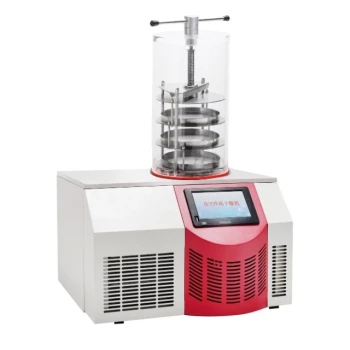
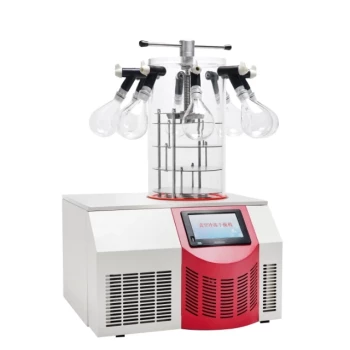
The primary function of a vacuum freeze dryer in the preparation of Samarium-Doped Ceria (SDC)-carbonate nanocomposites is to remove water solvents from a frozen precursor solution through sublimation. By converting ice directly into vapor under high vacuum, this equipment preserves the material's delicate microstructure and prevents the particles from fusing together.
Core Takeaway The freeze dryer is not just a drying tool; it is a structural preservation device. Its ability to bypass the liquid phase allows for the creation of loose, non-agglomerated powders with a narrow size distribution and a particle diameter consistently controlled below 100 nanometers.
The Mechanism of Preservation
Sublimation Over Evaporation
The defining feature of this process is sublimation.
Instead of applying heat to evaporate liquid water—which involves a turbulent phase change—the freeze dryer maintains the solution in a frozen state.
Under high vacuum, the ice within the precursor transitions directly into gas, leaving the solid nanoparticles undisturbed.
Preventing Hard Agglomeration
The most critical role of the freeze dryer is preventing "hard agglomeration."
When solvents evaporate normally, surface tension creates capillary forces that pull particles together tightly.
Freeze drying eliminates this liquid surface tension, ensuring the particles remain distinct and separated rather than forming dense, unusable clumps.
Impact on SDC Nanocomposite Properties
Controlling Particle Size
For SDC-carbonate nanocomposites, performance relies on surface area.
The freeze-drying process ensures that the final powder possesses a particle diameter controlled below 100 nanometers.
This nanoscale size is difficult to achieve with traditional heat drying, which often results in larger, fused particles.
Ensuring Narrow Size Distribution
Uniformity is key for the stability of the final material.
By locking the precursor in a frozen matrix before drying, the equipment preserves the original dispersion state of the solution.
This results in a final powder with a narrow size distribution, meaning the particles are not only small but also highly consistent in size.
The Critical Physics: Why Heat Drying Fails
The Danger of Capillary Collapse
It is vital to understand why alternative drying methods are unsuitable for this specific application.
Traditional heat drying introduces capillary forces as the liquid volume shrinks.
These forces can cause the lattice structure of the material to collapse, destroying the intended porous network.
Loss of Redispersibility
Powders dried via heat often suffer from poor redispersibility.
Because the particles have bonded physically during the drying phase, they cannot be easily separated again.
Freeze-dried precursors retain a loose structure, ensuring they can be effectively utilized in subsequent processing or sintering steps.
Making the Right Choice for Your Goal
When synthesizing SDC-carbonate nanocomposites, the drying method dictates the quality of your final product.
- If your primary focus is Microstructural Integrity: Use freeze drying to maintain the original porous network and prevent lattice collapse.
- If your primary focus is Particle Size Control: Rely on sublimation to guarantee particle diameters remain strictly below 100 nanometers.
- If your primary focus is Sintering Activity: Choose freeze drying to ensure a loose powder structure that offers high specific surface area and reactivity.
The vacuum freeze dryer is the definitive tool for translating a high-quality liquid precursor into a high-performance solid nanocomposite.
Summary Table:
| Feature | Vacuum Freeze Drying | Traditional Heat Drying |
|---|---|---|
| Mechanism | Sublimation (Solid to Gas) | Evaporation (Liquid to Gas) |
| Particle Size | Controlled below 100 nm | Often larger/fused |
| Surface Tension | Eliminated (No capillary forces) | High (Causes lattice collapse) |
| Powder State | Loose, non-agglomerated | Hard agglomerates/clumps |
| Microstructure | Preserved porous network | Collapsed structures |
Elevate Your Nanomaterial Synthesis with KINTEK Precision
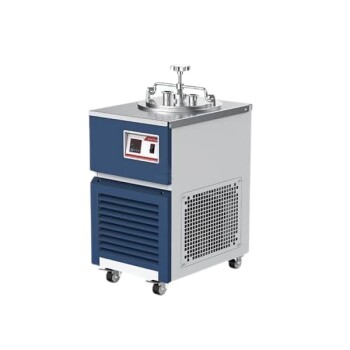
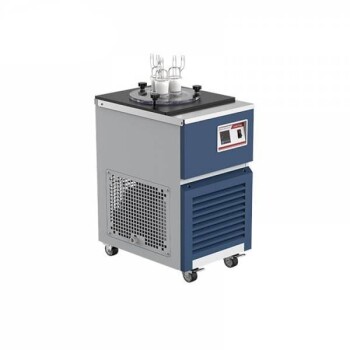
Precise control over microstructure is the difference between a failed experiment and a breakthrough. KINTEK specializes in advanced laboratory solutions designed for high-performance research. From our high-efficiency freeze dryers and cooling solutions (ULT freezers, cold traps) that prevent particle agglomeration, to our high-temperature furnaces (muffle, tube, vacuum) and crushing systems for post-processing, we provide the tools necessary for SDC-carbonate excellence.
Whether you are developing solid oxide fuel cell materials or advanced catalysts, our team offers the technical expertise and comprehensive equipment portfolio—including centrifuges, homogenizers, and ceramic consumables—to support your workflow.
Ready to optimize your nanoparticle size and distribution? Contact KINTEK today for a customized equipment consultation!
Related Products
- Benchtop Laboratory Vacuum Freeze Dryer
- High Performance Laboratory Freeze Dryer
- High Performance Laboratory Freeze Dryer for Research and Development
- Benchtop Laboratory Freeze Dryer for Lab Use
- Vacuum Cold Mounting Machine for Sample Preparation
People Also Ask
- What are the technical advantages of using a laboratory freeze dryer for porous carbon precursors? Preserve 3D Networks
- How do laboratory freeze dryers support scientific research? Preserve Sample Integrity for Reproducible Results
- Why is a laboratory freeze dryer preferred over traditional heating? Preserve Biochar Structure & Maximize Porosity
- What types of liquid samples can be processed using a laboratory freeze dryer? Preserve Your Sensitive Materials
- What role do laboratory freeze dryers play in the food industry? Unlock Superior Food Preservation