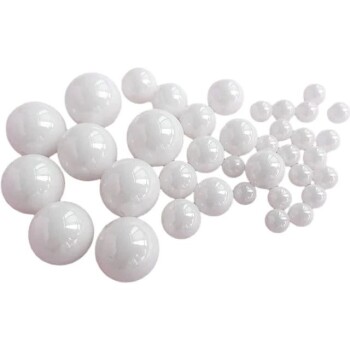
High-energy ball milling functions as a critical mechanical activation step in the recycling of zirconium alloy chips. By subjecting the chips and titanium powder to intense impact and shear forces, the process achieves necessary particle size reduction while simultaneously stripping away the material's protective oxide layer to expose fresh, reactive metal.
The defining value of this process is not just grinding, but mechanical activation. By continuously fracturing the passivation oxide layer, ball milling exposes fresh metallic surfaces, making the zirconium chemically reactive enough for effective alloying and hydrogenation.
The Mechanics of Material Transformation
To convert scrap chips into a usable alloy precursor, the material must undergo significant physical changes. High-energy ball milling facilitates this through specific mechanical forces.
Application of Intense Forces
The process utilizes grinding media to deliver intense mechanical impact and shear forces to the mixture.
This is not a gentle mixing process; the kinetic energy involved is sufficient to physically deform and fracture the metal structure.
Reduction of Particle Size
The primary physical result of these forces is the significant reduction of particle size in both the zirconium alloy chips and the titanium powder.
By pulverizing the material, the process drastically increases the specific surface area of the powder, which is a prerequisite for efficient chemical interaction in later stages.
Overcoming the Oxide Barrier
The deep need in recycling zirconium is handling its reactivity and natural defenses. Zirconium naturally forms a passivation layer that inhibits further reaction, which creates a barrier to recycling.
Breaking the Passivation Layer
The most critical function of high-energy ball milling in this context is the mechanical removal of the passivation oxide layer on the zirconium alloy surface.
Standard mixing cannot penetrate this layer; the high-energy impact is required to physically shatter this protective coating.
Continuous Generation of Fresh Surfaces
As the particles are repeatedly fractured, fresh, unoxidized metallic surfaces are continuously exposed.
This "mechanical activation" ensures that the metal beneath the oxide layer is brought to the surface, ready to interact with other elements.
Facilitating Downstream Reactions
Once the material is physically reduced and chemically activated, the ball milling process sets the stage for the final alloy production.
Enhancing Chemical Reactivity
The exposure of fresh surfaces directly enhances the chemical reactivity between the metal components and the surrounding environment.
This heightened reactive state is essential for facilitating reactions with gases or other metallic components during the recycling process.
Enabling Alloying and Hydrogenation
Specifically for Zr-Ti production, this activation facilitates subsequent alloying and hydrogenation reactions.
Without the mechanical activation provided by ball milling, the metals would likely remain inert, preventing the successful formation of the desired alloy.
Understanding the Trade-offs
While high-energy ball milling is essential for activation, it is an aggressive process that requires careful management of energy and material states.
Necessity of High Intensity
The process relies entirely on the intensity of the impact; low-energy methods will fail to break the passivation layer.
This means the equipment and energy input must be sufficient to fracture oxides, rather than simply tumbling the materials together.
Mechanical Stress vs. Material Integrity
The process involves repeated breaking and potential cold-welding of particles.
Operators must ensure the forces applied balance the need for size reduction with the goal of maintaining a uniform distribution of elements within the matrix.
Making the Right Choice for Your Goal
When designing a recycling workflow for zirconium alloys, understanding the specific outcome of ball milling helps in optimizing the process.
- If your primary focus is Reactivity: Ensure the milling duration and intensity are sufficient to fully break the passivation oxide layer, exposing fresh metal for hydrogenation.
- If your primary focus is Homogeneity: Prioritize the reduction of particle size to maximize specific surface area, ensuring uniform diffusion of titanium and zirconium.
High-energy ball milling transforms waste chips from inert scrap into a highly reactive feedstock capable of forming advanced alloys.
Summary Table:
| Function | Mechanism | Impact on Recycling |
|---|---|---|
| Mechanical Activation | Repeated fracturing of passivation layer | Exposes fresh, reactive metallic surfaces for alloying |
| Size Reduction | Intense impact & shear forces | Increases specific surface area for faster chemical reactions |
| Oxide Removal | Physical shattering of protective coating | Overcomes the barrier to hydrogenation and alloying |
| Homogenization | Constant cold-welding and fracturing | Ensures uniform distribution of Zr and Ti particles |
Elevate Your Advanced Material Synthesis with KINTEK
Transform your material processing with KINTEK’s high-performance crushing and milling systems. Whether you are recycling zirconium alloy chips or developing advanced Zr-Ti alloys, our equipment provides the intense mechanical activation required to break passivation layers and achieve superior homogeneity.
From high-energy ball mills to precision high-temperature furnaces and hydraulic presses, KINTEK specializes in laboratory solutions that empower researchers and manufacturers. Our portfolio includes specialized tools for battery research, high-pressure reactors, and premium ceramics designed to withstand the most demanding lab environments.
Ready to optimize your recycling workflow? Contact KINTEK today to discover how our expertise in laboratory equipment and consumables can drive your next breakthrough!
References
- Nadia S. Gamba, F.C. Gennari. Zirconium alloys produced by recycling zircaloy tunings. DOI: 10.1016/j.jallcom.2013.07.025
This article is also based on technical information from Kintek Solution Knowledge Base .
Related Products
- Laboratory Jar Ball Mill with Alumina Zirconia Grinding Jar and Balls
- High Energy Planetary Ball Mill Milling Machine for Laboratory
- High Energy Planetary Ball Mill Milling Machine for Laboratory
- High-Energy Omnidirectional Planetary Ball Mill Milling Machine for Laboratory
- High Energy Planetary Ball Mill for Laboratory Horizontal Tank Type Milling Machine
People Also Ask
- What are the primary functions of using a ball mill for BZCY72 powder? Achieve High Purity and Enhanced Sintering
- In what way does a laboratory ball mill affect material properties when modifying PHBV/pulp fiber composites?
- Why is a laboratory ball mill required for ultra-fine fly ash? Unlock Nano-Scale Adsorption Power
- What is the function of a laboratory ball mill in the preparation of AMMCs? Optimize Dispersion & Grain Refinement
- What is the function of a laboratory ball mill in the pretreatment of waste tire char (WTC)? Optimize Material Reactivity