Knowledge What is the oven in a biology laboratory? Essential for Sterilization and Sample Drying
Author avatar

Tech Team · Kintek Solution

Updated 6 days ago

What is the oven in a biology laboratory? Essential for Sterilization and Sample Drying


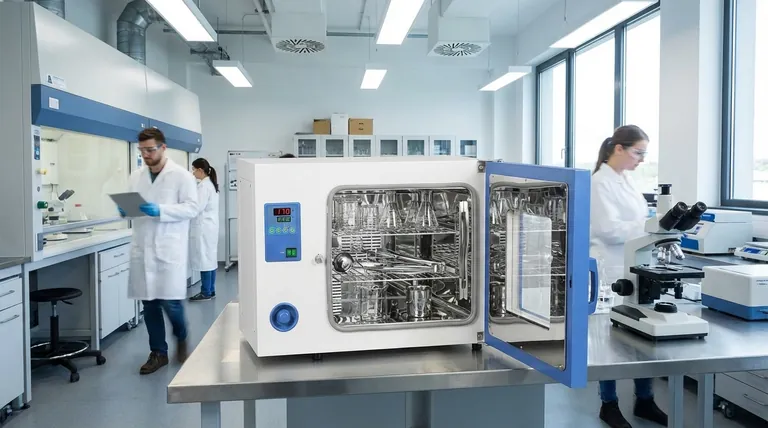
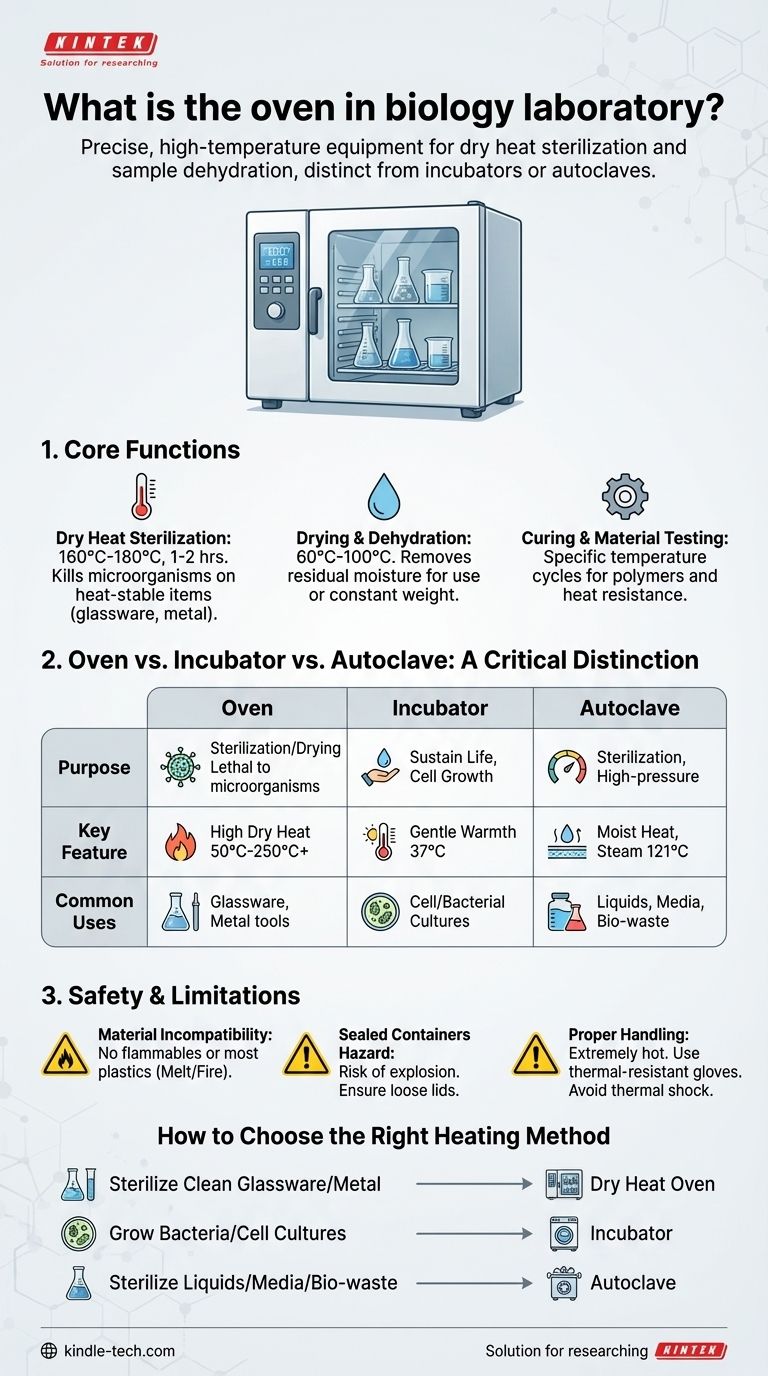
In a biology laboratory, an oven is a fundamental piece of equipment used for high-temperature applications, primarily dry heat sterilization and sample dehydration. Unlike a kitchen oven, a lab oven provides precise temperature control and uniform heat distribution, which is critical for reproducible scientific protocols. Its main function is to create a hot, dry environment, making it distinct from other heating devices like incubators or autoclaves.

A laboratory oven uses circulating dry heat to achieve high temperatures, making it essential for sterilizing heat-stable materials like glassware and for precisely drying samples. Its key limitation is that this intense, dry heat will destroy living cells and melt most plastics, defining its specific role in the lab.
What is the oven in a biology laboratory? Essential for Sterilization and Sample Drying

The Core Functions of a Laboratory Oven

A biology lab oven is not a general-purpose heater; it is a specialized tool with a few key applications that rely on its ability to produce high, dry heat.

Dry Heat Sterilization

The most common use for a lab oven is sterilization. By heating items to temperatures between 160°C and 180°C for an extended period (typically 1-2 hours), the intense heat denatures proteins and effectively kills all microorganisms, including bacteria, viruses, and spores.

This method is ideal for items that can withstand high temperatures but could be damaged by moisture, such as glassware (beakers, flasks, pipettes) and metal instruments (forceps, scalpels).

Drying and Dehydration

Another primary function is drying. After glassware is washed, it can be placed in an oven at a moderate temperature (e.g., 60-100°C) to rapidly remove all residual moisture, ensuring it is ready for use.

Ovens are also used in analytical procedures to dehydrate biological or chemical samples to a constant weight. This is critical for experiments where precise mass measurements are required without the variable influence of water content.

Curing and Material Testing

In some specialized applications, ovens are used to cure polymers or other materials that require a specific temperature cycle to set properly. They can also be used for material testing to determine how a substance reacts to prolonged heat exposure.

Oven vs. Incubator vs. Autoclave: A Critical Distinction

A common point of confusion for those new to a lab is differentiating between the three main heating devices. Each serves a unique and non-interchangeable purpose.

The Oven: High-Temperature, Dry Heat

An oven is designed for sterilization and drying, operating at very high temperatures (typically 50°C to over 250°C). Its purpose is to create an environment that is lethal to microorganisms and removes all moisture.

The Incubator: Gentle, Controlled Warmth

An incubator is designed to sustain life. It provides a stable, controlled, and gentle temperature—often around human body temperature (37°C)—to grow and maintain cell cultures, bacterial cultures, or other living specimens. Using an oven instead of an incubator would instantly kill these cultures.

The Autoclave: High-Pressure, Moist Heat

An autoclave is a sterilization device that uses high-pressure steam, typically at 121°C. The combination of moisture and pressure allows heat to penetrate materials much more effectively than dry heat. This makes the autoclave the superior method for sterilizing liquids (like culture media), biohazardous waste, and heat-sensitive plastics.

Understanding the Trade-offs and Safety Protocols

While essential, an oven has clear limitations and presents safety hazards if used improperly. Understanding these is crucial for maintaining a safe and efficient lab environment.

Limitation: Material Incompatibility

Never place flammable or volatile chemicals (like alcohol or solvents) in an oven, as this can cause a fire or explosion. Likewise, most plastics cannot withstand oven temperatures and will melt, releasing toxic fumes and ruining both the item and potentially the oven.

Limitation: Sealed Containers are a Hazard

Placing a tightly sealed container in an oven is extremely dangerous. As the air inside heats up, it expands, which can cause the container to explode violently. Always ensure containers have a loose-fitting lid or are open to the air.

Safety First: Proper Handling

Items removed from a hot oven will be extremely hot and can cause severe burns. Always use thermal-resistant gloves when handling items. Place hot glassware on a heat-proof surface and allow it to cool slowly to prevent thermal shock, which can cause it to shatter.

How to Choose the Right Heating Method

Selecting the correct device is fundamental to the success and safety of your experiment.

  • If your primary focus is sterilizing clean glassware or metal instruments: The dry heat oven is a reliable and effective choice.
  • If your primary focus is growing bacteria or cell cultures: You must use an incubator to maintain a stable, life-sustaining temperature.
  • If your primary focus is sterilizing liquids, culture media, or biohazardous waste: The autoclave is the correct tool, as it uses pressurized steam for rapid and thorough sterilization.

Understanding the specific role of each heating device is fundamental to ensuring safety, accuracy, and reproducibility in the laboratory.

Summary Table:

Function Key Features Common Uses
Dry Heat Sterilization 160°C - 180°C, kills microorganisms Sterilizing glassware, metal tools
Drying & Dehydration Removes moisture, precise temperature control Drying washed glassware, sample preparation
Curing & Material Testing Uniform heat distribution Polymer curing, heat resistance testing

Need a reliable lab oven for your biology lab? KINTEK specializes in high-performance laboratory equipment, including ovens designed for precise sterilization and drying. Our products ensure safety, accuracy, and reproducibility for your critical experiments. Contact us today to find the perfect oven for your laboratory needs!

Visual Guide
What is the oven in a biology laboratory? Essential for Sterilization and Sample Drying Visual Guide

Related Products

People Also Ask

Related Products

Laboratory Scientific Electric Heating Blast Drying Oven

Laboratory Scientific Electric Heating Blast Drying Oven

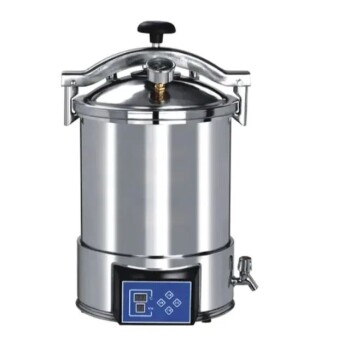
The desktop fast autoclave sterilizer is a compact and reliable device used for rapid sterilization of medical, pharmaceutical, and research items.

Portable Digital Display Automatic Laboratory Sterilizer Lab Autoclave for Sterilization Pressure

Portable Digital Display Automatic Laboratory Sterilizer Lab Autoclave for Sterilization Pressure

Portable autoclave sterilization pressure is a device that uses pressure saturated steam to quickly and effectively sterilize items.

1200℃ Muffle Furnace Oven for Laboratory

1200℃ Muffle Furnace Oven for Laboratory

Upgrade your lab with our 1200℃ Muffle Furnace. Achieve fast, precise heating with Japan alumina fibers and Molybdenum coils. Features TFT touch screen controller for easy programming and data analysis. Order now!

Graphite Vacuum Furnace Negative Material Graphitization Furnace

Graphite Vacuum Furnace Negative Material Graphitization Furnace

Graphitization furnace for battery production has uniform temperature and low energy consumption. Graphitization furnace for negative electrode materials: an efficient graphitization solution for battery production and advanced functions to enhance battery performance.

Large Vertical Graphite Vacuum Graphitization Furnace

Large Vertical Graphite Vacuum Graphitization Furnace

A large vertical high-temperature graphitization furnace is a type of industrial furnace used for the graphitization of carbon materials, such as carbon fiber and carbon black. It is a high-temperature furnace that can reach temperatures of up to 3100°C.

Graphite Vacuum Furnace Bottom Discharge Graphitization Furnace for Carbon Materials

Graphite Vacuum Furnace Bottom Discharge Graphitization Furnace for Carbon Materials

Bottom-out graphitization furnace for carbon materials, ultra-high temperature furnace up to 3100°C, suitable for graphitization and sintering of carbon rods and carbon blocks. Vertical design, bottom discharging, convenient feeding and discharging, high temperature uniformity, low energy consumption, good stability, hydraulic lifting system, convenient loading and unloading.

Vacuum Heat Treat and Pressure Sintering Furnace for High Temperature Applications

Vacuum Heat Treat and Pressure Sintering Furnace for High Temperature Applications

Vacuum pressure sintering furnaces are designed for high temperature hot pressing applications in metal and ceramic sintering. Its advanced features ensure precise temperature control, reliable pressure maintenance, and a robust design for seamless operation.

Isostatic Molding Pressing Molds for Lab

Isostatic Molding Pressing Molds for Lab

Explore high-performance isostatic pressing molds for advanced material processing. Ideal for achieving uniform density and strength in manufacturing.

30L Heating Chilling Circulator Cooling Water Bath Circulator for High and Low Temperature Constant Temperature Reaction

30L Heating Chilling Circulator Cooling Water Bath Circulator for High and Low Temperature Constant Temperature Reaction

Get versatile lab performance with KinTek KCBH 30L Heating Chilling Circulator. With max. heating temp of 200℃ and max. chilling temp of -80℃, it's perfect for industrial needs.

20L Heating Chilling Circulator Cooling Water Bath Circulator for High and Low Temperature Constant Temperature Reaction

20L Heating Chilling Circulator Cooling Water Bath Circulator for High and Low Temperature Constant Temperature Reaction

Maximize lab productivity with KinTek KCBH 20L Heating Chilling Circulator. Its all-in-one design offers reliable heating, chilling, and circulating functions for industrial and lab use.

50L Heating Chilling Circulator Cooling Water Bath Circulator for High and Low Temperature Constant Temperature Reaction

50L Heating Chilling Circulator Cooling Water Bath Circulator for High and Low Temperature Constant Temperature Reaction

Experience versatile heating, chilling, and circulating capabilities with our KinTek KCBH 50L Heating Chilling Circulator. Ideal for labs and industrial settings, with efficient and reliable performance.

Lab Internal Rubber Mixer Rubber Kneader Machine for Mixing and Kneading

Lab Internal Rubber Mixer Rubber Kneader Machine for Mixing and Kneading

Lab internal rubber mixer is suitable for mixing, kneading and dispersing various chemical raw materials such as plastics, rubber, synthetic rubber, hot melt adhesive and various low-viscosity materials.

Laboratory Vortex Mixer Orbital Shaker Multifunctional Rotation Oscillation Mixer

Laboratory Vortex Mixer Orbital Shaker Multifunctional Rotation Oscillation Mixer

The inching mixer is small in size, mixes quickly and thoroughly, and the liquid is in a vortex shape, which can mix all the test solutions attached to the tube wall.

Horizontal High Temperature Graphite Vacuum Graphitization Furnace

Horizontal High Temperature Graphite Vacuum Graphitization Furnace

Horizontal Graphitization Furnace: This type of furnace is designed with the heating elements placed horizontally, allowing for uniform heating of the sample. It's well-suited for graphitizing large or bulky samples that require precise temperature control and uniformity.

Electron Beam Evaporation Coating Tungsten Crucible and Molybdenum Crucible for High Temperature Applications

Electron Beam Evaporation Coating Tungsten Crucible and Molybdenum Crucible for High Temperature Applications

Tungsten and molybdenum crucibles are commonly used in electron beam evaporation processes due to their excellent thermal and mechanical properties.

Custom PTFE Teflon Parts Manufacturer for PTFE Measuring Cylinder 10/50/100ml

Custom PTFE Teflon Parts Manufacturer for PTFE Measuring Cylinder 10/50/100ml

PTFE measuring cylinder are a rugged alternative to traditional glass cylinders. They are chemically inert over a wide temperature range (up to 260º C), have excellent corrosion resistance and maintain a low coefficient of friction, ensuring ease of use and cleaning.

Engineering Advanced Fine Ceramics Alumina Crucibles (Al2O3) for Thermal Analysis TGA DTA

Engineering Advanced Fine Ceramics Alumina Crucibles (Al2O3) for Thermal Analysis TGA DTA

TGA/DTA thermal analysis vessels are made of aluminum oxide (corundum or aluminum oxide). It can withstand high temperature and is suitable for analyzing materials that require high temperature testing.

Custom Machined and Molded PTFE Teflon Parts Manufacturer with PTFE Crucible and Lid

Custom Machined and Molded PTFE Teflon Parts Manufacturer with PTFE Crucible and Lid

PTFE crucibles, made from pure Teflon, offer chemical inertness and resistance from -196°C to 280°C, ensuring compatibility with a wide range of temperatures and chemicals. These crucibles feature machine-finished surfaces for easy cleaning and prevention of contamination, making them ideal for precise laboratory applications.

Vibratory Sieve Shaker Machine Dry Three-Dimensional Vibrating Sieve

Vibratory Sieve Shaker Machine Dry Three-Dimensional Vibrating Sieve

The KT-V200 product focuses on solving common sieving tasks in the laboratory. It is suitable for sieving 20g-3kg dry samples.

Custom PTFE Teflon Parts Manufacturer for Culture Dish and Evaporation Dish

Custom PTFE Teflon Parts Manufacturer for Culture Dish and Evaporation Dish

The PTFE culture dish evaporating dish is a versatile laboratory tool known for its chemical resistance and high-temperature stability. PTFE, a fluoropolymer, offers exceptional non-stick properties and durability, making it ideal for various applications in research and industry, including filtration, pyrolysis, and membrane technology.


Leave Your Message