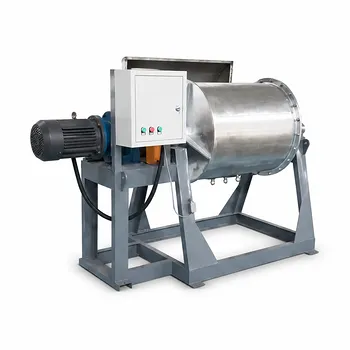
The primary function of a high-energy ball mill in this context is to act as a reactor that delivers intense mechanical energy through high-frequency collisions, grinding, and shearing forces. This energy physically fractures and refines mixed powder raw materials, driving the particle size reduction of nickel down to the nanoscale while simultaneously promoting the formation of new material phases.
By subjecting raw materials to repeated plastic deformation and fracturing, the high-energy ball mill transforms kinetic energy into the physical and chemical changes required to produce spherical nickel nanopowders.
Mechanisms of Action
Generating Mechanical Energy
The core operation revolves around the movement of grinding balls within the mill. As the mill rotates, it generates high-frequency collisions between the balls and the nickel precursors.
Shearing and Grinding Forces
Beyond simple impact, the process creates significant shearing and friction forces. These forces act to tear apart the bulk material structure rather than just crushing it.
Fracturing and Refinement
The combination of impact and shear leads to the continuous fracturing of the powder particles. This effectively refines micron-sized raw materials into significantly smaller nanometer-scale particles.
Physical and Chemical Transformations
Plastic Deformation
Before fracturing, the intense mechanical action causes repeated plastic deformation of the nickel powder. This deformation is critical for breaking down the material's internal structure and preparing it for size reduction.
Introduction of Lattice Defects
The high mechanical energy does more than change the shape; it introduces lattice defects into the nickel structure. These defects increase the internal energy of the material, enhancing the reaction activity of the resulting nanoparticles.
Phase Formation
The mechanical energy supplied is sufficient to trigger chemical changes alongside physical ones. It promotes the formation of new phases, allowing for the synthesis of specific spherical nickel nanopowders that might not form under low-energy conditions.
Understanding the Trade-offs
Risk of Contamination
Because the process relies on violent collisions between grinding media and the powder, there is an inherent risk of impurity introduction. Material from the grinding balls or the jar liner can erode and mix with the nickel nanoparticles.
Crystalline Structure Alteration
While lattice defects enhance reactivity, excessive milling can lead to unwanted amorphization. If the goal is a highly crystalline structure, the intensity and duration of the milling must be carefully balanced to avoid destroying the crystal lattice entirely.
Agglomeration Management
The high energy involved can sometimes cause particles to cold weld or agglomerate rather than fracture. This counteracts the goal of size reduction and requires precise control over process parameters to prevent.
Making the Right Choice for Your Goal
When employing high-energy ball milling for nickel synthesis, align your process parameters with your specific material requirements:
- If your primary focus is particle size reduction: Maximize the collision frequency and shearing forces to prioritize the fracturing of the nickel precursors into spherical nanopowders.
- If your primary focus is enhanced chemical reactivity: Optimize the milling time to introduce sufficient lattice defects without degrading the material into a completely amorphous state.
Ultimately, the high-energy ball mill serves as the fundamental engine for converting bulk mechanical force into precise nanoscale structural refinement.
Summary Table:
| Mechanism | Action Description | Impact on Nickel Nanoparticles |
|---|---|---|
| High-Frequency Collisions | Grinding balls impact precursors at high speeds. | Drives physical fracturing and size reduction to nanoscale. |
| Shearing & Friction | Tearing forces applied to material structures. | Refines particle morphology into spherical shapes. |
| Plastic Deformation | Repeated reshaping of the powder particles. | Increases internal energy and introduces lattice defects. |
| Phase Formation | Mechanical energy triggers chemical changes. | Promotes the synthesis of new, highly reactive material phases. |
Elevate Your Nanomaterial Synthesis with KINTEK
Precision at the nanoscale requires equipment that can withstand the rigors of high-energy mechanical alloying. KINTEK specializes in advanced crushing and milling systems, providing high-performance high-energy ball mills designed to optimize particle size reduction while minimizing contamination risk.
Whether you are synthesizing nickel nanopowders, developing battery research materials, or exploring new alloy phases, our comprehensive portfolio—including planetary ball mills, milling media (PTFE, Ceramics, Zirconia), and hydraulic pellet presses—ensures your lab achieves consistent, repeatable results.
Ready to refine your material processing? Contact KINTEK today for expert guidance and custom laboratory solutions!
References
- Md. RAKIB HASSAN, SNAHASISH BHOWMIK. Synthesis and Applications of Nickel Nanoparticles (NiNPs)- Comprehensive Review. DOI: 10.22147/juc/190102
This article is also based on technical information from Kintek Solution Knowledge Base .
Related Products
- High Energy Planetary Ball Mill Milling Machine for Laboratory
- High Energy Planetary Ball Mill Milling Machine for Laboratory
- High Energy Planetary Ball Mill for Laboratory Horizontal Tank Type Milling Machine
- High-Energy Omnidirectional Planetary Ball Mill Milling Machine for Laboratory
- High Energy Vibratory Ball Mill for Lab Use
People Also Ask
- How does a planetary ball mill provide mechanical activation for scandium recovery? Maximize Your Leaching Efficiency
- What role do planetary ball mills and zirconia media play in LLZT preparation? Optimize Your Solid Electrolyte Research
- What is the function of a planetary ball mill in the preparation of high-entropy rare earth silicate multi-phase ceramics?
- What is the purpose of using a planetary ball mill for cathode material regeneration? Achieve Atomic-Level Mixing
- What is the primary function of a planetary ball mill? Mastering SiC/Al Composite Mixing for Homogeneity