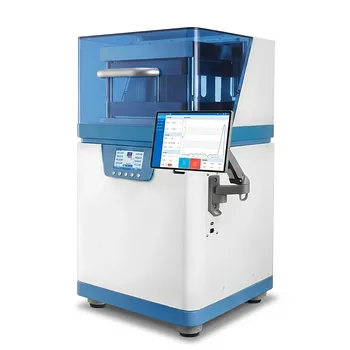
In the production of bucky nanodiamond (ND) catalysts, the high-temperature high-pressure reactor is the essential tool for post-synthesis purification.
Its primary function is to facilitate the chemical treatment of nanodiamonds with strong oxidizing acids following their initial detonation synthesis. By creating a controlled, high-energy environment, the reactor allows these acids to efficiently strip away non-diamond carbon impurities and prepare the diamond surface for further modification.
Core Takeaway: The high-temperature high-pressure reactor serves as a purification and functionalization vessel that removes amorphous carbon and introduces critical oxygen-containing groups to the nanodiamond surface, providing the necessary foundation for high-performance catalyst development.
The Role of the Reactor in Nanodiamond Purification
Removing Surface Amorphous Carbon
The initial detonation synthesis of nanodiamonds often leaves a layer of amorphous carbon or soot on the diamond core. The high-temperature high-pressure (HTHP) reactor enables the use of strong oxidizing acids, such as nitric and sulfuric acids, to chemically "burn away" these impurities. Without this step, the nanodiamonds would lack the purity required for sensitive catalytic applications.
Introducing Surface Functional Groups
Beyond simple cleaning, the reactor environment induces the formation of oxygen-containing functional groups on the nanodiamond surface. These groups are vital because they serve as the chemical "anchors" for subsequent thermal modifications or the attachment of other active catalytic components. This process transforms a raw carbon byproduct into a sophisticated catalytic precursor.
Establishing a Foundation for Thermal Modification
Purification in the reactor is not the final step, but the most critical one for surface engineering. By standardizing the surface chemistry through high-pressure oxidation, the reactor ensures that the nanodiamonds respond predictably to later stages of synthesis. This uniformity is what eventually allows for the creation of the "bucky" shell (graphitic layers) in bucky nanodiamonds.
The Physics of the Reaction Environment
Exceeding Atmospheric Boiling Points
The sealed environment of the reactor allows solvents and acids to remain in a liquid state at temperatures far exceeding their standard boiling points. This increased thermal energy significantly accelerates reaction rates, allowing the purification process to reach completion much faster than at atmospheric pressure.
Enhancing Chemical Reactivity
High pressure increases the collision frequency between the acid molecules and the carbon impurities. This creates a highly aggressive oxidative environment that can break down resilient non-diamond carbon structures that would otherwise remain stable.
Ensuring Uniform Treatment
The pressurized hydrothermal or solvothermal conditions within the reactor ensure that the acids permeate the nanodiamond aggregates thoroughly. This results in uniform nucleation and growth of functional groups across the entire batch, preventing the inconsistencies common in open-vessel processing.
Understanding the Trade-offs and Risks
Equipment Corrosion and Longevity
The combination of high pressure, high temperature, and strong acids is extremely taxing on hardware. Reactors must be constructed from specialized, corrosion-resistant alloys or lined with inert materials like PTFE to prevent the vessel itself from contaminating the catalyst.
Safety and Pressure Management
Operating at high pressures introduces significant safety risks that require rigorous monitoring and pressure-relief systems. Any failure in the seal or temperature control can lead to rapid depressurization, which is a primary concern in industrial scaling.
Risk of Over-Oxidation
While the goal is to remove amorphous carbon, excessive time or temperature in the reactor can lead to the degradation of the diamond core itself. Precise control over the reaction parameters is necessary to balance effective cleaning with the preservation of the nanodiamond’s structural integrity.
How to Apply This to Your Process
When integrating a high-temperature high-pressure reactor into your catalyst synthesis workflow, focus your parameters based on your specific material requirements.
- If your primary focus is Maximum Surface Purity: Prioritize longer residence times at moderate temperatures to ensure the complete removal of amorphous carbon without etching the diamond core.
- If your primary focus is High Functional Group Density: Utilize higher pressures and concentrated nitric acid to maximize the introduction of oxygen-containing groups for subsequent grafting.
- If your primary focus is Industrial Throughput: Optimize for the highest safe temperature allowed by your reactor's lining to accelerate the reaction rate and minimize batch cycle times.
Mastering the high-pressure environment is the definitive step in transforming raw detonation soot into a high-value, functionalized bucky nanodiamond catalyst.
Summary Table:
| Feature | Function in Catalyst Preparation |
|---|---|
| Purification | Removes amorphous carbon soot via strong acid oxidation |
| Functionalization | Introduces oxygen-containing groups for chemical anchoring |
| High-Energy Environment | Exceeds boiling points to accelerate reaction rates |
| Surface Engineering | Creates a uniform foundation for the "bucky" graphitic shell |
| Consistency | Ensures uniform acid permeation throughout nanodiamond aggregates |
Elevate Your Nanomaterial Synthesis with KINTEK
Precise control over high-pressure environments is the key to transforming raw detonation soot into high-value catalysts. KINTEK specializes in advanced laboratory equipment designed to withstand the most aggressive chemical conditions.
Whether you are purifying nanodiamonds or engineering complex surface chemistries, our high-temperature high-pressure reactors and autoclaves offer the durability and safety you need. From corrosion-resistant PTFE linings to sophisticated pressure management systems, we provide the tools that ensure uniform results and protect your research investment.
Ready to optimize your bucky nanodiamond production?
Contact KINTEK Today to explore our range of reactors, hydrothermal solutions, and high-performance consumables.
References
- Liyun Zhang, Zhen‐An Qiao. Metal‐Free Catalytic Reduction of 4‐Nitrophenol to 4‐Aminophenol by <i>sp</i><sup>3</sup>@<i>sp</i><sup>2</sup>‐Hybridized Bucky Nanodiamond. DOI: 10.1002/aesr.202200190
This article is also based on technical information from Kintek Solution Knowledge Base .
Related Products
- Customizable Laboratory High Temperature High Pressure Reactors for Diverse Scientific Applications
- High Pressure Laboratory Autoclave Reactor for Hydrothermal Synthesis
- Mini SS High Pressure Autoclave Reactor for Laboratory Use
- Stainless High Pressure Autoclave Reactor Laboratory Pressure Reactor
- Customizable High Pressure Reactors for Advanced Scientific and Industrial Applications
People Also Ask
- How do high-pressure and high-temperature reactors ensure the effective treatment of lignocellulosic wastewater in WAO?
- What equipment is required for high-pressure high-temperature reactions? Master Extreme Chemistry Safely
- How do you control high pressure in a reactor? A Guide to Safe & Stable Operation
- How does initial oxygen pressure affect the wet oxidation of pharmaceutical sludge? Master Your Oxidation Depth
- Why is argon better than nitrogen for inert atmosphere? Ensure Absolute Reactivity & Stability