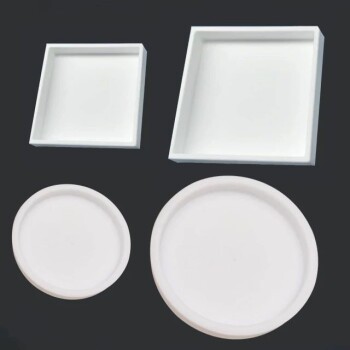
In the solvothermal synthesis of Gallium MIL-53, a PTFE-lined high-pressure reactor serves as a critical reaction vessel that facilitates the controlled self-assembly of metal ions and organic ligands. By creating a sealed, high-pressure environment, it allows solvents to reach temperatures far exceeding their normal boiling points while remaining in a liquid state. This specific condition is essential for increasing precursor solubility and ensuring the formation of highly crystalline Metal-Organic Frameworks (MOFs).
The primary function of a PTFE-lined reactor is to maintain a chemically inert, high-pressure environment that overcomes solubility barriers. This enables the precise thermodynamic conditions required for the nucleation and growth of high-purity, crystalline materials.
The Role of Autogenous Pressure in MOF Synthesis
Overcoming Solubility Barriers
The reactor provides a sealed environment where heating generates autogenous pressure, allowing solvents like methanol or NMP to remain liquid well above their boiling points. This environment significantly increases the solubility of reactants, such as 1,4-benzenedicarboxylic acid, which might otherwise remain insoluble.
Driving Nucleation and Growth
High-pressure conditions provide the necessary energy to drive the nucleation and growth of MOF crystals. This energy helps overcome the kinetic barriers of supramolecular assembly, ensuring that metal ions and ligands bond in an ordered, repeating lattice.
Achieving High Crystallinity
By maintaining a stable, high-temperature environment (often between 160°C and 200°C), the reactor ensures high-crystallinity. This controlled environment allows for the slow, precise formation of the Gallium MIL-53 structure rather than a disordered amorphous solid.
The Critical Importance of the PTFE Liner
Protection Against Corrosion
The Polytetrafluoroethylene (PTFE) liner is essential for its exceptional chemical inertness and resistance to aggressive organic solvents and acidic solutions. It protects the stainless steel outer shell of the autoclave from corrosive attack during long-duration synthesis cycles.
Ensuring Chemical Purity
Without a liner, corrosive reactants could leach metal ions from the reactor walls, introducing impurities into the MOF structure. The PTFE liner acts as a barrier, ensuring the structural integrity and purity of the resulting Gallium MIL-53 crystals.
Facilitating a Reliable Seal
PTFE liners are designed to fit precisely within the reactor jacket, helping to create a reliable seal under high heat. This seal is what allows the system to generate and maintain the internal pressure required for the solvothermal process to succeed.
Understanding the Trade-offs and Limitations
Temperature Constraints of PTFE
While PTFE is highly non-reactive, it has a physical limit; it generally cannot be used at temperatures exceeding 250°C without risking deformation or decomposition. For synthesis requiring higher temperatures, alternative liners like PPL (Polyphenylene polymers) or quartz may be necessary.
Pressure Safety and Filling Ratios
The amount of solvent added—the filling ratio—is a critical safety factor that determines the internal pressure. Overfilling a reactor can lead to dangerous pressure spikes that exceed the mechanical limits of the stainless steel jacket, leading to equipment failure.
Thermal Lag in Heating
The combination of a thick stainless steel jacket and a PTFE liner creates thermal insulation, meaning the internal reaction temperature may lag behind the external furnace setting. Users must account for this delay to ensure the precursors spend the required amount of time at the target synthesis temperature.
How to Apply This to Your Project
Making the Right Choice for Your Goal
- If your primary focus is high-purity MOF production: Always ensure the PTFE liner is free of scratches or residue from previous reactions to prevent cross-contamination.
- If your primary focus is rapid crystal growth: Utilize the highest safe temperature within the PTFE limit (typically 180°C-200°C) to maximize the reaction rate and precursor solubility.
- If your primary focus is structural uniformity: Maintain a consistent filling ratio (usually 50-70%) to ensure reproducible autogenous pressure across different synthesis batches.
By mastering the balance of pressure, temperature, and chemical inertness, researchers can reliably synthesize complex materials like Gallium MIL-53 with high precision and purity.
Summary Table:
| Key Feature | Primary Function | Benefit for MOF Synthesis |
|---|---|---|
| PTFE Liner | Chemical inertness | Prevents corrosion and metal ion contamination |
| Autogenous Pressure | Maintains liquid phase | Increases precursor solubility and drives nucleation |
| High Temp Seal | Precise thermodynamics | Ensures high crystallinity and stable crystal growth |
| SS Jacket | Mechanical strength | Safely contains high internal pressures |
Elevate Your MOF Synthesis with KINTEK Precision
Reliable solvothermal synthesis of materials like Gallium MIL-53 requires equipment that guarantees both safety and chemical purity. KINTEK specializes in premium high-temperature high-pressure reactors and autoclaves designed specifically for the rigorous demands of material science and chemical engineering.
From high-performance PTFE and PPL liners to our robust stainless steel jackets, we provide the tools needed to achieve exceptional crystallinity and structural integrity. Our comprehensive portfolio also includes crushing and milling systems, hydraulic presses, and specialized cooling solutions to ensure a seamless and efficient laboratory workflow for your most sensitive research.
Ready to achieve high-purity results and superior material performance? Contact KINTEK today to discover the perfect reactor solution for your laboratory!
References
- A. R. Bonity J. Lutton‐Gething, Martin P. Attfield. Breathing Behaviour Modification of Gallium MIL‐53 Metal–Organic Frameworks Induced by the Bridging Framework Inorganic Anion. DOI: 10.1002/chem.202203773
This article is also based on technical information from Kintek Solution Knowledge Base .
Related Products
- Custom PTFE Teflon Parts Manufacturer for Hydrothermal Synthesis Reactor Polytetrafluoroethylene Carbon Paper and Carbon Cloth Nano-growth
- Custom PTFE Teflon Parts Manufacturer for Reagent Wide Mouth Fine Mouth Sample High Temperature Bottles
- Stainless High Pressure Autoclave Reactor Laboratory Pressure Reactor
- Customizable High Pressure Reactors for Advanced Scientific and Industrial Applications
- Custom PTFE Teflon Parts Manufacturer for Microwave Digestion Tank
People Also Ask
- What is the function of a PTFE reactor in MXene etching? Ensure Safe, High-Purity MAX Phase Conversion
- Why is a PTFE reactor required for titanium-based nano-ceramic coating solutions? Ensure Chemical Inertness & Purity
- Why must a Polytetrafluoroethylene (PTFE) reactor be used for Ti3C2TX MXene etching? Ensure Safety and Purity
- Why are PTFE reactors preferred for silver phosphate glass testing? Ensure Purity and Kinetic Accuracy
- What are the advantages of using polytetrafluoroethylene (PTFE) liners in hydrothermal synthesis reactors? High Purity