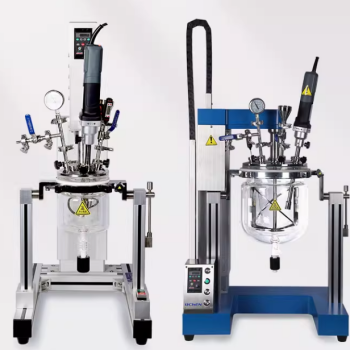
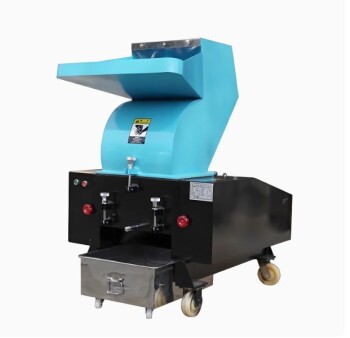
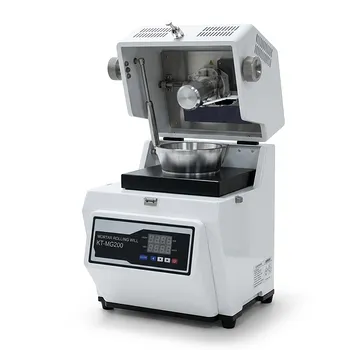
The primary function of mechanical mixing equipment in the pretreatment of C-SiC-B4C composites is to achieve the long-term, uniform dispersion of flake graphite, SiC, B4C, and TiO2 powders. By physically integrating these components, the equipment ensures that sintering additives and reinforcing phases are distributed consistently throughout the matrix, rather than clumping in isolated areas.
Mechanical mixing serves as the foundational step for quality control, preventing component segregation to ensure the final material achieves a homogeneous microstructure and stable mechanical properties during sintering.
Achieving Microstructural Homogeneity
Dispersion of Constituent Powders
The specific goal of this equipment is to blend diverse materials—specifically flake graphite, Silicon Carbide (SiC), Boron Carbide (B4C), and Titanium Dioxide (TiO2)—into a single, cohesive unit.
Distributing Reinforcing Phases
The mixing process must ensure that the reinforcing phases (SiC and B4C) are not clustered.
Uniform distribution is essential so that the physical benefits of these hard materials are felt evenly throughout the final composite.
Integration of Sintering Additives
The equipment is also responsible for dispersing sintering additives like TiO2.
Consistent placement of these additives is required to facilitate the chemical reactions and bonding that occur during the subsequent heating phases.
Preventing Material Defects
Eliminating Local Segregation
The most critical role of mechanical mixing is the prevention of local component segregation.
If powders separate or settle unevenly, the final composite will develop weak points where the ratio of carbon to ceramic is incorrect.
Establishing the Sintering Foundation
Proper mixing creates the necessary conditions for successful sintering.
Without a strictly homogeneous mixture in the pretreatment phase, the microstructure obtained after firing will be inconsistent, leading to unpredictable mechanical failure.
Understanding the Trade-offs
Process Precision vs. Throughput
While mechanical mixing is vital, it requires precise calibration to achieve "long-term" dispersion.
Rushing this phase to increase throughput often leads to micro-segregation, which may not be visible until the material fails under stress.
Homogeneity vs. Particle Integrity
The equipment must mix thoroughly enough to disperse additives but must be controlled to maintain the desired characteristics of the flake graphite.
Over-aggressive mixing can potentially alter the morphology of the components, while under-mixing fails to create a stable matrix foundation.
Ensuring Process Success
To maximize the effectiveness of the pretreatment phase for C-SiC-B4C composites:
- If your primary focus is Structural Integrity: Prioritize mixing duration and intensity to guarantee the complete prevention of local component segregation.
- If your primary focus is Sintering Efficiency: Ensure the TiO2 sintering additives are perfectly distributed to promote uniform densification during the heating cycle.
Mechanical mixing is not merely a preparation step; it is the quality gate that determines the ultimate reliability of the composite material.
Summary Table:
| Key Component | Role in Mixing Process | Impact on Final Composite |
|---|---|---|
| Powder Dispersion | Uniformly blends flake graphite, SiC, B4C, and TiO2 | Ensures consistent material density |
| Phase Distribution | Prevents clustering of reinforcing phases | Eliminates weak points and structural defects |
| Additive Integration | Evenly disperses sintering additives (TiO2) | Facilitates uniform chemical bonding and densification |
| Defect Prevention | Eliminates local component segregation | Provides stable mechanical properties and reliability |
Elevate Your Composite Material Research with KINTEK
Achieving the perfect dispersion in C-SiC-B4C composites requires precision tools. KINTEK specializes in advanced laboratory equipment designed to meet the rigorous demands of material science. From high-performance crushing and milling systems to precision sieving equipment and high-temperature furnaces, we provide the end-to-end solutions you need for perfect pretreatment and sintering.
Whether you are a researcher or an industrial manufacturer, our expert team is ready to help you optimize your microstructure homogeneity and material reliability.
Ready to enhance your lab's performance? Contact KINTEK Today to discover our comprehensive range of milling systems, hydraulic presses, and high-temperature reactors.
Related Products
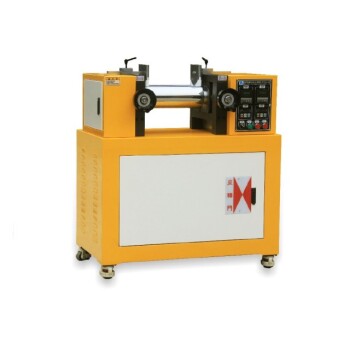
- Open Type Two Roll Mixing Mill Machine for Rubber Crusher
- Laboratory Disc Rotary Mixer for Efficient Sample Mixing and Homogenization
- Laboratory Vortex Mixer Orbital Shaker Multifunctional Rotation Oscillation Mixer
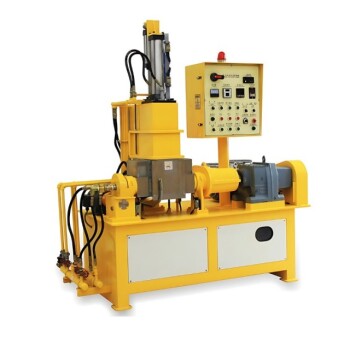
- Lab Internal Rubber Mixer Rubber Kneader Machine for Mixing and Kneading
- Laboratory Oscillating Orbital Shaker
People Also Ask
- What is a two roll mill for rubber compounding? A Foundational Tool for Polymer Processing
- What is the use of two roll mill? Essential for Polymer Mixing, R&D, and Quality Control
- What is the two roll mill mixing process? Master Polymer Compounding with High Shear
- What is the disadvantage of a two-roll mill? Limited Thickness Reduction Due to Roll Flattening
- What are the advantages of a two roll mill? Achieve Superior Polymer Mixing & Quality Control