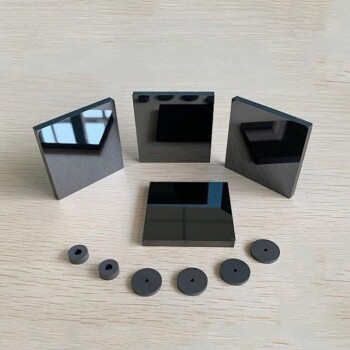
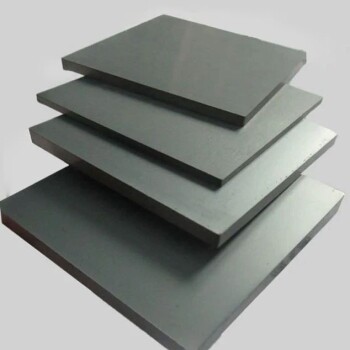
The primary purpose of using high-mesh Silicon Carbide (SiC) grinding paper is to achieve exceptional surface flatness and extremely low roughness.
In the context of diffusion bonding for austenitic iron-based alloys, using fine abrasives—specifically around 4000 mesh—is critical for removing microscopic irregularities. This rigorous preparation ensures that the mating surfaces can establish tight physical contact under pressure, effectively eliminating gaps that would otherwise prevent the bonding process from initiating.
Core Takeaway Diffusion bonding relies on atomic proximity, not melting. High-mesh SiC grinding creates the necessary surface conditions to eliminate voids, allowing for effective atomic diffusion and grain boundary migration—the fundamental mechanisms required to form a high-quality, seamless joint.
The Mechanics of Surface Preparation
Achieving Tight Physical Contact
The success of diffusion bonding is dictated by the interface between the two materials. Unlike welding, which melts the base metal to fill gaps, diffusion bonding requires solid-state contact.
If the surfaces are not perfectly flat, they will only touch at the highest points (asperities). High-mesh grinding removes these high points, maximizing the contact area when the parts are compressed.
Eliminating Surface Irregularities
Microscopic peaks and valleys on a metal surface act as barriers to bonding. Even under high pressure, deep valleys can remain as voids or air pockets.
Using 4000 mesh SiC paper acts as a finishing step to level these irregularities. This ensures that the interface is uniform, preventing defects that would compromise the structural integrity of the final part.
Facilitating the Bonding Mechanism
Promoting Effective Atomic Diffusion
For a bond to form, atoms must move (diffuse) across the interface to intermingle with the mating material.
This process is distance-dependent. By minimizing roughness, you reduce the distance between atoms on opposing surfaces, enabling them to diffuse freely at high temperatures.
Enabling Grain Boundary Migration
A high-quality diffusion joint often becomes indistinguishable from the base metal. This occurs through grain boundary migration, where the crystalline structure re-aligns across the original seam.
Rough surfaces interrupt this migration. Proper preparation with high-mesh SiC ensures the boundary is conducive to this movement, resulting in a stronger, more homogeneous joint.
Common Pitfalls in Preparation
The Risk of Coarse Grinding
It is often tempting to stop surface preparation at a lower mesh (e.g., 600 or 1000 mesh) to save time. However, this is a critical error in diffusion bonding.
Coarse grinding leaves deeper scratches that pressure cannot close. These scratches become permanent voids in the joint, acting as stress concentrators that significantly weaken the final assembly.
The Necessity of Flatness
Smoothness alone is not enough; the part must also be macroscopically flat.
If a part is polished to a mirror finish but has a wavy surface profile, large gaps will still exist. The grinding process must focus on maintaining planarity to ensure the entire surface mates evenly.
Making the Right Choice for Your Goal
To ensure the success of your diffusion bonding process, consider the following regarding surface preparation:
- If your primary focus is Joint Strength: Ensure you finish with high-mesh (e.g., 4000 mesh) SiC paper to maximize atomic contact and grain migration.
- If your primary focus is Process Reliability: Do not shortcut the grinding stage; surface irregularities are the leading cause of voids and unbonded areas.
Meticulous surface preparation is the non-negotiable prerequisite for activating the atomic mechanisms that create a successful diffusion bond.
Summary Table:
| Preparation Factor | Impact on Diffusion Bonding | Recommended Specification |
|---|---|---|
| Abrasive Type | Silicon Carbide (SiC) | High-Mesh (e.g., 4000) |
| Surface Finish | Minimizes microscopic asperities | Extremely low roughness |
| Planarity | Ensures uniform mating area | High Macroscopic Flatness |
| Bonding Mechanism | Facilitates atomic diffusion | Gap-free interface |
| Joint Quality | Prevents voids and stress points | Homogeneous grain structure |
Elevate Your Material Research with KINTEK Precision
Achieving the perfect diffusion bond starts with the right equipment and consumables. At KINTEK, we specialize in providing high-performance laboratory solutions tailored for advanced metallurgy and material science.
Whether you are preparing austenitic alloys with our high-quality SiC grinding papers or performing the bonding process in our state-of-the-art high-temperature vacuum furnaces and hydraulic presses, we ensure your lab achieves superior results. From crushing and milling systems to high-pressure reactors and specialized ceramics/crucibles, our comprehensive portfolio supports every stage of your research.
Ready to eliminate bonding defects and enhance your joint integrity? Contact our technical experts today to discover how KINTEK's premium laboratory equipment can optimize your workflow.
References
- Sunghwan Kim, Injin Sah. Microstructure and Tensile Properties of Diffusion Bonded Austenitic Fe-Base Alloys—Before and After Exposure to High Temperature Supercritical-CO2. DOI: 10.3390/met10040480
This article is also based on technical information from Kintek Solution Knowledge Base .
Related Products
- Silicon Carbide (SIC) Ceramic Sheet Wear-Resistant Engineering Advanced Fine Ceramics
- Silicon Carbide (SIC) Ceramic Plate for Engineering Advanced Fine Ceramics
People Also Ask
- What is the strongest ceramics? Silicon Carbide Leads in Hardness & Thermal Strength
- What are the properties and applications of silicon carbide ceramics? Solve Extreme Engineering Challenges
- What are the uses of silicon carbide ceramics in different industries? Master Extreme Performance in Aerospace, Semiconductors & More
- What are the properties of SiC? Unlock High-Temperature, High-Frequency Performance
- What are the applications of silicon carbide? From Abrasives to High-Tech Semiconductors