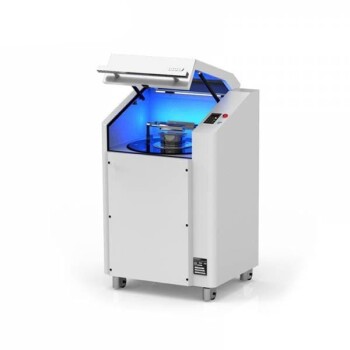
The primary purpose of implementing forward/reverse rotation and pause intervals is to ensure material homogeneity and prevent thermal degradation during high-energy milling. These settings facilitate multi-directional impacts to eliminate "dead zones" within the grinding jar while providing a critical cooling window to protect the structural integrity of the sample.
Core Takeaway: By alternating rotation and integrating timed pauses, operators can achieve a uniform particle size distribution and maintain mechanical alloying conditions without the risk of localized melting or material accumulation.
Enhancing Grinding Efficiency Through Rotation Control
Overcoming Material Accumulation
In a standard planetary ball mill, centrifugal and gravitational forces can cause material to stick to the jar walls or accumulate in specific areas. Forward and reverse rotation breaks these patterns by constantly shifting the flow of the grinding media and the sample.
This mechanical reversal ensures that all materials are subjected to consistent, high-energy impacts. It prevents the formation of "dead zones" where material might otherwise remain unprocessed.
Promoting Homogeneity and Mixing
Achieving a uniform final powder requires intensive mixing throughout the milling cycle. Periodically reversing the direction of the turntable forces particles to interact from multiple vectors, significantly increasing mixing efficiency.
This is especially critical for metal powders and biochar, where a high degree of homogeneity is required for consistent performance. Multi-directional impacts ensure that the alloying process occurs evenly across the entire sample volume.
Maintaining Grinding Media Integrity
Planetary ball mills often feature automatic reversal mechanisms to promote even wear on the grinding balls. If the mill rotates in only one direction, the grinding media can develop flat spots or uneven surfaces over time.
By alternating the direction, the wear is distributed across the entire surface of the balls. This maintains their spherical shape, which is essential for maintaining high grinding efficiency over long durations.
Thermal Management and Sample Protection
Dissipating Mechanical Heat
High-energy milling generates substantial heat through friction and impact. Pause intervals (such as a five-minute stop every hour) provide the necessary time for this heat to dissipate from the grinding jar.
Without these pauses, the internal temperature can rise to levels that cause thermal damage to sensitive materials like biochar. Controlled cooling ensures the material's structural performance remains intact.
Driving Solid-State Reactions
In mechanical alloying, the goal is to facilitate the formation of intermetallic compounds through mechanical energy rather than thermal melting. Excessive heat can lead to unwanted phase changes or localized melting of the powder.
Implementing periodic stops ensures that the chemical changes are driven by the kinetic energy of the impact. This allows for the creation of unique alloys that would be impossible to produce through traditional smelting.
Understanding the Trade-offs
Impact on Total Processing Time
While pauses are essential for thermal control, they naturally extend the total duration of the milling process. Operators must find a balance between the cooling requirements of the material and the desired throughput of the lab.
Mechanical Stress on Equipment
Frequent reversals of the rotation direction can place additional strain on the mill’s motor and transmission system. While modern mills are designed for this, constant high-frequency switching may lead to increased maintenance requirements over the long term.
How to Apply This to Your Project
Implementing the correct rotation and pause strategy depends heavily on your material properties and desired outcomes.
- If your primary focus is material uniformity: Use frequent rotation reversals (e.g., every 30-60 minutes) to ensure consistent mixing and eliminate material buildup.
- If your primary focus is temperature-sensitive samples: Prioritize longer or more frequent pause intervals to prevent heat-induced structural damage or phase transitions.
- If your primary focus is mechanical alloying: Utilize shorter milling bursts with mandatory pauses to ensure reactions are driven by impact energy rather than heat.
Mastering the balance between kinetic energy and thermal rest is the key to achieving reproducible, high-quality results in planetary ball milling.
Summary Table:
| Feature | Primary Function | Key Benefit |
|---|---|---|
| Forward/Reverse Rotation | Shifts media flow and eliminates "dead zones" | Ensures material homogeneity and even media wear |
| Timed Pause Intervals | Dissipates mechanical heat generated by friction | Protects samples from thermal degradation and phase changes |
| Multi-directional Impact | Increases particle interaction vectors | Enhances mixing efficiency for alloying and biochar |
| Thermal Management | Controls internal jar temperature | Drives solid-state reactions via kinetic rather than thermal energy |
Elevate Your Material Research with KINTEK Precision
Achieving perfect homogeneity and maintaining sample integrity requires more than just high energy—it requires precise control. KINTEK specializes in high-performance crushing and milling systems, including advanced planetary ball mills designed to handle the most demanding rotation and cooling protocols.
Whether you are working on mechanical alloying, battery research, or advanced ceramics, our comprehensive range of laboratory equipment—from high-temperature furnaces and hydraulic presses to PTFE consumables and cooling solutions—is engineered for reliability and reproducible results.
Ready to optimize your milling process? Contact KINTEK Experts Today to find the perfect equipment and consumable configuration for your laboratory. Let us help you achieve superior particle size distribution and material excellence.
References
- Fei Jiang, Bin Gao. Remarkable synergy between sawdust biochar and attapulgite/diatomite after co-ball milling to adsorb methylene blue. DOI: 10.1039/d3ra01123b
This article is also based on technical information from Kintek Solution Knowledge Base .
Related Products
- High Energy Planetary Ball Mill for Laboratory Horizontal Tank Type Milling Machine
- Laboratory Planetary Ball Mill Rotating Ball Milling Machine
- High-Energy Omnidirectional Planetary Ball Mill Milling Machine for Laboratory
- High Energy Planetary Ball Mill Milling Machine for Laboratory
- Laboratory Horizontal Planetary Ball Mill Milling Machine
People Also Ask
- What is the role of a planetary ball mill in sulfide-based solid-state batteries? Engineer High-Performance Cathodes
- What are the parameters of a planetary ball mill? Master Speed, Time, and Media for Perfect Grinding
- What is the function of a planetary ball mill for nanostructured eutectic steel? Essential Prep for High-Strength Alloys
- What role does a planetary ball mill play in the preparation of NASICON-type solid electrolytes like LATP and LAGP?
- What is the function of a planetary ball mill in solid-state electrolyte prep? Milling vs. SDS Methods Explained