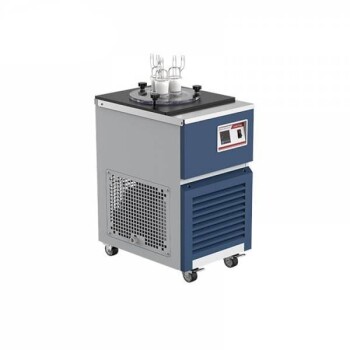
The primary purpose of a condenser in this context is to preserve the chemical integrity of the solution by preventing evaporation loss. In high-temperature or boiling acid experiments, the condenser captures rising vapors and returns them to the vessel via reflux, ensuring the solution volume and concentration remain constant.
High temperatures cause rapid solvent volatilization, which leads to shifting acid concentrations that can invalidate experimental data. By enabling reflux, the condenser maintains the stable chemical environment required for accurate, long-term corrosion performance evaluations.
Maintaining Chemical Stability
Preventing Concentration Drift
When heating acid solutions, particularly nitric acid, solvent volatilization occurs rapidly. Without intervention, water and acid vapors escape, drastically altering the ratio of the remaining solution.
The Mechanism of Reflux
The condenser acts as a barrier to this loss by cooling rising vapors and converting them back into liquid form. This liquid refluxes back into the main vessel, effectively creating a closed-loop cycle that preserves the total volume.
Stabilizing Acidity Levels
By returning the condensate to the bulk solution, the setup maintains a constant acidity. This is critical because even minor fluctuations in pH or concentration can significantly accelerate or decelerate electrochemical reactions.
The Impact on Data Integrity
Ensuring Long-Term Accuracy
Corrosion performance evaluations often require extended observation periods to yield valid data. A condenser ensures that the aggressive nature of the environment remains consistent over time, rather than becoming artificially more corrosive due to evaporation.
Eliminating Environmental Variables
To accurately measure how a material degrades, you must isolate the material's properties from environmental anomalies. The condenser locks in the chemical composition, ensuring that observed changes in current or potential are due to the material's behavior, not solution degradation.
Operational Considerations and Trade-offs
Setup Complexity
Including a condenser adds physical height and fragility to the electrochemical cell. It requires reliable plumbing for cooling water and secure clamping, which increases the complexity of the physical apparatus.
Thermal Homogeneity
While reflux maintains concentration, the return of cooler liquid to a boiling solution can create localized temperature gradients. Proper stirring is essential to ensure the refluxed liquid mixes instantly, preventing cold spots that could skew local electrochemical readings.
Optimizing Your Experimental Design
To ensure your electrochemical measurements are reproducible and valid, consider the following regarding your setup:
- If your primary focus is long-term corrosion monitoring: You must install a condenser to prevent acid concentration spikes that would artificially accelerate corrosion rates and invalidate your data.
- If your primary focus is high-temperature stability: Rely on the condenser to maintain a steady-state boiling environment, allowing you to test under aggressive conditions without depleting your solvent.
Reliable data begins with a stable environment; in high-temperature acid testing, the condenser is the key to that stability.
Summary Table:
| Feature | Function in High-Temp Acid Testing | Impact on Data |
|---|---|---|
| Reflux Mechanism | Captures and returns solvent vapors to the vessel | Maintains constant solution volume and acid concentration |
| Concentration Control | Prevents rapid volatilization of water/acid | Eliminates artificial corrosion rate spikes due to acidity drift |
| Environment Stability | Locks in chemical composition over time | Ensures long-term reproducibility for corrosion performance evaluations |
| Thermal Management | Manages boiling environment steady-state | Isolates material behavior from environmental anomalies |
Secure Your Research Accuracy with KINTEK Precision Solutions
In demanding electrochemical and high-temperature research, environmental stability is the foundation of reliable data. KINTEK specializes in high-performance laboratory equipment designed to withstand aggressive conditions. Whether you are conducting long-term corrosion studies or high-pressure synthesis, we provide the tools you need for success.
Our extensive portfolio includes:
- High-Temperature & High-Pressure Reactors and Autoclaves for stable reaction environments.
- Electrolytic Cells and Specialized Electrodes for precise electrochemical measurements.
- Crushing, Milling, and Sieving Systems for meticulous sample preparation.
- Advanced Cooling Solutions, including chillers and cold traps to support your condenser setups.
Don't let evaporation or equipment failure compromise your results. Contact the experts at KINTEK today to find the perfect solution for your lab’s specific needs.
References
- Masaumi Nakahara, Hitoshi Abe. Electrochemical properties of zirconium in highly concentrated plutonium nitrate solution. DOI: 10.15669/pnst.5.52
This article is also based on technical information from Kintek Solution Knowledge Base .
Related Products
People Also Ask
- Why are precision Condensers and Cold Traps necessary at the collection end of a pyrolysis system? Maximize Yield & Purity
- Why is it necessary to configure efficient cold traps in membrane distillation? Ensure Flux Stability & Data Accuracy
- What is the purpose of connecting a cold trap at the reactor outlet? Protect Equipment and Analyze Liquid Products
- What is the role of glass condensation components in arsenic collection? Optimize Niccolite Roasting & Kinetics
- What is the function of a cold trap in bio-ethanol and methane reforming experiments? Optimize Purity & Protect Systems