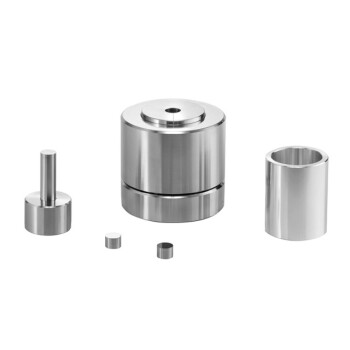
Graphite paper serves as a critical, flexible interface layer utilized primarily to isolate battery powder from the rigid walls of the graphite mold. Its immediate purpose is to prevent the sintered battery sample from adhering to the mold, thereby simplifying the demolding process, while simultaneously compensating for surface irregularities to ensure uniform current and pressure distribution.
Core Takeaway By acting as a sacrificial barrier, graphite paper solves the dual challenge of high-temperature adhesion and mechanical variation. It ensures that the final solid-state battery pellet is chemically pure and structurally uniform, while protecting expensive mold tooling from damage during extraction.
The Role of Isolation and Demolding
Preventing Adhesion and Reaction
During the assembly and sintering of all-solid-state batteries, materials are subjected to high heat and pressure. Without a barrier, the battery powder can chemically react with or physically diffuse into the rigid graphite mold.
Graphite paper acts as a shield, preventing this direct contact. It stops the sample from bonding to the mold walls, which is a common occurrence during processes like Spark Plasma Sintering (SPS).
Simplifying Sample Extraction
The extraction of a sintered pellet is a delicate process. If the sample adheres to the mold, the force required to eject it can crack the brittle ceramic electrolyte or damage the mold itself.
Using graphite paper ensures the sample "slips" out easily. This preserves the structural integrity of your battery sample and significantly reduces the risk of sample fracture during ejection.
Optimizing Sintering Conditions
Compensating for Surface Irregularities
Graphite molds are rigid and may have minor microscopic imperfections or roughness on their inner surfaces. These irregularities can lead to uneven contact points.
Graphite paper is flexible and compressible. It fills these gaps, effectively smoothing out the interface between the powder and the tool.
Ensuring Uniform Distribution
For a solid-state battery to function correctly, the electrolyte and electrode layers must be densified uniformly. Inconsistent pressure or electrical current (in field-assisted sintering) can lead to hotspots or density gradients.
The graphite paper facilitates the uniform transmission of electrical current and mechanical pressure across the entire surface area of the sample. This homogeneity is essential for achieving consistent electrochemical performance.
Protecting the Tooling
Extending Mold Lifespan
Graphite molds are precision tools and are often expensive to replace. Direct contact with reactive powders at high temperatures causes wear and contamination over time.
By absorbing the chemical and mechanical stress of the process, the graphite paper acts as a sacrificial layer. It protects the mold surfaces from degradation, thereby extending the service life of your tooling equipment.
Understanding the Trade-offs
Assembly Precision
While graphite paper offers significant benefits, it introduces an additional step in the assembly process. The paper must be cut and placed with high precision.
If the paper is creased or overlaps incorrectly, it can introduce defects into the battery pellet surface. Poor alignment may also lead to "flashing," where powder squeezes between the paper and the mold wall.
Consumable Costs
Graphite paper is a consumable material. Unlike the mold, which is reusable, the paper is typically discarded after a single use or a few uses.
While individual sheets are inexpensive, for high-volume research or production, this represents a recurring cost and a waste stream that must be managed.
Making the Right Choice for Your Goal
When assembling your cell, consider how the graphite paper aligns with your specific objectives.
- If your primary focus is Sample Integrity: Prioritize the use of graphite paper to prevent micro-cracks caused by adhesion during the demolding phase.
- If your primary focus is Electrochemical Consistency: Ensure the graphite paper is perfectly smooth and fitted to the mold to guarantee uniform pressure and current density during sintering.
- If your primary focus is Equipment Longevity: Use graphite paper strictly to prevent chemical reactions between aggressive powders (like sulfides or oxides) and the mold walls.
The correct application of graphite paper transforms a high-risk sintering process into a reliable, repeatable method for producing high-quality solid-state electrolytes.
Summary Table:
| Function | Primary Benefit | Why It Matters |
|---|---|---|
| Isolation Barrier | Prevents chemical reactions & adhesion | Ensures sample purity and easy demolding |
| Surface Smoothing | Compensates for mold irregularities | Eliminates hotspots and density gradients |
| Force Distribution | Uniform current & pressure transmission | Achieves consistent electrochemical performance |
| Tooling Protection | Reduces mold wear and contamination | Extends the lifespan of expensive graphite molds |
| Mechanical Buffer | Absorbs ejection stress | Prevents micro-cracks in brittle ceramic pellets |
Elevate Your Battery Research with KINTEK Precision Solutions
Precision is the foundation of energy innovation. KINTEK specializes in advanced laboratory equipment and consumables designed for the rigorous demands of all-solid-state battery development. From high-performance graphite molds and paper to sophisticated high-temperature furnaces (CVD, PECVD, vacuum) and hydraulic pellet presses, we provide the tools necessary for uniform densification and superior sample integrity.
Whether you are working with sulfide electrolytes or advanced oxide materials, our comprehensive portfolio—including crushing and milling systems, isostatic presses, and specialized ceramics—ensures your research is repeatable and your results are world-class.
Ready to optimize your sintering process and protect your lab equipment?
Contact KINTEK Today to Explore Our Solutions
Related Products
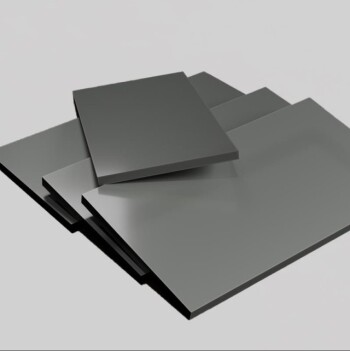
- Carbon Graphite Plate Manufactured by Isostatic Pressing Method
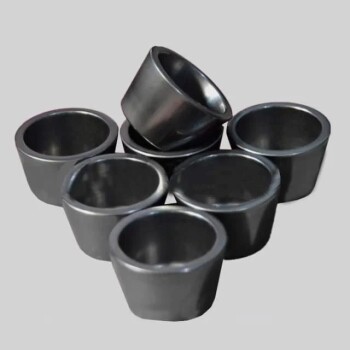
- High Purity Pure Graphite Crucible for Evaporation
- High Purity Pure Graphite Crucible for Electron Beam Evaporation
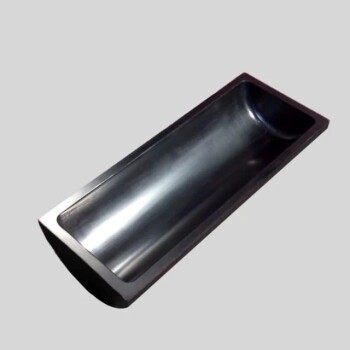
- Carbon Graphite Boat -Laboratory Tube Furnace with Cover
- Vertical High Temperature Graphite Vacuum Graphitization Furnace
People Also Ask
- What is the process of isostatic graphite manufacturing? Achieve Unmatched Material Uniformity and Performance
- What is isostatic graphite? The Ultimate Material for High-Tech and High-Temperature Applications
- What is the density of isostatic graphite? Unlock Superior Performance for Demanding Applications
- How big is the isostatic pressing market? A Deep Dive into the $1.2B+ Advanced Manufacturing Enabler
- Why Use an Isostatic or High-Precision Hydraulic Press for Li/LLZO/Li Batteries? Master Solid-State Interfaces