At its core, an XRF (X-Ray Fluorescence) test is a rapid, non-destructive analytical method used to determine the elemental composition of a material. It works by bombarding a sample with high-energy X-rays and analyzing the unique "fingerprint" of secondary X-rays that the sample emits in response. This allows you to identify which elements are present and in what general concentrations, often in a matter of seconds.
XRF is not just about identifying elements; it's about providing immediate, actionable intelligence on a material's makeup without damaging the object itself. This makes it an invaluable tool for quality control, compliance screening, and rapid field analysis where both speed and sample preservation are critical.
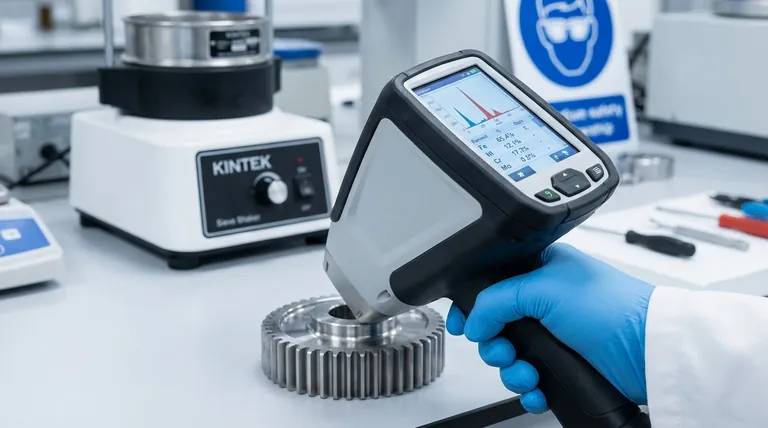
How XRF Translates X-rays into Elemental Data
To trust the results, you must first understand the process. The technique is based on a predictable atomic-level event that acts like a unique signature for each element.
The Fundamental Principle: Excitation and Emission
An XRF analyzer directs a primary X-ray beam at the sample. This beam has enough energy to knock an electron out of one of the inner shells of an atom.
This creates a vacancy, leaving the atom in an unstable, high-energy state. To regain stability, an electron from a higher-energy outer shell immediately drops down to fill the vacancy.
As this electron moves to a lower energy state, it releases a specific amount of energy in the form of a secondary, or fluorescent, X-ray.
Identifying the "Who": Qualitative Analysis
The energy of that emitted fluorescent X-ray is the key. It is unique to the element from which it came. For example, the fluorescent X-ray from an iron atom has a different energy than one from a nickel atom.
A detector inside the XRF instrument measures the energies of all the secondary X-rays coming from the sample. By plotting these energies, the instrument generates a spectrum that serves as a fingerprint, revealing exactly which elements are present.
Measuring the "How Much": Quantitative Analysis
The instrument also counts the number of X-rays detected at each characteristic energy. The intensity, or number of X-rays, for a specific element is generally proportional to the concentration of that element in the sample.
With proper calibration, the software can convert these intensity counts into a percentage or parts-per-million (PPM) concentration, giving you a quantitative breakdown of the material's composition.
Key Applications: Where XRF Delivers Value
The speed and non-destructive nature of XRF make it indispensable across numerous industries for immediate decision-making.
Manufacturing and Quality Control
This is one of XRF's most common uses. A handheld analyzer can instantly verify the grade of stainless steel, confirm the composition of an incoming metal alloy, or measure the thickness of a zinc coating on steel. It prevents incorrect materials from entering the production stream.
Environmental and Geological Screening
In the field, geologists use portable XRF to analyze rock or soil samples for mineral content, guiding exploration and mining efforts. Environmental consultants use it to screen sites for heavy metal contamination like lead, arsenic, and mercury.
Regulatory Compliance (RoHS)
The Restriction of Hazardous Substances (RoHS) directive limits the use of specific materials like lead, cadmium, and mercury in electronics. XRF is the frontline screening tool used by manufacturers to ensure their components and final products are compliant.
Cultural Heritage and Forensics
Because XRF is non-destructive, it is perfect for analyzing irreplaceable items. Museums use it to identify the pigments in a historical painting or determine the metallic composition of an ancient coin without causing any damage.
Understanding the Trade-offs and Limitations
No technique is perfect. Understanding XRF's limitations is just as important as knowing its strengths to avoid misinterpreting data.
It's a Surface-Level Technique
XRF analysis only penetrates a very shallow depth into the material, typically from a few micrometers to a few millimeters, depending on the sample's density. If you are analyzing a plated object or a corroded part, the XRF will primarily report the composition of the surface layer, not the bulk material underneath.
Difficulty with Lighter Elements
Standard XRF analyzers struggle to detect very light elements (those with low atomic numbers, like lithium, beryllium, carbon, and sodium). The low-energy fluorescent X-rays they produce are often absorbed by the air or the instrument's own detector window before they can be measured.
The Challenge of Matrix Effects
The X-ray signal from a target element can be absorbed or enhanced by the other elements present in the sample matrix. Accurate quantitative analysis, especially in complex alloys, requires sophisticated software corrections and careful calibration to compensate for these matrix effects.
Not for Ultra-Trace Analysis
While excellent for identifying elements from 100% down to the parts-per-million (PPM) range, XRF is generally not the right tool for detecting elements at the parts-per-billion (PPB) level. For such ultra-trace analysis, more sensitive (and destructive) lab methods like ICP-MS are required.
Making the Right Choice for Your Goal
To apply XRF correctly, match the tool to your specific objective.
- If your primary focus is rapid quality control or alloy sorting: A handheld XRF provides instant pass/fail results directly on the factory floor or in the field.
- If your primary focus is precise, certified compositional analysis: Lab-based XRF on a properly prepared (e.g., ground and pelletized) homogenous sample is necessary for high-accuracy quantitative results.
- If your primary focus is detecting hazardous substances for compliance (like RoHS): XRF is the industry-standard screening tool to quickly check for restricted heavy metals.
- If your primary focus is analyzing precious or irreplaceable items: The non-destructive nature of XRF makes it the ideal choice for analyzing artifacts, artwork, and historical objects.
Ultimately, understanding both the power and the boundaries of XRF allows you to leverage it effectively as a strategic diagnostic tool.
Summary Table:
| Feature | Benefit |
|---|---|
| Non-Destructive | Preserves sample integrity; ideal for artifacts and finished goods. |
| Rapid Analysis | Delivers results in seconds for immediate decision-making. |
| Elemental Identification | Identifies and quantifies elements from ppm levels to 100%. |
| Portable Options | Handheld analyzers enable on-site testing in the field or factory. |
| Wide Application | Used in manufacturing, geology, environmental science, and cultural heritage. |
Ready to harness the power of XRF analysis for your laboratory?
KINTEK specializes in providing high-quality lab equipment, including XRF analyzers and consumables, to meet your precise analytical needs. Whether you require rapid alloy verification, compliance screening, or non-destructive material analysis, our solutions deliver the accuracy and reliability you demand.
Contact us today using the form below to discuss how our expertise can enhance your laboratory's capabilities and efficiency. Let KINTEK be your trusted partner in analytical excellence.
Visual Guide

Related Products
- Laboratory Test Sieves and Vibratory Sieve Shaker Machine
- Three-dimensional electromagnetic sieving instrument
- Custom PTFE Teflon Parts Manufacturer for PTFE Tweezers
- Custom PTFE Wafer Holders for Lab and Semiconductor Processing
- Laboratory High Pressure Horizontal Autoclave Steam Sterilizer for Lab Use
People Also Ask
- What is the operating procedure of a sieve shaker? Master Accurate Particle Size Analysis
- What can be separated by sieving? A Guide to Particle Size Separation for Various Materials
- Can sieving be used to separate a solid substance from a liquid substance? Learn the Right Technique for Your Mixture
- What are the advantages and disadvantages of sieve analysis? A Guide to Cost-Effective Particle Sizing
- What are the different methods of sieving? Choose the Right Technique for Your Material