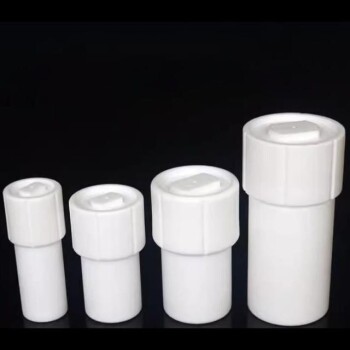
A high-pressure digestion tank creates a controlled, sealed environment designed to sustain elevated temperatures and pressures during chemical synthesis. This specific environment forces reaction solvents into a subcritical state, which dramatically enhances the solubility and reactivity of the precursor components used to build open-framework materials.
Core Takeaway The high-pressure digestion tank is not merely a container; it is a thermodynamic tool that enables the solubility and crystal growth necessary for high-quality Metal-Organic Frameworks (MOFs) and Covalent Organic Frameworks (COFs), while simultaneously ensuring chemical purity through corrosion-resistant linings.
The Mechanics of Enhanced Synthesis
To understand the value of this equipment, one must look beyond simple containment and understand the thermodynamic changes it induces.
Achieving the Subcritical State
The primary function of the tank is to allow reaction solvents to reach a subcritical state.
In a standard open vessel, solvents boil off at specific temperatures.
However, the sealed nature of the digestion tank traps pressure, allowing the solvent to remain liquid at temperatures far exceeding its normal boiling point.
Enhancing Precursor Reactivity
This subcritical state fundamentally changes the behavior of the chemical precursors.
It significantly enhances solubility, allowing materials that are typically insoluble to dissolve and interact.
This heightened reactivity is critical for initiating the complex chemical bonding required for MOFs and COFs.
Facilitating Crystal Growth
The controlled environment is essential for the structural integrity of the final product.
It supports the precise crystal growth of open-framework materials.
Furthermore, it allows for the in-situ construction of uniform thin films on substrates, a process that requires consistent, uninterrupted reaction conditions.
Ensuring Purity and Durability
The synthesis of open-framework materials often involves harsh chemical environments. The digestion tank is engineered to handle these conditions without degrading.
The Role of the PTFE Liner
These tanks are typically equipped with a Polytetrafluoroethylene (PTFE) liner.
Commonly known as Teflon, this liner serves as the primary barrier between the reaction mixture and the steel casing of the tank.
Preventing Corrosion and Contamination
The PTFE liner provides exceptional resistance to corrosion.
It effectively withstands exposure to aggressive organic solvents, acids, and bases often used in these syntheses.
By preventing the degradation of the vessel walls, the liner ensures the high purity of the synthesized reaction products is maintained.
Understanding the Trade-offs
While the high-pressure digestion tank is a powerful tool, it imposes specific operational constraints that must be managed.
The "Black Box" Limitation
The reaction environment must remain sealed to maintain high pressure.
This means the process cannot be physically accessed or adjusted once initiated; you cannot add reagents mid-reaction without breaking the critical state.
Material Constraints
The operating limits are often dictated by the PTFE liner rather than the steel tank itself.
While PTFE is chemically resistant, it has thermal limits. Exceeding these limits can deform the liner, compromising both safety and the purity of the reaction.
Making the Right Choice for Your Goal
When planning your synthesis strategy, consider how the specific features of the digestion tank align with your objectives.
- If your primary focus is Crystal Quality: Utilize the tank to access subcritical solvent states, which are necessary for growing uniform, high-quality thin films and crystals.
- If your primary focus is Chemical Purity: Rely on the PTFE liner's resistance to harsh acids and bases to prevent metallic contamination from the reactor walls.
The high-pressure digestion tank is the definitive solution for synthesizing complex materials that require conditions beyond the reach of standard atmospheric chemistry.
Summary Table:
| Feature | Function in MOF/COF Synthesis | Benefit |
|---|---|---|
| Sealed Environment | Creates subcritical solvent states | Enhances solubility of insoluble precursors |
| PTFE Liner | Provides high corrosion resistance | Ensures chemical purity and prevents contamination |
| Pressure Control | Maintains elevated internal pressure | Facilitates uniform crystal growth and thin-film deposition |
| Thermal Stability | Sustains high-temperature reactions | Enables complex chemical bonding in open-frameworks |
Elevate Your Material Research with KINTEK
Precise control over thermodynamics is the key to high-quality MOFs and COFs. At KINTEK, we specialize in providing researchers with the high-performance laboratory equipment needed to push the boundaries of material science.
From our robust high-temperature high-pressure reactors and autoclaves equipped with premium PTFE liners to our extensive range of high-temperature furnaces (muffle, vacuum, and CVD) and crushing and milling systems, we provide everything you need for superior synthesis. Our portfolio also includes precision hydraulic presses for pellet preparation and essential PTFE/ceramic consumables to maintain absolute purity.
Ready to achieve superior crystal quality and purity? Contact KINTEK experts today to find the perfect digestion solution for your laboratory.
References
- Weijin Li, Roland A. Fischer. Open Framework Material Based Thin Films: Electrochemical Catalysis and State‐of‐the‐art Technologies. DOI: 10.1002/aenm.202202972
This article is also based on technical information from Kintek Solution Knowledge Base .
Related Products
- Custom PTFE Teflon Parts Manufacturer for Microwave Digestion Tank
- Portable High Pressure Laboratory Autoclave Steam Sterilizer for Lab Use
- Customizable High Pressure Reactors for Advanced Scientific and Industrial Applications
- Stainless High Pressure Autoclave Reactor Laboratory Pressure Reactor
- High Pressure Laboratory Autoclave Reactor for Hydrothermal Synthesis
People Also Ask
- Why are PTFE containers required for PCT leaching tests? Ensure Chemical Inertness and Analytical Precision
- Why use high-quality PTFE containers for CO2 reduction electrolytes? Eliminate silicon contamination and ensure data.
- Why is PTFE Mandatory for Hydrofluoric Acid (HF) Handling? Ensure Safety and Data Integrity in Corrosion Testing
- Why is a PTFE container required for acid leaching of silicon nanosheets? Ensure High Purity and Safety
- Why are polytetrafluoroethylene (PTFE) containers essential for assessing the corrosion resistance of glassified waste?