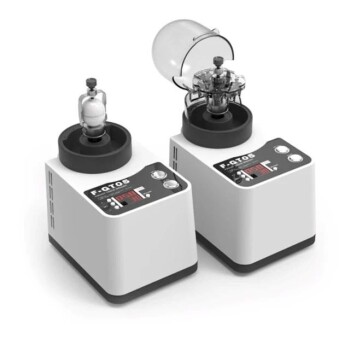
High-energy ball milling is the essential precursor step for synthesizing $\zeta-V_2O_5$ insertion hosts because it facilitates the intensive micro-mixing of metal powders, such as copper or silver, with vanadium pentoxide raw materials. Through high-frequency mechanical collisions, the system reduces the particle size of these components and significantly increases their contact area. This physical transformation enhances the chemical activity and compositional uniformity necessary for successful solid-state reactions.
High-energy ball milling acts as a mechanical activator that transforms raw powders into a highly reactive, homogeneous precursor. By achieving sub-micron refinement and atomic-scale mixing, it lowers the energy barrier for subsequent thermal processing and ensures the structural integrity of the final insertion host.
The Primary Role of Ball Milling in $\zeta-V_2O_5$ Synthesis
Achieving Atomic-Scale Homogeneity
High-energy ball milling uses high-speed rotation to generate intense impact and shear forces between the grinding media and the raw powders.
This process ensures that metal powders (Cu or Ag) are distributed uniformly throughout the $V_2O_5$ matrix at a microscopic or even atomic scale.
Such high levels of homogeneity are crucial because they establish the kinetic foundation required for forming single-phase solid solutions during the final synthesis stages.
Increasing Reactivity via Particle Refinement
The mechanical energy from the milling system continuously crushes and refines hard oxide powders down to the sub-micron or nano-scale.
Reducing the particle size significantly increases the specific surface area, which maximizes the contact points between the reacting species.
This increased surface-to-volume ratio enhances the chemical activity of the powders, making them far more responsive to subsequent heat treatments.
The Influence on Subsequent Reaction Kinetics
Lowering the Energy Barrier
By creating an intimate mixture of refined particles, ball milling effectively lowers the energy barrier for the solid-state reactions that occur in quartz tubes.
The high-energy state of the milled powder allows for faster diffusion of ions, which is vital for the successful insertion of metal atoms into the $V_2O_5$ framework.
Without this mechanical activation, the subsequent reactions would require significantly higher temperatures or much longer processing times to reach completion.
Ensuring Uniform Phase Formation
The uniformity achieved during the milling stage directly influences the purity and accuracy of the resulting $\zeta-V_2O_5$ phases.
Consistent micro-mixing prevents the formation of localized impurities or secondary phases that can degrade the performance of the insertion host.
This level of control is necessary for producing stable materials capable of serving as reliable hosts for ion insertion in electrochemical applications.
Understanding the Trade-offs
Risk of Media Contamination
While high-energy milling is effective, the intense friction and impact can cause wear on the grinding balls and vials.
This wear can introduce trace amounts of impurities (such as iron or alumina) into the $\zeta-V_2O_5$ precursor, potentially altering its electronic or structural properties.
Careful selection of milling media and vial materials is required to balance grinding efficiency with the need for high chemical purity.
Over-Milling and Amorphization
Extended milling times—often exceeding 20 hours—can lead to excessive heat generation and the unintended formation of amorphous phases.
If the powder becomes too disordered, it may behave unpredictably during the subsequent solid-state reaction, leading to inconsistent crystal growth.
Researchers must optimize the rotation speed and milling duration to achieve refinement without destroying the necessary short-range order of the raw materials.
How to Apply This to Your Synthesis Project
Making the Right Choice for Your Goal
To maximize the effectiveness of high-energy ball milling in your synthesis process, consider the following recommendations:
- If your primary focus is phase purity: Utilize high-purity milling media like zirconia and limit milling time to the minimum required for uniform color change in the powder.
- If your primary focus is rapid reaction kinetics: Maximize the rotation speed to achieve the smallest possible particle size, which will provide the highest specific surface area for the solid-state reaction.
- If your primary focus is scalability: Opt for a continuous milling approach or larger-volume planetary mills that can maintain consistent impact energy across larger batches of $V_2O_5$ and metal powders.
By mastering the mechanical activation of your raw materials, you ensure a predictable and high-quality synthesis of $\zeta-V_2O_5$ insertion hosts.
Summary Table:
| Feature | Role in Synthesis | Impact on Final Product |
|---|---|---|
| Particle Refinement | Reduces size to sub-micron/nano scale | Increases surface area and reaction kinetics |
| Micro-Mixing | Atomic-scale distribution of Cu/Ag in V2O5 | Ensures single-phase solid solution formation |
| Mechanical Activation | Lowers the activation energy barrier | Reduces required sintering temperature and time |
| Phase Control | Prevents localized impurities | Enhances structural integrity and electrochemical stability |
Elevate your material research with KINTEK’s high-performance laboratory solutions. We specialize in providing the precision equipment necessary for advanced synthesis, including high-energy planetary ball mills for superior particle refinement and a comprehensive range of high-temperature furnaces (muffle, tube, and vacuum) for flawless solid-state reactions.
Whether you need crushing and milling systems, hydraulic presses, or specialized ceramics and crucibles, KINTEK ensures your lab achieves unmatched phase purity and consistency. Contact KINTEK today to discuss your specific requirements and discover how our expertise can accelerate your synthesis projects.
References
- Joseph V. Handy, Sarbajit Banerjee. Protecting groups in insertion chemistry: Site-selective positioning of lithium ions in intercalation hosts. DOI: 10.1016/j.matt.2023.01.028
This article is also based on technical information from Kintek Solution Knowledge Base .
Related Products
- High-Energy Omnidirectional Planetary Ball Mill Milling Machine for Laboratory
- High Energy Planetary Ball Mill Milling Machine for Laboratory
- High Energy Planetary Ball Mill Milling Machine for Laboratory
- High Energy Planetary Ball Mill for Laboratory Horizontal Tank Type Milling Machine
- High-Energy Omnidirectional Planetary Ball Mill Machine for Laboratory
People Also Ask
- How does a planetary ball mill solve mixing challenges with PEO? Unlock solid-state synthesis for insoluble dopants
- What is the role of a planetary ball mill in preparing doped high-nickel cathode materials? Enhance Battery Stability
- Why is a planetary ball mill used for LNMO precursor powders? Optimize Particle Uniformity & Battery Performance
- What is the function of a planetary ball mill in the solid-state synthesis of LiTa2PO8? Achieve High-Purity Electrolytes
- What is the critical role of a planetary ball mill in the processing of inorganic fillers? Enhance Battery Performance