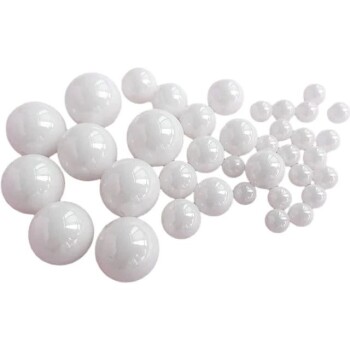
Zirconia grinding jars act as the critical containment vessel for high-purity mechanical alloying. In the synthesis of LLZTO (Lithium Lanthanum Zirconium Tantalum Oxide), these jars facilitate the high-energy pulverization and mixing of raw precursors like LiOH, La2O3, ZrO2, and Ta2O5. Their primary function is to withstand aggressive mechanical forces while strictly preventing the introduction of metallic contaminants that would degrade the electrolyte's performance.
Core Insight: The success of LLZTO synthesis hinges on absolute purity; zirconia’s extreme hardness and chemical inertness allow for the necessary particle refinement without introducing iron or chromium impurities, which are fatal to the ionic conductivity of solid-state electrolytes.
The Mechanics of Purity and Performance
Eliminating Metallic Contamination
The primary danger in synthesizing solid-state electrolytes is contamination. Standard stainless steel grinding equipment sheds microscopic metallic particles (such as iron or chromium) due to abrasive wear.
Zirconia grinding jars solve this by being chemically inert. Because LLZTO is highly sensitive to impurities, using zirconia prevents the introduction of foreign metal ions that could cause internal short circuits or unwanted side reactions during battery cycling.
Enabling High-Energy Particle Refinement
Synthesis requires breaking down hard raw materials, specifically Lanthanum Oxide (La2O3) and Zirconium Dioxide (ZrO2). This demands significant kinetic energy.
Zirconia jars possess exceptional hardness and wear resistance. They allow the milling process to run for extended periods (often 5 to 12 hours) at high speeds without the jar material degrading or chipping into the powder.
Ensuring Homogeneity
To achieve high ionic conductivity, the precursor materials must be mixed to a high degree of uniformity.
The zirconia jars, when paired with zirconia grinding balls, provide a consistent, high-impact environment. This mechanical force refines the particle size and ensures the raw ingredients are perfectly blended, which is a prerequisite for a successful solid-phase reaction.
Operational Considerations and Compatibility
The Necessity of Matched Media
To maximize the effectiveness of a zirconia jar, it must be paired exclusively with zirconia grinding balls.
Using mismatched media, such as stainless steel balls in a zirconia jar, defeats the purpose of the setup. The harder component will abrade the softer one, or the metal media will reintroduce the very impurities you are trying to avoid.
Durability Under Stress
While chemically superior, zirconia is a ceramic and behaves differently than metal under stress.
It offers superior wear resistance against the sliding and impact of grinding balls, maintaining its integrity over long-term grinding cycles. However, operators must rely on the material's density to provide the necessary impact force for mechanical alloying, rather than the ductility associated with metal jars.
Making the Right Choice for Your Goal
When setting up your synthesis protocol for LLZTO, your equipment choices define your ceiling for performance.
- If your primary focus is Maximum Ionic Conductivity: Prioritize zirconia jars to eliminate conductive metallic impurities that disrupt lithium-ion transport pathways.
- If your primary focus is Process Stability: Rely on zirconia's wear resistance to ensure consistent particle size distribution across long, repetitive milling cycles.
Summary: Zirconia grinding jars provide the mandatory high-purity environment required to transform raw oxides into high-performance solid-state electrolytes without compromise.
Summary Table:
| Feature | Benefit for LLZTO Synthesis |
|---|---|
| Material Hardness | Facilitates high-energy refinement of hard oxides (La2O3, ZrO2). |
| Chemical Inertness | Prevents iron/chromium contamination and unwanted side reactions. |
| Wear Resistance | Maintains structural integrity during long 5–12 hour milling cycles. |
| Purity Control | Eliminates conductive impurities to maximize lithium-ion transport. |
| Homogeneity | Ensures uniform precursor blending for stable solid-phase reactions. |
Elevate Your Battery Research with KINTEK Precision Solutions
Don't let metallic contamination undermine the ionic conductivity of your solid-state electrolytes. KINTEK specializes in high-performance laboratory equipment designed for the rigorous demands of advanced materials science.
Our premium zirconia grinding jars and milling media provide the ultra-pure, wear-resistant environment essential for synthesizing LLZTO and other sensitive materials. Beyond milling, we offer a comprehensive suite of tools including:
- High-Temperature Furnaces (Muffle, Vacuum, CVD) for precise sintering.
- Hydraulic Presses (Pellet, Hot, Isostatic) for high-density electrolyte formation.
- High-Pressure Reactors & Autoclaves for diverse chemical synthesis.
- Battery Research Consumables including electrolytic cells and electrodes.
Ready to achieve superior homogeneity and purity in your lab? Contact KINTEK today to discuss your specific research goals and let our experts help you select the perfect equipment for your workflow.
Related Products
- Laboratory Jar Ball Mill with Alumina Zirconia Grinding Jar and Balls
- Laboratory Jar Mill with Agate Grinding Jar and Balls
- Laboratory Ball Mill Jar Mill with Metal Alloy Grinding Jar and Balls
- Precision Machined Zirconia Ceramic Ball for Engineering Advanced Fine Ceramics
- Engineering Advanced Fine Ceramics Head Tweezers with Pointed Elbow Zirconia Ceramic Tip
People Also Ask
- What are the primary functions of using a ball mill for BZCY72 powder? Achieve High Purity and Enhanced Sintering
- In what way does a laboratory ball mill affect material properties when modifying PHBV/pulp fiber composites?
- Why is a laboratory ball mill required for ultra-fine fly ash? Unlock Nano-Scale Adsorption Power
- What is the function of a laboratory ball mill in the preparation of AMMCs? Optimize Dispersion & Grain Refinement
- What is the function of a laboratory ball mill in the pretreatment of waste tire char (WTC)? Optimize Material Reactivity