Optimizing pressure levels during assembly is the critical factor in balancing electrochemical performance with mechanical integrity in all-solid-state batteries. When using assembly molds, varying the applied force allows you to create dense, highly conductive solid-to-solid interfaces without fracturing the fragile components that prevent short circuits.
Core Takeaway: Successful assembly requires a staged pressure strategy rather than a uniform application of force. You must apply high pressure to densify the cathode for maximum contact, but significantly lower the pressure when integrating the anode to preserve the electrolyte structure.
The Principles of Staged Pressure
Consolidating the Monolithic Structure
In solid-state batteries, ions move through physical contact points rather than flowing liquids.
Pressure is the tool used to force these solid components together. By consolidating the battery structure, you increase the contact area between electrodes and the electrolyte.
This reduces interface resistance and enhances overall conductivity.
High Pressure for the Cathode Layer
The first stage of assembly often involves the cathode and the solid electrolyte. Here, aggressive densification is required.
High pressures, such as 3.5 tons, are typically applied to the cathode layer.
This force is necessary to maximize the contact between the active cathode materials and the electrolyte particles. It eliminates voids that would otherwise block ion transport.
Moderate Pressure for the Anode Layer
The strategy shifts once the anode, such as a lithium-indium alloy, is introduced to the stack.
At this stage, lower pressures, such as 1 ton, are applied.
The objective changes from maximum densification to careful integration. You need enough force to ensure connectivity, but not enough to mechanically stress the underlying layers.
Understanding the Trade-offs
Avoiding Structural Failure
The primary reason for lowering pressure during anode assembly is to protect the solid electrolyte layer.
If you continue to apply high pressure (like the 3.5 tons used on the cathode) to the full stack, you risk structural destruction.
Over-compressing the complete assembly can crack the electrolyte or force electrode materials through it. This inevitably leads to short circuits and battery failure.
Balancing Contact vs. Integrity
There is a delicate window of operation.
Insufficient pressure leads to poor interface contact and high internal resistance.
Excessive pressure leads to mechanical fracture. The "stepped" pressure approach—high for the cathode, lower for the anode—is the engineering solution to this physical contradiction.
Making the Right Choice for Your Goal
To ensure high performance and high yield during fabrication, apply the following pressure logic:
- If your primary focus is maximizing conductivity: Apply higher pressure (e.g., 3.5 tons) specifically to the cathode-electrolyte interface to ensure a dense, low-resistance pathway.
- If your primary focus is preventing short circuits: Reduce the pressure (e.g., to 1 ton) when adding the anode to maintain the structural integrity of the electrolyte layer.
Precise pressure modulation is not just about assembly; it is the primary control for defining the internal architecture and reliability of the battery.
Summary Table:
| Assembly Stage | Pressure Level | Primary Objective | Risk of Deviation |
|---|---|---|---|
| Cathode Layer | High (e.g., 3.5 tons) | Maximize contact & densification; eliminate voids. | High interface resistance & poor ion transport. |
| Anode Layer | Moderate (e.g., 1 ton) | Secure integration without structural damage. | Electrolyte cracking & internal short circuits. |
| Full Stack | Controlled | Maintain electrochemical & mechanical balance. | Mechanical failure or poor cycle life. |
Precision Engineering for Your Battery Research
Unlock the full potential of your energy storage research with KINTEK’s specialized laboratory solutions. From hydraulic pellet presses for precise staged pressure application to advanced battery research tools and consumables, we provide the high-performance equipment needed to build reliable all-solid-state batteries.
Whether you require high-temperature furnaces (vacuum, CVD, or atmosphere) for material synthesis or PTFE and ceramic consumables for contamination-free processing, KINTEK ensures your lab is equipped for success.
Ready to optimize your battery assembly process? Contact KINTEK today for expert guidance and a quote!
Related Products
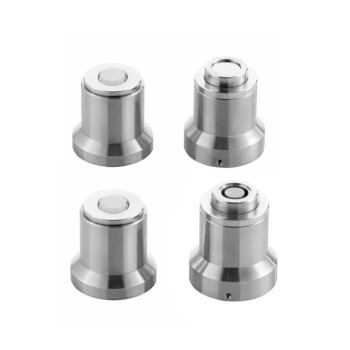
- Button Battery Disassembly and Sealing Mold for Lab Use
- Button Battery Tablet Press Sealing Mold for Lab Use
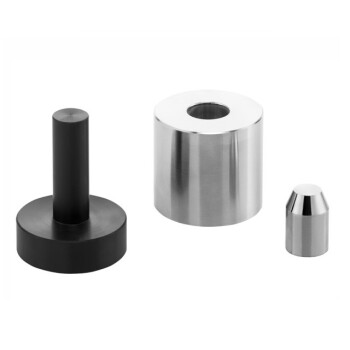
- Assemble Square Lab Press Mold for Laboratory Applications
- Cylindrical Battery Steel Case for Battery Lab
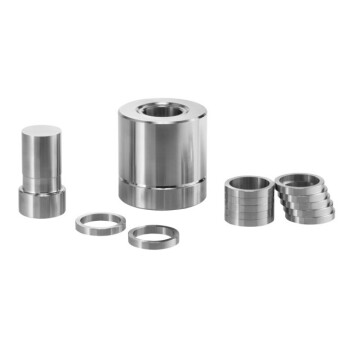
- Anti-Cracking Press Mold for Lab Use
People Also Ask
- What role do battery test molds or coin cell cases play? Optimize Your All-Solid-State Battery Assembly Today
- What are the parts of a mold assembly? A Guide to Injection Mold Components
- What is a molding tool used for? A Guide to Mass Production Efficiency
- What is a mold assembly? The Critical Final Step to a Functional Injection Mold
- What advantages do standardized laboratory compression-cell molds provide for c-LLZO? Optimize Battery Data Accuracy