The H-type electrolytic cell is technically indispensable for nitrate reduction (NO3RR) because it ensures the chemical integrity of the reaction products. Without the physical isolation provided by this cell design, the ammonia generated at the cathode would migrate to the anode and be destroyed through re-oxidation. This separation is the only way to obtain reliable data for ammonia yield and Faradaic efficiency (FE) measurements.
The H-type cell uses an ion-exchange membrane to isolate the cathode and anode chambers, preventing cross-chamber migration of reactive species. This configuration is essential for protecting synthesized ammonia from re-oxidation and ensuring that the measured performance reflects the catalyst's true capability.
The Role of the Ion-Exchange Membrane
Achieving Physical Compartmentalization
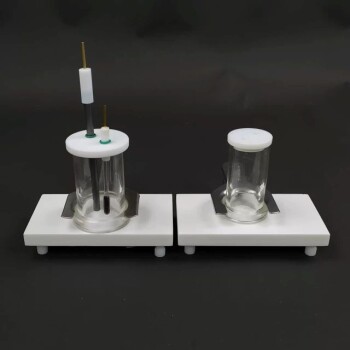
The H-type cell features a dual-chamber design split by a proton exchange membrane (often Nafion). This barrier creates two distinct chemical environments, allowing researchers to control the conditions at the cathode independently from those at the anode.
Regulating Selective Ionic Flux
While the membrane blocks the bulk diffusion of products, it facilitates the necessary flow of ions to complete the circuit. This selective permeability ensures that protons or other charge carriers move between chambers without allowing the larger product molecules to mix.
Preventing Product Degradation and Re-oxidation
The Vulnerability of Cathodic Ammonia
In NO3RR, the primary goal is often the production of ammonia (NH3). If an H-type cell is not used, the ammonia molecules generated at the cathode will naturally diffuse toward the anode.
Preventing Anodic Destruction
Upon reaching the anode, ammonia can be re-oxidized back into nitrates (NO3-) or nitrogen gas (N2). This "recycling" or destruction of the product makes it impossible to quantify the amount of ammonia actually produced by the catalyst.
Ensuring Quantitative Accuracy
Precise calculation of Faradaic efficiency depends on a 1:1 correlation between the electrons consumed and the products collected. By preventing re-oxidation, the H-type cell ensures that every molecule of ammonia produced is preserved for final analysis.
Eliminating Anodic Interference
Blocking Oxygen and Oxidative Intermediates
The oxidation of water at the anode produces oxygen (O2) and other oxidative intermediates. In a single-compartment cell, these species can migrate to the cathode and compete with the nitrate reduction reaction.
Mitigating Parasitic Reactions
Oxygen reaching the cathode can be reduced back to water, a process that consumes electrons without contributing to ammonia yield. The H-type cell blocks this oxygen flux, ensuring the current density measured is specifically tied to the nitrate reduction process.
Enhancing Experimental Safety
By isolating the chambers, the H-type cell prevents the cross-mixing of hydrogen and oxygen gases. This isolation not only improves data purity but also significantly reduces the risk of creating explosive gas mixtures within the testing apparatus.
Understanding Technical Trade-offs and Limitations
Increased Internal Resistance
The inclusion of a membrane introduces Ohmic resistance into the system. This can lead to a significant voltage drop across the cell, which must be compensated for during electrochemical testing to ensure the reported potentials are accurate.
Diffusion and Concentration Gradients
Because the chambers are separated, concentration gradients can develop over long testing periods. If the electrolyte is not properly stirred or replenished, the local depletion of nitrates at the cathode surface can limit the reaction rate and skew performance data.
Applying Cell Selection to Your Research Goals
Making the Right Choice for Your Goal
- If your primary focus is high-precision quantification of yield: You must use an H-type cell with a high-quality ion-exchange membrane to prevent any product loss via anodic re-oxidation.
- If your primary focus is assessing Faradaic efficiency: The H-type configuration is mandatory to ensure that the measured current corresponds exclusively to the desired reduction pathway.
- If your primary focus is screening catalyst durability over long periods: Utilize an H-type cell to prevent the accumulation of anodic by-products that could poison the cathode catalyst over time.
By providing a controlled environment that isolates the reduction and oxidation halves of the reaction, the H-type cell remains the gold standard for reliable nitrate reduction research.
Summary Table:
| Feature | Technical Function | Impact on NO3RR Results |
|---|---|---|
| Dual-Chamber Design | Physical separation of anode and cathode | Prevents cathodic ammonia from reaching the anode |
| Ion-Exchange Membrane | Selective ionic flux (e.g., Nafion) | Facilitates circuit completion while blocking product migration |
| Product Isolation | Eliminates anodic re-oxidation | Ensures accurate ammonia yield and Faradaic efficiency (FE) |
| Interference Blocking | Prevents O2 migration to cathode | Reduces parasitic reactions and improves current density accuracy |
| Safety Barrier | Isolates H2 and O2 gases | Minimizes risk of forming explosive gas mixtures |
Elevate Your Electrochemical Precision with KINTEK
Ensure the integrity of your NO3RR research with high-performance laboratory equipment designed for accuracy. KINTEK specializes in providing researchers with the specialized electrolytic cells and electrodes necessary for reliable ammonia quantification, alongside a comprehensive range of high-temperature furnaces (CVD, PECVD, vacuum) and hydraulic presses for advanced material synthesis.
From high-temperature high-pressure reactors to essential PTFE and ceramic consumables, we offer the tools you need to prevent product degradation and maximize Faradaic efficiency. Stop compromising your data with subpar isolation—contact our technical experts today to equip your lab with the gold standard in electrochemical testing solutions!
References
- Xiaoyu Li, Wei Wang. Multi-layer core–shell metal oxide/nitride/carbon and its high-rate electroreduction of nitrate to ammonia. DOI: 10.1039/d3nr02972g
This article is also based on technical information from Kintek Solution Knowledge Base .
Related Products
- H-Type Double-Layer Optical Electrolytic Electrochemical Cell with Water Bath
- H Type Electrolytic Cell Triple Electrochemical Cell
- Customizable PEM Electrolysis Cells for Diverse Research Applications
- Electrolytic Electrochemical Cell with Five-Port
- Super Sealed Electrolytic Electrochemical Cell
People Also Ask
- What is the overall structure of the H-type double-layer optical water bath electrolytic cell? Precision Design for Controlled Experiments
- How is the electrolyte managed in H-type electrolytic cells for specific reactions? Achieve Precise Control and High Purity
- What checks should be performed on the H-type electrolytic cell before use? Ensure Accurate Electrochemical Data
- What is important regarding temperature control for the H-type electrolytic cell? Ensure Precision and Data Integrity
- What is the overall structure of the H-type electrolytic cell? Understanding Dual-Chamber Electrochemical Designs