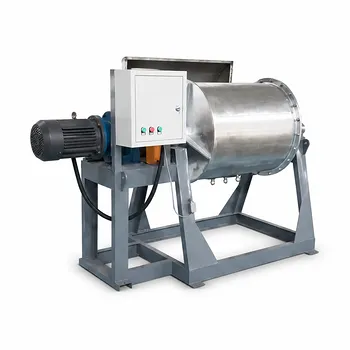
Ball mills function as the primary mechanism for interface engineering in the preparation of all-solid-state lithium-sulfur battery cathodes. By utilizing mechanical force over extended periods, typically around 20 hours, they intimately mix and disperse carbon nanotube-sulfur composites, solid electrolytes (such as Li10GeP2S12), and conductive agents to ensure physical connectivity.
Core Insight: In the absence of liquid electrolytes, solid materials do not naturally flow into contact with one another. Ball milling solves this by applying high-energy mechanical force to press active materials and electrolytes together, establishing the continuous ionic and electronic pathways necessary for the battery to function.
Overcoming Interface Impedance
The fundamental challenge in all-solid-state batteries is the solid-solid interface. Unlike liquid batteries where the electrolyte wets the electrode, solid components can have microscopic gaps that block energy flow.
Establishing Tight Contact
Ball milling serves to forcefully mix components like CNTs@S composites and acetylene black with the solid electrolyte.
This mechanical pressure ensures a tight contact interface between these distinct solids. Without this step, the internal resistance would be too high for the battery to operate efficiently.
Reducing Solid-Solid Impedance
The primary outcome of this rigorous mixing is a significant reduction in interface impedance.
By minimizing the resistance at the junction where the active material meets the electrolyte, the ball mill ensures that ions and electrons can move freely across boundaries.
Creating Conductive Networks
For a battery to discharge, it requires uninterrupted pathways for both electrons and lithium ions.
Continuous Ionic Pathways
The ball mill disperses the solid electrolyte (Li10GeP2S12) evenly throughout the cathode mixture.
This dispersion creates a continuous network for lithium ions to travel from the cathode to the anode, which is critical for the battery's basic electrochemical reaction.
Electronic Conductivity
Simultaneously, the process distributes conductive agents, such as acetylene black and carbon nanotubes.
This ensures that every particle of active sulfur is electrically connected to the current collector, facilitating electron flow during charge and discharge cycles.
Nanostructuring and Performance
Beyond simple mixing, high-energy ball milling physically alters the structure of the materials to enhance performance.
Refining Particle Size
Through high-frequency impact and shear forces, the ball mill refines micron-sized active material powders down to the nanoscale.
This reduction in particle size dramatically increases the specific surface area of the electrode materials.
Improving Rate Performance
Smaller particles mean shorter distances for lithium ions to travel within the material itself.
By shortening the lithium-ion diffusion path, the process effectively improves the power density and rate performance of the resulting battery, allowing it to charge and discharge more quickly.
Understanding the Trade-offs
While ball milling is essential for performance, it is a resource-intensive process that requires careful management.
Process Duration and Intensity
The process described involves extended milling times, such as 20 hours.
This indicates that achieving the necessary degree of contact is not instantaneous; it requires sustained energy input to overcome the physical resistance of the solid materials.
Mechanical Stress
The method relies on impact and shear forces.
While this creates beneficial contact, the parameters must be controlled to avoid pulverizing the materials to the point where their crystal structure is damaged, though the primary goal remains increasing surface area and contact.
Making the Right Choice for Your Goal
The specific application of ball milling parameters should be tailored to the performance metrics you value most.
- If your primary focus is Reducing Internal Resistance: Prioritize long-duration milling (e.g., 20 hours) to maximize the physical contact between the solid electrolyte and the active sulfur composites.
- If your primary focus is High Power Density: Focus on high-energy impact settings that refine particle sizes to the nanoscale, thereby shortening diffusion paths for faster ion movement.
Ultimately, the ball mill is not just a mixer; it is the tool that forces solid components to behave as a cohesive electrochemical system.
Summary Table:
| Feature | Function in Cathode Preparation | Impact on Battery Performance |
|---|---|---|
| Interface Engineering | Forces tight contact between sulfur, electrolyte, and carbon | Dramatically reduces solid-solid interface impedance |
| Network Creation | Disperses solid electrolytes and conductive agents | Establishes continuous ionic and electronic pathways |
| Particle Refinement | Reduces micron-sized powders to the nanoscale | Shortens Li-ion diffusion paths for higher rate performance |
| Mechanical Force | High-energy impact and shear for ~20 hours | Ensures cohesive electrochemical system without liquid wetting |
Elevate Your Battery Research with KINTEK Precision
Achieving the perfect solid-solid interface requires more than just mixing—it requires the high-energy precision of KINTEK’s advanced material processing solutions. As specialists in laboratory equipment, KINTEK provides the high-performance crushing and milling systems and planetary ball mills essential for engineering nanostructured cathode materials.
Beyond milling, our comprehensive portfolio supports your entire workflow with:
- High-Temperature Furnaces (Muffle, Vacuum, Tube) for material synthesis.
- Hydraulic Presses (Pellet, Isostatic) for high-density solid-state electrolyte forming.
- Battery Research Tools and specialized consumables like ceramic crucibles.
Ready to reduce your interface impedance and boost power density? Contact our technical experts today to find the ideal equipment for your all-solid-state battery breakthroughs.
Related Products
- Stainless Steel Laboratory Ball Mill for Dry Powder and Liquid with Ceramic Polyurethane Lining
- High-Energy Omnidirectional Planetary Ball Mill Milling Machine for Laboratory
- Laboratory Ball Mill Jar Mill with Metal Alloy Grinding Jar and Balls
- High-Energy Omnidirectional Planetary Ball Mill Machine for Laboratory
- Hybrid High Energy Vibratory Ball Mill for Lab Use
People Also Ask
- How do laboratory ball mills facilitate the mechanochemical synthesis of ZIF-8? Solvent-Free Synthesis Explained
- What is the primary function of a laboratory ball mill in the modification of sulfide-based solid electrolytes with LiPO2F2?
- How does a laboratory ball mill ensure the mixing quality of Mn3Zn0.8Sn0.2N and Ti? Achieve Perfect Homogeneity
- What is the function of a laboratory ball mill in the preparation of AMMCs? Optimize Dispersion & Grain Refinement
- In what way does a laboratory ball mill affect material properties when modifying PHBV/pulp fiber composites?