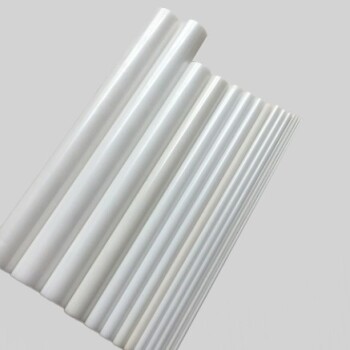
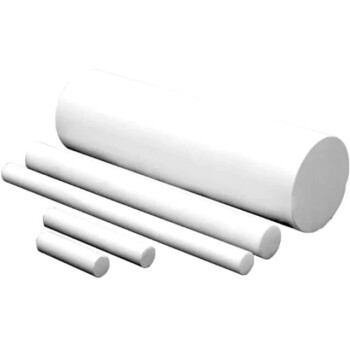
In a Microbial Electrolysis Cell (MEC), industrial-grade graphite rods function as the central "backbone" of the electrical collection system. Inserted directly into the center of a graphite granule bed, these rods act as the primary interface connecting the internal electrode material to the external power supply. Their fundamental purpose is to bridge the gap between the loose, biologically active granules and the rigid electrical circuit.
Core Takeaway While graphite granules provide the surface area for biology, the graphite rod ensures the system is electrically efficient. Its primary function is to lower ohmic internal resistance and distribute voltage uniformly, ensuring the entire reactor bed remains active and stable.
Optimizing Electrical Performance
Reducing Internal Resistance
The most critical role of the graphite rod is the reduction of ohmic internal resistance.
Loose graphite granules have many contact points, creating resistance that impedes electron flow.
The solid graphite rod provides a high-conductivity "highway" through the center of the bed, bypassing this resistance and allowing current to flow freely.
Ensuring Uniform Voltage Distribution
For an MEC to function correctly, the externally applied voltage must reach every part of the electrode.
The graphite rod ensures this voltage is distributed uniformly throughout the entire granule bed.
This prevents voltage drops that would leave outer or distant sections of the bed electrically inactive.
Maintaining a Stable Reaction Environment
Bio-electrochemical reactions are sensitive to fluctuations in their environment.
By stabilizing the voltage and current flow, the rod creates a consistent condition for the microorganisms.
This stability allows for sustained, efficient metabolic activity within the biofilm.
The Relationship Between Rod and Granules
The Role of the Granules
It is important to distinguish the rod from the surrounding material.
As noted in supporting technical literature, high-purity graphite granules are used as fillers to provide a large specific surface area.
This surface area is necessary for the attachment of microorganisms and the formation of high-density biofilms.
The Role of the Rod
The rod does not primarily serve as a home for bacteria; it serves as the current collector.
It extracts the electrons generated by the microbes on the granules (or supplies them, depending on the electrode type).
Together, the granules provide the biological capacity, while the rod provides the electrical capacity.
Understanding the Trade-offs
Contact Resistance
The efficiency of the rod relies heavily on physical contact.
If the granule bed is loosely packed around the rod, "contact resistance" will occur at the interface.
This can negate the benefits of the rod, leading to energy losses despite the high conductivity of the material itself.
Material Quality
Not all graphite is created equal.
The system relies on "industrial-grade" rods to ensure chemical stability and consistent conductivity.
Using lower-grade graphite can introduce impurities or result in faster degradation under electrochemical stress.
Making the Right Choice for Your Goal
To maximize the efficiency of your MEC reactor design, consider how the rod integrates with your specific objectives:
- If your primary focus is minimizing energy loss: Ensure the rod is centrally positioned and the surrounding granules are tightly packed to reduce ohmic resistance.
- If your primary focus is biological health: Monitor the voltage distribution provided by the rod to ensure no parts of the bed are subjected to potential potentials that could inhibit microbial growth.
By anchoring your current collection system with a central graphite rod, you transform a passive bed of granules into a cohesive, high-performance bio-electrochemical engine.
Summary Table:
| Component | Primary Function | Key Performance Benefit |
|---|---|---|
| Graphite Rod | Central Current Collector | Reduces internal ohmic resistance & bridges internal/external circuits |
| Graphite Granules | High-Surface Bio-Carrier | Provides maximum area for microbial attachment & biofilm growth |
| Rod-Granule Interface | Electrical Connectivity | Ensures uniform voltage distribution throughout the entire reactor bed |
| Industrial-Grade Material | Chemical Stability | Maintains conductivity and prevents degradation under electrochemical stress |
Maximize Your Reactor Efficiency with KINTEK
Ready to optimize your bio-electrochemical research? KINTEK specializes in high-performance laboratory equipment, including electrolytic cells, electrodes, and industrial-grade graphite components designed for precision and durability. Whether you are developing Microbial Electrolysis Cells (MEC) or advanced battery technologies, our comprehensive range of high-temperature furnaces, hydraulic presses, and specialized consumables like PTFE and ceramics ensures your lab operates at peak performance.
Take your research to the next level—Contact KINTEK Today to find the perfect solution for your application!
References
- Xianshu Liu, Luyan Zhang. The Detoxification and Degradation of Benzothiazole from the Wastewater in Microbial Electrolysis Cells. DOI: 10.3390/ijerph13121259
This article is also based on technical information from Kintek Solution Knowledge Base .
Related Products
- Graphite Disc Rod and Sheet Electrode Electrochemical Graphite Electrode
- Carbon Graphite Plate Manufactured by Isostatic Pressing Method
- High Purity Pure Graphite Crucible for Evaporation
- Carbon Graphite Boat -Laboratory Tube Furnace with Cover
- High Purity Pure Graphite Crucible for Electron Beam Evaporation
People Also Ask
- Why is a graphite electrode used as a counter electrode? Achieve Pure Electrochemical Reduction with KINTEK
- What is the correct procedure for installing and connecting a graphite electrode during an experiment? Ensure Accurate Electrochemical Results
- What are the potential risks when using a graphite electrode in electrochemical tests? Avoid Decomposition and Contamination
- What are the key precautions for handling graphite electrodes? Ensure Safety & Maximize Performance
- Why are Dimensionally Stable Anodes (DSA) preferred for indium electrowinning? Ensure High-Purity Results.