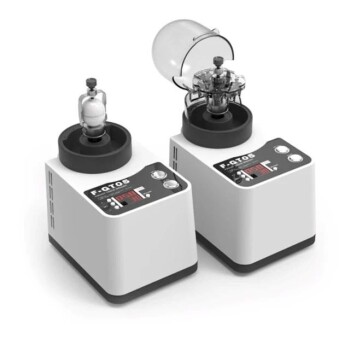
Planetary ball mills and high-efficiency mixers function as the critical homogenization engine in cathode slurry preparation. They utilize high mechanical shear forces to thoroughly disperse active materials (such as LiFePO4 or NCM622), conductive agents (like acetylene black), and binders (like PVDF) within a solvent. This process goes beyond simple stirring to ensure a microscopic, uniform distribution of all components.
Core Insight: The primary goal of this equipment is not merely mixing, but the construction of a robust electronic conductive network. By breaking down aggregates and ensuring intimate contact between particles, these tools directly determine the battery's final rate performance and cycle life.
The Mechanics of Slurry Optimization
Establishing the Conductive Network
For materials like NCM622 or LiFePO4, the active material itself is often not sufficiently conductive. The ball mill forces conductive agents, such as acetylene black or Super P, to coat the active particles evenly.
This creates a continuous pathway for electrons to move, significantly reducing interfacial impedance. Without this high-shear dispersion, isolated islands of active material would fail to contribute to the battery's capacity.
Particle Refinement and Diffusion
particularly for phosphate-based materials (like LiFePO4), these mills provide the high energy needed to break down particle aggregates.
By reducing particle size—sometimes from microns to nanometers—the equipment shortens the solid-phase diffusion path for lithium ions. This physical refinement is essential for improving the material's reaction kinetics and overall rate capability.
Enabling Uniform Film Formation
The quality of the slurry directly dictates the quality of the final electrode film. High-energy mixing ensures a homogenous consistency that prevents agglomeration.
This uniformity leads to improved flatness in subsequent tape casting or coating processes. A smooth, dense electrode film is vital for ensuring consistent energy density and preventing hot spots during battery operation.
Understanding the Trade-offs: Energy vs. Integrity
While high shear force is beneficial for dispersion, it introduces specific risks depending on the material chemistry.
The Risk to NCM Secondary Particles
Materials like NCM622 are often composed of secondary particles (spheres made of smaller primary particles). Excessive high-energy milling can shatter these spheres, destroying the material's structural integrity.
Calibrating for Material Type
For NCM622, "low-speed" ball milling is often preferred. This approach achieves the necessary dispersion of conductive agents and binders without delivering high-energy impacts that damage the active material's structure.
Conversely, LiFePO4 is mechanically robust and often requires higher energy to refine particles and mix with carbon precursors effectively. Using the wrong energy setting for the specific chemistry will degrade performance rather than enhance it.
Making the Right Choice for Your Goal
To optimize your cathode slurry, you must tailor the mechanical force to the physical properties of your active material.
- If your primary focus is LiFePO4 (LFP): Prioritize high-energy milling to break down aggregates and ensure a tight mix with carbon precursors for maximum conductivity.
- If your primary focus is NCM622 or NCM811: Prioritize low-speed or controlled-shear mixing to preserve the secondary particle structure while still dispersing the binder and conductive additive.
Ultimately, the uniformity achieved in the mixing stage sets the upper limit for the battery's electrochemical performance.
Summary Table:
| Feature | LiFePO4 (LFP) Requirements | NCM622/811 Requirements |
|---|---|---|
| Energy Level | High-energy milling | Low-speed / Controlled-shear |
| Primary Goal | Aggregate breakdown & carbon coating | Homogeneous dispersion & structure preservation |
| Mechanical Risk | Low (Material is robust) | High (Risk of shattering secondary particles) |
| Effect on Battery | Shortens Li+ diffusion path | Maintains structural integrity & cycle life |
| Conductive Network | Critical for low-conductivity LFP | Essential for reducing interfacial impedance |
Elevate Your Battery Research with KINTEK
Precise homogenization is the foundation of high-performance battery technology. Whether you are refining LiFePO4 or preserving the delicate structure of NCM622, KINTEK provides the specialized tools you need for success.
Our comprehensive range includes:
- Planetary Ball Mills & High-Efficiency Mixers for perfect slurry homogenization.
- Crushing & Milling Systems for precise particle size control.
- High-Temperature Furnaces (Tube, Vacuum, CVD) for advanced material synthesis.
- Hydraulic Presses (Pellet, Isostatic) and Battery Research Tools for electrode fabrication.
- PTFE Consumables, Ceramics, and Crucibles to ensure contamination-free processing.
Don't let poor dispersion limit your battery's potential. Contact KINTEK today to discover how our expert equipment solutions can optimize your lab's efficiency and electrochemical results.
Related Products
- High Energy Planetary Ball Mill for Laboratory Horizontal Tank Type Milling Machine
- High-Energy Omnidirectional Planetary Ball Mill Milling Machine for Laboratory
- Laboratory Planetary Ball Mill Rotating Ball Milling Machine
- High Energy Planetary Ball Mill Milling Machine for Laboratory
- High Energy Planetary Ball Mill Machine for Laboratory Horizontal Tank Type
People Also Ask
- What is the role of a planetary ball mill in sulfide-based solid-state batteries? Engineer High-Performance Cathodes
- What are the parameters of a planetary ball mill? Master Speed, Time, and Media for Perfect Grinding
- What is the function of a planetary ball mill for nanostructured eutectic steel? Essential Prep for High-Strength Alloys
- What role does a planetary ball mill play in the preparation of NASICON-type solid electrolytes like LATP and LAGP?
- What is the function of a planetary ball mill in solid-state electrolyte prep? Milling vs. SDS Methods Explained