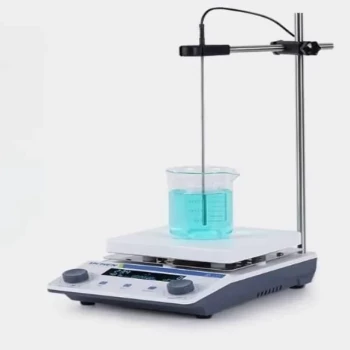
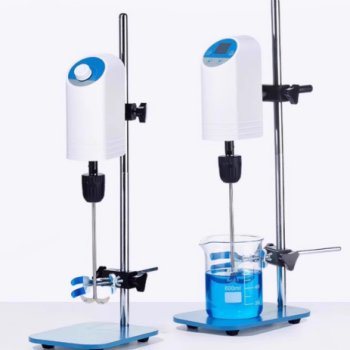
Precision mechanical agitation is the critical driver of uniformity in Cu-TiO2 sol-gel synthesis. Specifically, precision magnetic stirrers or homogenizers provide the continuous, uniform energy required to disperse the copper precursor (such as CuCl2) at a molecular level within the titanium isopropoxide solution. This mechanical consistency is the only way to prevent local segregation and ensure the chemical doping process can occur.
Core Takeaway Achieving a transparent sol is not merely a matter of correct chemical ratios; it is a mechanical engineering challenge. The uniform action of a precision stirrer is the prerequisite for effective doping, ensuring copper ions are physically distributed well enough to integrate into the TiO2 lattice rather than clustering in isolation.
The Mechanics of Molecular Distribution
Establishing Uniformity
The primary function of this equipment is to maintain continuous mechanical action.
This constant input of energy prevents the copper precursor from settling or clumping. It forces the copper agents to distribute evenly throughout the titanium isopropoxide solution.
Reaching the Molecular Level
Standard mixing is often insufficient for sol-gel processes.
Precision stirrers or homogenizers ensure the distribution reaches a molecular level. This degree of fineness is essential for the subsequent chemical reactions to take place uniformly across the entire volume of the solution.
The Impact on Lattice Doping
Preventing Local Segregation
Without precise agitation, copper components will naturally segregate locally.
This segregation creates pockets of high copper concentration and areas of voids. Precision mixing mitigates this risk, ensuring the copper is available everywhere in the solution simultaneously.
Integrating Copper Ions
The ultimate goal of this synthesis is the effective doping of copper ions into the TiO2 lattice.
This atomic-level integration cannot happen if the precursor materials are not perfectly intermingled. The mechanical stirrer creates the physical conditions necessary for this chemical incorporation to succeed.
Common Pitfalls to Avoid
Misinterpreting Solution Transparency
A key indicator of successful synthesis is the formation of a transparent sol.
If the mechanical action is insufficient, the solution will likely not achieve transparency. This opacity is a visual signal that local segregation has occurred and the copper ions have failed to integrate into the lattice structure.
Making the Right Choice for Your Goal
To ensure the success of your Cu-TiO2 synthesis, you must verify that your mixing equipment can deliver sustained, uniform power.
- If your primary focus is Structural Doping: Ensure your equipment is capable of molecular-level homogenization to facilitate the entry of copper ions into the TiO2 lattice.
- If your primary focus is Sol Quality: Use the formation of a completely transparent sol as your benchmark for sufficient mechanical mixing duration and intensity.
Precision in the physical process is the foundation of perfection in the chemical product.
Summary Table:
| Feature | Role in Cu-TiO2 Synthesis | Key Outcome |
|---|---|---|
| Mechanical Agitation | Continuous energy input to prevent precursor settling | Uniform molecular dispersion |
| Molecular Homogenization | Breaking down CuCl2 and titanium isopropoxide clusters | Enables TiO2 lattice doping |
| Precision Control | Maintains consistent mixing intensity and duration | Formation of transparent sol |
| Segregation Prevention | Eliminates pockets of high copper concentration | Prevents local clustering/voids |
Elevate Your Sol-Gel Synthesis with KINTEK Precision Equipment
Success in Cu-TiO2 synthesis depends on more than just chemical ratios—it requires the mechanical precision to achieve perfect molecular distribution. At KINTEK, we specialize in high-performance laboratory equipment designed for the most demanding research applications.
Whether you are aiming for structural doping or high-transparency sol quality, our advanced homogenizers and magnetic stirrers provide the uniform power needed to prevent segregation and ensure lattice integration. Beyond mixing, KINTEK offers a comprehensive range of tools for material science, including:
- High-Temperature Furnaces: Muffle, tube, and vacuum systems for calcining your synthesized gels.
- Material Processing: Crushing, milling, and sieving systems to refine your final powders.
- Research Consumables: High-purity ceramics, crucibles, and PTFE products for contamination-free experiments.
Ready to achieve superior chemical uniformity? Contact us today to discover how KINTEK’s precision solutions can optimize your laboratory’s workflow and research outcomes.
References
- Marcin Janczarek, Jan Hupka. Transparent thin films of Cu-TiO2 with visible light photocatalytic activity. DOI: 10.1039/c4pp00271g
This article is also based on technical information from Kintek Solution Knowledge Base .
Related Products
- Laboratory Small Constant Temperature Heated Magnetic Stirrer Heater and Stirrer
- Custom PTFE Teflon Parts Manufacturer for Magnetic Stirring Bar
- High Performance Laboratory Stirrers for Diverse Applications
- Three-dimensional electromagnetic sieving instrument
- Custom PTFE Teflon Parts Manufacturer for PTFE Stirring Bar Recovery Rod
People Also Ask
- What role does a magnetic stirrer with heating play in ZnO nanoparticle synthesis? Precision Control for Quality Results
- What role does a constant temperature heating magnetic stirrer play in MFC-HAp synthesis? Achieve Material Homogeneity
- What is the function of a laboratory magnetic stirrer in Ni–Cr–P electrodeposition? Optimize Ion Transport & Coating
- Why is a laboratory magnetic stirrer required for benzoic acid esters? Boost Reaction Speed & Yield with High RPM
- What role does a laboratory magnetic stirrer play in TiO2 and TiO2-Ag sol preparation? Master Chemical Kinetics