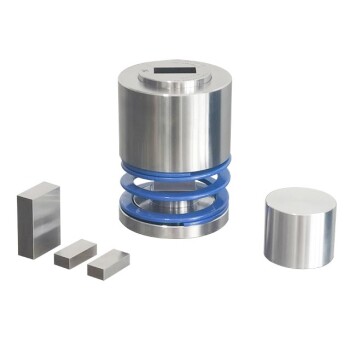
A high-pressure reactor is the critical stabilizing force in the Self-propagating High-temperature Synthesis (SHS) of Manganese-doped MAX phase powders. Its primary role is to maintain a high-pressure inert atmosphere, typically using argon gas at levels such as 5 MPa, to suppress the volatilization of chemical components. By preventing the evaporation of volatile elements during the intense heat of reaction, the reactor ensures the stable propagation of the combustion wave and the successful formation of the target ceramic phase.
The high-pressure reactor transforms the volatile, chaotic environment of Self-propagating High-temperature Synthesis (SHS) into a controlled, efficient process. Its defining function is to enforce a high-pressure inert atmosphere that locks reactants in place, ensuring the final material composition matches the intended stoichiometry.
The Mechanism of Stabilization
To understand the necessity of this equipment, one must look beyond the hardware to the chemical physics of the reaction. The reactor does not merely hold the materials; it actively dictates the conditions under which synthesis occurs.
Suppression of Component Volatilization
In SHS, temperatures rise instantaneously. Without containment, volatile components—specifically manganese in this context—would likely evaporate before reacting.
The high-pressure reactor counters this by introducing a high-pressure environment (e.g., 5 MPa argon). This pressure raises the boiling point of the volatile constituents, forcing them to remain in the reaction zone long enough to form the solid MAX phase structure.
Maintaining Reaction Kinetics
Successful SHS relies on a specific reaction speed and pathway. If components gasify and escape, the reaction stoichiometry changes, leading to impurities or incomplete synthesis.
The reactor maintains the necessary kinetic conditions by keeping the reactant mixture dense and contained. This ensures that the combustion wave propagates steadily through the material rather than fizzling out due to mass loss.
Engineering for Extreme Conditions
The synthesis of Mn-doped MAX phases is a violent, exothermic event. The equipment used must be specifically engineered to handle these transient extremes.
Withstanding Instantaneous Spikes
Unlike steady-state heating, SHS generates a sudden, massive release of energy.
Industrial-grade high-pressure reactors are designed to withstand these instantaneous spikes in both temperature and pressure. They prevent structural failure while maintaining the sealed environment required for safety and purity.
Ensuring Wave Propagation
The "self-propagating" aspect of SHS requires a continuous combustion wave.
By stabilizing the pressure and preventing gas expansion (which could disrupt the powder bed), the reactor ensures this wave moves uniformly through the initial mixture. This uniformity is essential for synthesizing a homogeneous product.
Understanding the Trade-offs
While high-pressure reactors are essential for this specific synthesis, they introduce specific constraints and complexities compared to standard atmospheric furnaces.
Complexity vs. Purity
Using a high-pressure reactor increases the complexity and cost of the operation compared to open-air synthesis. However, this is the price paid for chemical purity. In atmospheric conditions, maintaining the correct ratio of Manganese in the final powder would be nearly impossible due to evaporation.
Inert vs. Reactive Atmospheres
It is critical to distinguish the role of pressure here. In other applications, such as high-nitrogen steel synthesis, pressure is used to force gas into the material.
In the context of Mn-doped MAX phases, the reactor uses inert gas (Argon) specifically to exclude reactions with the atmosphere. The pressure is a physical constraint to prevent loss, not a chemical reactant.
Making the Right Choice for Your Goal
The use of a high-pressure reactor is not optional if your target material contains volatile elements like Manganese. Here is how to view its utility based on your specific objectives:
- If your primary focus is Compositional Accuracy: The reactor is your tool for stoichiometry control; rely on the 5 MPa argon cap to prevent the loss of volatile dopants like Manganese.
- If your primary focus is Phase Purity: The reactor ensures the combustion wave propagates without interruption, preventing the formation of secondary, unwanted phases caused by incomplete reactions.
- If your primary focus is Scalability: View the reactor as a safety vessel that manages the thermal shock of SHS, allowing for larger batch sizes without the risk of containment failure.
By leveraging the high-pressure environment to suppress volatility, you convert the inherent instability of high-temperature synthesis into a precise manufacturing method.
Summary Table:
| Feature | Role in SHS Synthesis | Key Benefit |
|---|---|---|
| Inert Atmosphere | Maintains 5 MPa Argon environment | Prevents component oxidation |
| Pressure Control | Suppresses element volatilization | Ensures stoichiometric accuracy |
| Structural Integrity | Withstands instantaneous energy spikes | Safe containment of exothermic waves |
| Kinetic Stability | Keeps reactant mixture dense | Ensures uniform combustion wave propagation |
Elevate Your Material Research with KINTEK Solutions
Precision in MAX phase synthesis requires more than just high temperatures—it demands the controlled stability of industry-leading equipment. KINTEK specializes in advanced laboratory solutions designed for extreme conditions. Whether you are conducting Self-propagating High-temperature Synthesis or complex battery research, our high-performance high-pressure reactors and autoclaves provide the reliability you need to maintain stoichiometry and phase purity.
From high-temperature furnaces and crushing systems to precision hydraulic presses and specialized ceramics, KINTEK offers a comprehensive range of tools for the most demanding lab environments. Contact us today to find the perfect reactor for your synthesis goals!
References
- S.N. Zhevnenko, В. А. Горшков. Interaction of Cu-Al melts with Cr₂AlC and (Cr₀.₉₅Mn₀.₀₅)₂AlC MAX-phases. DOI: 10.46690/capi.2025.05.02
This article is also based on technical information from Kintek Solution Knowledge Base .
Related Products
- Customizable Laboratory High Temperature High Pressure Reactors for Diverse Scientific Applications
- Customizable High Pressure Reactors for Advanced Scientific and Industrial Applications
- Stainless High Pressure Autoclave Reactor Laboratory Pressure Reactor
- Visual High-Pressure Reactor for In-Situ Observation
- Mini SS High Pressure Autoclave Reactor for Laboratory Use
People Also Ask
- How do high-pressure and high-temperature reactors ensure the effective treatment of lignocellulosic wastewater in WAO?
- What equipment is required for high-pressure high-temperature reactions? Master Extreme Chemistry Safely
- How do you control high pressure in a reactor? A Guide to Safe & Stable Operation
- Why is argon better than nitrogen for inert atmosphere? Ensure Absolute Reactivity & Stability
- How does initial oxygen pressure affect the wet oxidation of pharmaceutical sludge? Master Your Oxidation Depth