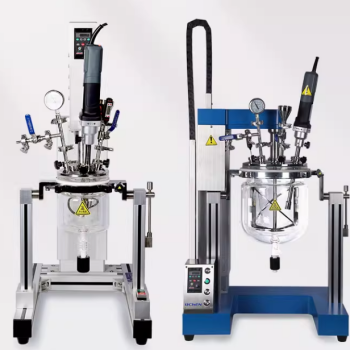
The high-vacuum reactor serves two simultaneous, critical functions in Ti-Al-Y alloy synthesis: it acts as a thermodynamic trigger for chemical decomposition and as a protective barrier against environmental contamination. By maintaining an extremely low pressure (specifically 0.01 Pa), the reactor forces the release of hydrogen from titanium and yttrium precursors while preventing catastrophic oxidation at the required 1200°C synthesis temperature.
The vacuum environment is not merely a passive container; it is an active processing condition. It lowers the partial pressure of hydrogen to drive dehydrogenation while simultaneously excluding reactive gases that would otherwise destroy the alloy's phase integrity at high temperatures.
Driving Chemical Transformation
Facilitating Dehydrogenation
The "hydride technology" method relies on using titanium and yttrium hydrides as starting materials. To form the final alloy, the hydrogen locked within these precursors must be removed.
The high-vacuum environment (0.01 Pa) creates a pressure differential that thermodynamically drives hydrogen out of the metal lattice. Without this deep vacuum, the hydrogen would remain trapped, preventing the formation of the desired metallic alloy.
Synergizing with Heat
This process occurs at a high synthesis temperature of 1200°C.
While the heat provides the kinetic energy for the reaction, the vacuum ensures the direction of the reaction is correct. It continuously evacuates the released hydrogen gas, preventing it from re-adsorbing into the material.
Ensuring Material Purity
Preventing Oxidation
At 1200°C, titanium and aluminum are highly reactive and have a strong affinity for oxygen.
If the synthesis occurred in standard atmospheric conditions—or even a poor vacuum—the sample would suffer from rapid oxidation. The high-vacuum reactor creates a void that effectively removes oxygen, ensuring the metals remain pure enough to bond with one another.
Eliminating Side Reactions
Oxygen is not the only threat to the alloy's quality.
The vacuum also eliminates residual gases such as nitrogen and carbon dioxide. Excluding these prevents the formation of unwanted nitrides or carbides, ensuring the accurate formation of the alloy's phase structure.
Understanding Process Sensitivities
The Necessity of Deep Vacuum
A standard vacuum is often insufficient for this specific chemical pathway.
While some sintering processes might tolerate pressures around 8 Pa, the decomposition of Ti and Y hydrides requires a significantly stricter environment (0.01 Pa). Failing to achieve this depth of vacuum can lead to incomplete dehydrogenation.
Thermal and Atmospheric Balance
The relationship between temperature and pressure is non-negotiable.
If the vacuum integrity is breached while the reactor is at 1200°C, the result is not just a lower quality alloy, but likely a completely different, brittle ceramic compound. The equipment must maintain the vacuum seal flawlessly throughout the entire high-temperature cycle.
Making the Right Choice for Your Goal
To ensure successful synthesis of Ti-Al-Y alloys via hydride technology, consider the following operational priorities:
- If your primary focus is Phase Purity: Verify that your reactor can sustain 0.01 Pa consistently to prevent the formation of oxides, nitrides, and carbides that disrupt the alloy structure.
- If your primary focus is Chemical Conversion: Ensure the vacuum system has sufficient pumping capacity to handle the volume of hydrogen gas released during the decomposition of the hydride precursors.
The high-vacuum reactor is the enabling tool that converts volatile hydride precursors into stable, high-performance Ti-Al-Y alloys.
Summary Table:
| Feature | Requirement | Role in Synthesis |
|---|---|---|
| Vacuum Level | 0.01 Pa | Drives dehydrogenation and removes H₂ gas |
| Temperature | 1200°C | Provides kinetic energy for chemical transformation |
| Environment | Ultra-Low Oxygen | Prevents oxidation and formation of nitrides/carbides |
| Precursors | Ti/Y Hydrides | Starting materials requiring vacuum-induced decomposition |
Elevate Your Advanced Material Synthesis with KINTEK
Precision is paramount when synthesizing Ti-Al-Y alloys at 1200°C. KINTEK specializes in state-of-the-art laboratory equipment, offering high-performance high-vacuum reactors and high-temperature furnaces designed to maintain critical pressures of 0.01 Pa. Whether you are conducting battery research, dental material development, or complex alloy synthesis, our comprehensive range—from vacuum and atmosphere furnaces to high-pressure autoclaves and crushing systems—ensures your phase integrity and chemical purity are never compromised.
Ready to achieve superior material purity and process control?
Contact KINTEK Experts Today to find the perfect vacuum solution for your laboratory.
References
- Natalia Karakchieva, И. А. Курзина. Influence of Yttrium on the Phase Composition of the Ti-Al System Obtained by the ‘Hydride Technology’. DOI: 10.3390/met12091481
This article is also based on technical information from Kintek Solution Knowledge Base .
Related Products
- Customizable Laboratory High Temperature High Pressure Reactors for Diverse Scientific Applications
- Customizable High Pressure Reactors for Advanced Scientific and Industrial Applications
- Stainless High Pressure Autoclave Reactor Laboratory Pressure Reactor
- High Pressure Laboratory Autoclave Reactor for Hydrothermal Synthesis
- Mini SS High Pressure Autoclave Reactor for Laboratory Use
People Also Ask
- How do high-pressure and high-temperature reactors ensure the effective treatment of lignocellulosic wastewater in WAO?
- What equipment is required for high-pressure high-temperature reactions? Master Extreme Chemistry Safely
- How do you control high pressure in a reactor? A Guide to Safe & Stable Operation
- Why is argon better than nitrogen for inert atmosphere? Ensure Absolute Reactivity & Stability
- How does initial oxygen pressure affect the wet oxidation of pharmaceutical sludge? Master Your Oxidation Depth