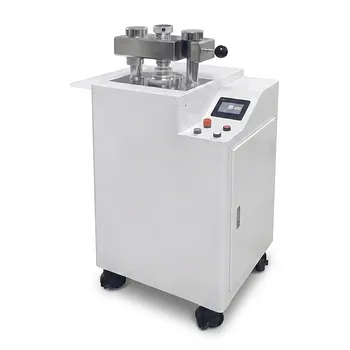
The laboratory hydraulic press serves as the critical bridge between loose ceramic powder and a functional solid electrolyte. By applying precise axial pressure to multi-doped Gadolinium-doped Ceria (GDC) powders within high-strength alloy molds, the press transforms a disorganized volume of particles into a coherent "green body." This process establishes the initial geometry, density, and mechanical integrity required for the electrolyte to survive the high-temperature sintering stage.
The primary role of the hydraulic press is to facilitate particle rearrangement and mechanical interlocking, creating a structural foundation with reduced internal porosity. This preliminary densification is a non-negotiable prerequisite for achieving the high final densities (93%–97%) necessary for efficient ionic conductivity in GDC electrolytes.
Mechanical Transformation of Powder into Form
Defining Geometric Shape and Handling Strength
The hydraulic press uses high-strength alloy steel molds to confine multi-doped GDC powder while applying axial pressure. This mechanical compression creates a "green body"—a physical prototype of the electrolyte—that possesses sufficient mechanical strength to be handled and transported without crumbling.
Achieving Preliminary Densification
By applying pressures typically ranging from 2 to 10 MPa (and sometimes up to 50 MPa depending on the specific doping), the press forces particles into a tighter packing arrangement. This step is vital because it establishes the initial packing density, which dictates how much the material will shrink and densify during the subsequent sintering process.
Optimizing the Microstructure for Sintering
Reducing Large Internal Pores
The application of controlled pressure effectively eliminates large voids between loose powder particles. Reducing this initial porosity is essential because large pores are difficult to remove during sintering and can act as structural defects in the final electrolyte membrane.
Ensuring Uniform Particle Contact
For multi-doped GDC, tight contact between particles is necessary to facilitate the solid-state diffusion that occurs at high temperatures. The hydraulic press ensures that the doped ceria particles are in intimate contact, providing the physical foundation needed to reach near-theoretical density after heat treatment.
Understanding the Trade-offs and Limitations
Pressure Gradients and Friction
One common challenge with axial pressing is the friction between the powder and the mold walls, which can lead to uneven pressure distribution. This gradient can cause variations in density within the green body, potentially leading to warping or cracking during the sintering phase.
Risk of Lamination and Cracking
If the pressure is applied or released too rapidly, air trapped within the powder can cause lamination cracks. Furthermore, while higher pressures generally increase density, exceeding the material's limit can lead to "over-pressing," where the green body expands and fails upon removal from the mold.
Applying This to Your Fabrication Process
To ensure the highest quality for your multi-doped GDC electrolyte green bodies, consider the following recommendations based on your specific objectives:
- If your primary focus is maximum handling strength: Utilize binders in your powder mix and apply a higher axial pressure (near 50 MPa) to ensure robust mechanical interlocking of particles.
- If your primary focus is high final sintered density: Use the hydraulic press as a "pre-pressing" step at lower pressures (10-30 MPa) to define the shape, then follow with cold isostatic pressing (CIP) to achieve a more uniform density distribution.
- If your primary focus is avoiding lamination or structural defects: Ensure a slow, controlled release of pressure and use high-strength alloy steel molds with polished internal surfaces to minimize wall friction.
The precise application of pressure through a laboratory hydraulic press is the fundamental first step in crafting high-performance, crack-free GDC electrolyte membranes.
Summary Table:
| Function | Mechanism | Impact on Electrolyte |
|---|---|---|
| Geometric Shaping | Axial compression in alloy molds | Provides handleable form and mechanical strength |
| Initial Densification | Applied pressure (2–50 MPa) | Reduces internal porosity for superior sintering |
| Microstructure Prep | Particle rearrangement | Facilitates solid-state diffusion and conductivity |
| Defect Control | Controlled pressure release | Minimizes lamination, warping, and internal cracks |
Elevate Your Electrolyte Research with KINTEK Precision
Achieving near-theoretical density in GDC electrolytes starts with a superior green body. KINTEK specializes in high-performance laboratory equipment designed for material science excellence. Our range of hydraulic presses (pellet, hot, and isostatic) ensures uniform pressure distribution and precise density control for your ceramic powders.
Beyond pressing, KINTEK offers a complete ecosystem for fuel cell and battery research, including:
- High-Temperature Furnaces: Muffle, vacuum, and atmosphere furnaces for optimal sintering.
- Material Preparation: Advanced crushing, milling systems, and sieving equipment.
- Consumables: High-purity ceramics, crucibles, and PTFE products.
- Thermal Management: Cooling solutions, ULT freezers, and freeze dryers.
Whether you are a researcher focused on ionic conductivity or a laboratory looking for reliable OEM/ODM support, KINTEK provides the tools and technical expertise to advance your work.
Ready to optimize your fabrication process? Contact our specialists today!
References
- Yuheng Liu, Bahman Amini Horri. Multi-doped ceria-based composite as a promising low-temperature electrolyte with enhanced ionic conductivity for steam electrolysis. DOI: 10.1039/d3me00011g
This article is also based on technical information from Kintek Solution Knowledge Base .
Related Products
- Laboratory Hydraulic Press Split Electric Lab Pellet Press
- Glassy Carbon Electrochemical Electrode
- Laboratory Hydraulic Pellet Press for XRF KBR FTIR Lab Applications
- Laboratory Hydraulic Press Lab Pellet Press Machine for Glove Box
- Automatic Fluorescent Pellet Press for XRF Sample Preparation
People Also Ask
- What role does a laboratory hydraulic press play in platinum recovery research? Enhancing Sample Precision
- What are the specific applications of a lab hydraulic press in biochar evaluation? Optimize density and data accuracy.
- What are the roles of a laboratory hydraulic press and stainless steel molds in the preparation of graphite samples?
- What is the role of a laboratory hydraulic press in electrode prep? Maximize Energy Density & Sealing Precision
- Why must a laboratory hydraulic press equipped with cylindrical molds be used when preparing BZY green bodies? High Density