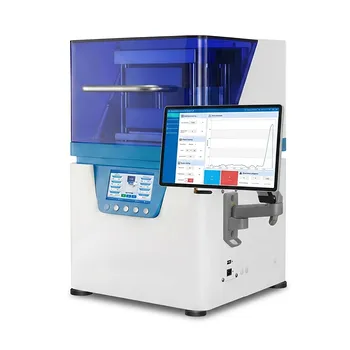
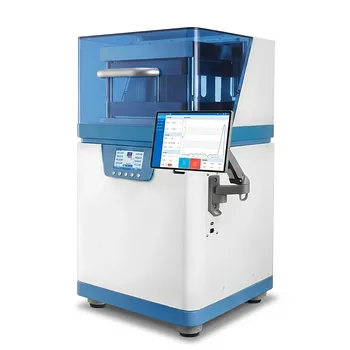
The laboratory hydraulic press is the primary tool for converting loose Ti-TiB2 powder mixtures into a structurally sound "green body" through high-pressure uniaxial compaction. By applying forces often reaching 800 MPa, the press eliminates air between particles and maximizes contact tightness, creating a dense physical foundation necessary for successful high-temperature sintering.
The hydraulic press acts as the critical bridge between raw powder and a solid component, utilizing extreme pressure to achieve the optimal green density required to prevent cracking and excessive shrinkage. Without this precise consolidation, the material would lack the structural integrity to survive the thermal stresses of the furnace.
Facilitating Mechanical Consolidation
Powder Rearrangement and Binding
When pressure is applied, the individual particles of titanium and titanium diboride undergo rearrangement, sliding into voids to fill empty spaces. This initial movement significantly increases the packing density of the mixture before any heat is applied.
Deformation of Ductile Components
The titanium (Ti) in the mixture acts as a ductile binder under high pressure. The hydraulic press forces these metallic particles to deform and interlock mechanically with the harder, brittle TiB2 ceramic particles, providing the green body with enough strength for handling.
Elimination of Internal Voids
By applying uniaxial pressure through a precision mold, the press effectively expels air trapped between particles. Removing these gaps is essential for reaching the extremely low porosity levels required in advanced ceramic-metal composites.
Establishing the Foundation for Sintering
Maximizing Green Density
A high green density—the density of the sample before sintering—is the most reliable predictor of final part quality. The hydraulic press ensures the particles are packed closely enough that the subsequent sintering process can achieve full densification without catastrophic volume loss.
Prevention of Structural Defects
Inadequate compaction often leads to non-uniform shrinkage or internal stress during the heating phase. By providing a highly compacted and uniform green body, the hydraulic press prevents the sample from warping or cracking as it undergoes chemical reactions in the furnace.
Enhancing Reaction Kinetics
The extreme pressure reduces the physical distance between the raw material particles. This tight contact facilitates the flow of materials and accelerates the diffusion process during sintering, which is critical for forming complex phases like Ti-TiB2.
Precision and Geometric Control
Defining Geometric Shape
The use of precision steel molds in conjunction with the hydraulic press allows researchers to produce green bodies with exact dimensions. This ensures that the final product meets specific geometric requirements for testing or industrial application.
Ensuring Mechanical Green Strength
The pressure applied—ranging from 10 MPa to 800 MPa depending on the specific material requirements—gives the green body sufficient mechanical strength. This "green strength" allows the sample to be demolded and moved to the sintering furnace without crumbling or losing its shape.
Controlled Uniaxial Pressure
Unlike manual methods, a laboratory hydraulic press provides measurable and repeatable axial pressure. This control allows for consistent results across multiple samples, which is vital for scientific accuracy and process optimization.
Understanding the Trade-offs
Pressure Limits and Tooling Wear
While higher pressure generally increases density, exceeding the limits of the precision mold can lead to tool failure or deformation. At 800 MPa, the stresses on steel molds are significant, requiring high-quality materials to avoid contamination of the Ti-TiB2 powder.
Density Gradients
Because the press applies uniaxial (one-way) pressure, the friction between the powder and the mold walls can cause uneven density. The top of the sample may be denser than the bottom, which can lead to slight distortions during the sintering process if not managed correctly.
Lack of Isostatic Uniformity
While a hydraulic press is excellent for simple geometric shapes (cylinders or blocks), it does not apply pressure equally from all directions. For highly complex shapes, the uniaxial compaction provided by a standard press may be insufficient compared to cold isostatic pressing.
Strategies for Effective Ti-TiB2 Fabrication
How to Apply This to Your Project
To achieve the best results when using a laboratory hydraulic press for Ti-TiB2 green bodies, consider your primary objective for the material's final application.
- If your primary focus is Maximum Density: Utilize the highest safe pressure (up to 800 MPa) to minimize internal voids and maximize particle contact before sintering.
- If your primary focus is Structural Handling: Ensure the mixture contains enough ductile titanium to allow for mechanical interlocking, providing the green strength needed for demolding.
- If your primary focus is Dimensional Accuracy: Use high-precision, hardened steel molds and apply pressure slowly to ensure uniform powder rearrangement and minimal elastic recovery.
Through precise pressure control and high-load capacity, the laboratory hydraulic press ensures that Ti-TiB2 green bodies possess the density and integrity required for advanced material science applications.
Summary Table:
| Key Function | Mechanism | Impact on Quality |
|---|---|---|
| Powder Consolidation | Uniaxial pressure up to 800 MPa | Transforms loose powder into a solid green body |
| Void Elimination | Air expulsion & particle rearrangement | Maximizes green density to minimize sintering shrinkage |
| Mechanical Interlocking | Deformation of ductile Ti particles | Provides the green strength necessary for handling |
| Geometric Precision | Use of precision-hardened steel molds | Ensures repeatable dimensions and uniform sample shape |
Precision Compaction for Superior Material Science
Achieving the perfect Ti-TiB2 green body requires consistent pressure and high-quality tooling. KINTEK specializes in advanced laboratory solutions designed to optimize your fabrication workflow. Our comprehensive range of hydraulic presses (pellet, hot, and isostatic) ensures maximum green density and structural integrity for your samples.
Beyond compaction, KINTEK supports your entire research cycle with:
- High-Temperature Furnaces: Muffle, vacuum, and atmosphere furnaces for flawless sintering.
- Sample Preparation: Crushing, milling, and sieving systems for precise powder mixtures.
- Essential Consumables: High-quality ceramics, crucibles, and precision molds.
Ready to enhance your lab's efficiency and experimental accuracy? Contact our technical experts today to find the ideal equipment for your specific application!
References
- Ali Mohammad Ali Aljafery, Julfikar Haider. Powder Metallurgy Preparation and Characterization of Titanium-Titanium Diboride Composite Targeted for Dental Implant. DOI: 10.3390/jcs7090353
This article is also based on technical information from Kintek Solution Knowledge Base .
Related Products
- Laboratory Hydraulic Press Split Electric Lab Pellet Press
- Laboratory Hydraulic Press Lab Pellet Press Machine for Glove Box
- Laboratory Hydraulic Press Lab Pellet Press for Button Battery
- Automatic Laboratory Hydraulic Pellet Press Machine for Lab Use
- Fully Automatic Heated Hydraulic Lab Press for Materials Sintering and Sample Preparation
People Also Ask
- What role does a laboratory hydraulic press play in platinum recovery research? Enhancing Sample Precision
- What are the specific applications of a lab hydraulic press in biochar evaluation? Optimize density and data accuracy.
- What are the roles of a laboratory hydraulic press and stainless steel molds in the preparation of graphite samples?
- What is the role of a laboratory hydraulic press in electrode prep? Maximize Energy Density & Sealing Precision
- Why must a laboratory hydraulic press equipped with cylindrical molds be used when preparing BZY green bodies? High Density