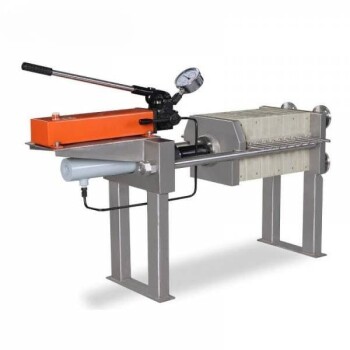
The laboratory hydraulic press is a critical tool for transforming loose pine sawdust biochar into standardized, densified pellets or specimens. This densification is essential for evaluating the material's electrical conductivity, mechanical strength, and chemical composition, as it ensures consistent sample geometry and structural compactness required for accurate technical data.
Central Takeaway: A laboratory hydraulic press enables the precise control of pressure and density, transforming biochar powder into stable forms necessary for both analytical characterization and the simulation of industrial-scale performance.
Enhancing Material Characterization and Testing
Structural Compactness for Electrode Evaluation
When evaluating pine sawdust-based biochar as an electrode material, a hydraulic press is used to compress the biochar-binder mixture into specific shapes. This process ensures structural compactness, which is a prerequisite for obtaining repeatable and accurate data during subsequent electrical conductivity tests.
Sample Preparation for Spectroscopy
For techniques like X-ray fluorescence (XRF) and Fourier-Transform Infrared (FTIR) spectroscopy, the press creates dense, uniform pellets. In FTIR specifically, biochar is mixed with potassium bromide (KBr) and subjected to approximately 20 MPa of pressure to form transparent pellets that allow for the accurate detection of chemical bond vibrations.
Standardizing Mechanical Strength Tests
The press allows researchers to create specimens with precise densities and geometries to measure the mechanical durability of the biochar. By applying uniform pressure, the resulting pellets can be tested for wear resistance and their ability to withstand physical stress without crumbling into dust.
Optimizing Performance for Industrial Applications
Improving Adsorption Bed Efficiency
In wastewater and gas treatment research, the hydraulic press is used to form biochar into regular granules or pellets. This densification reduces the pressure drop within continuous-flow systems and prevents the loss of material as dust when subjected to high-speed liquid or gas flows.
Increasing Volumetric Energy Density
For biochar intended as a fuel source, the press simulates the briquetting process to increase volumetric energy density. This evaluates how well the pine sawdust biochar can be compressed to improve its transportation, storage characteristics, and combustion efficiency.
Simulating Large-Scale Production Parameters
The press acts as a pilot-scale simulator, applying pressures typically ranging from 50 to 1000 PSI to model industrial pelletizing. This allows researchers to determine the minimum critical pressure required for specific tree species and moisture contents before moving to mass production.
Understanding the Trade-offs
Balancing Porosity and Mechanical Strength
While high pressure increases the mechanical strength of a biochar pellet, it can simultaneously collapse the internal pore structure. For adsorption applications, researchers must find a "sweet spot" where the material is strong enough to handle flow but porous enough to remain chemically active.
The Influence of Binder Chemistry
The use of a hydraulic press often requires chemical binders to ensure the biochar holds its shape. These binders can interfere with certain analytical results or change the surface chemistry of the biochar, necessitating careful selection to avoid skewed performance data.
How to Apply This to Your Project
Recommendations Based on Research Goals
- If your primary focus is electrochemical performance: Use the press to ensure maximum specimen density, as voids between particles will lead to inconsistent electrical resistance readings.
- If your primary focus is environmental filtration: Focus on finding the lowest pressure that prevents pellet disintegration to preserve the biochar's internal surface area and macro-pores.
- If your primary focus is industrial fuel production: Use the press to test varying moisture contents and pressure holds to identify the most energy-efficient parameters for large-scale pellet mills.
Precise pressure control is the bridge between raw biochar powder and the high-fidelity data required for advanced material science.
Summary Table:
| Application Category | Specific Use Case | Key Benefit of Using a Hydraulic Press |
|---|---|---|
| Electrochemical Analysis | Electrode preparation | Ensures structural compactness for reliable conductivity data. |
| Chemical Characterization | FTIR & XRF spectroscopy | Creates transparent, uniform pellets (e.g., KBr pellets at 20 MPa). |
| Mechanical Evaluation | Durability & wear testing | Produces standardized geometries to measure crush resistance. |
| Environmental Science | Adsorption bed granules | Reduces pressure drop and prevents dust loss in flow systems. |
| Industrial Modeling | Briquetting simulation | Determines critical pressure (50-1000 PSI) for fuel production. |
Elevate Your Biochar Research with KINTEK Precision
Precise sample preparation is the foundation of high-fidelity material science. At KINTEK, we specialize in high-performance laboratory equipment designed to transform raw materials into accurate data. Whether you are evaluating pine sawdust biochar or developing next-generation energy storage, our comprehensive range of laboratory hydraulic presses (pellet, hot, and isostatic) ensures the density and consistency your research demands.
Beyond sample preparation, KINTEK offers a full suite of laboratory solutions, including:
- High-Temperature Furnaces: Muffle, tube, vacuum, and CVD systems for precise carbonization.
- Crushing & Milling Systems: For uniform biochar powder preparation.
- Reactors & Autoclaves: High-temperature and high-pressure systems for hydrothermal processing.
- Advanced Tools: Electrolytic cells, battery research consumables, and high-purity ceramics.
Ready to standardize your testing parameters and achieve industrial-grade results? Contact KINTEK today to find the perfect hydraulic press and laboratory equipment tailored to your specific application.
References
- Linen Xie, Huanhuan Ma. Co-Pyrolysis for Pine Sawdust with Potassium Chloride: Insight into Interactions and Assisting Biochar Graphitization. DOI: 10.3390/ma16103667
This article is also based on technical information from Kintek Solution Knowledge Base .
Related Products
- Laboratory Hydraulic Press Split Electric Lab Pellet Press
- Laboratory Hydraulic Press Lab Pellet Press Machine for Glove Box
- Laboratory Hydraulic Press Lab Pellet Press for Button Battery
- Automatic Laboratory Hydraulic Pellet Press Machine for Lab Use
- Automatic Laboratory Hydraulic Press for XRF & KBR Pellet Press
People Also Ask
- What are the roles of a laboratory hydraulic press and stainless steel molds in the preparation of graphite samples?
- What is the role of a laboratory hydraulic press in electrode prep? Maximize Energy Density & Sealing Precision
- How does a laboratory hydraulic press ensure the quality of alumina-forming alloy green bodies? Optimize CSP Research
- How is a laboratory hydraulic press used to evaluate the mechanical performance of nano-modified concrete? Expert Guide
- Why is a laboratory hydraulic press used for ASSB assembly? Achieving 392 MPa for Optimal Solid-State Battery Density