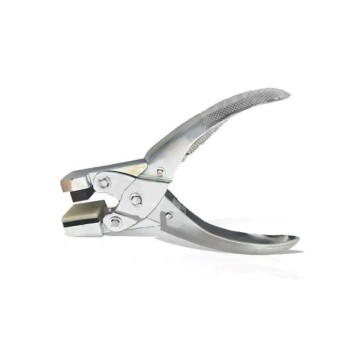
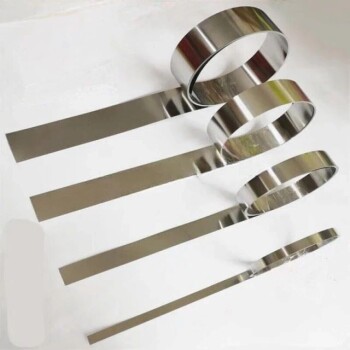
Indium foil functions as a critical interface material during the Electrochemical Impedance Spectroscopy (EIS) testing of solid electrolytes. It acts as a soft metal blocking electrode that is applied directly to both sides of the solid electrolyte pellet to establish a high-fidelity connection. By filling microscopic surface voids, it ensures the electrical contact is uniform and stable throughout the testing process.
Solid electrolytes often suffer from poor surface contact with rigid measurement probes. Indium foil solves this by using its high ductility to bridge microscopic gaps, significantly reducing contact resistance to yield precise and reliable impedance data.
The Physical Challenge of Solid Interfaces
The Roughness of Solids
Unlike liquid electrolytes, solid electrolyte pellets possess microscopic surface irregularities. Even polished surfaces contain valleys and peaks that are invisible to the naked eye.
The Failure of Rigid Contacts
When a standard rigid electrode is pressed against these surfaces, it only touches the "peaks" of the electrolyte.
This creates air gaps between the electrode and the material. These gaps act as insulators, disrupting the flow of current and introducing errors into your measurement.
The Mechanism of Indium Foil
Exploiting High Ductility
Indium is chosen specifically for its high ductility and softness. It is not merely a conductor; it is a malleable gasket.
When pressure is applied, the indium flows physically into the microscopic gaps of the electrolyte. This transforms a patchy, point-to-point contact into a continuous, uniform interface.
Acting as a Blocking Electrode
In this context, indium serves as a blocking electrode. This means it blocks the transfer of ions (the actual mass transport) while allowing the measurement of electrical response.
This isolation is necessary to focus the EIS measurement specifically on the properties of the solid electrolyte itself, rather than reaction kinetics at the interface.
Impact on Data Integrity
Eliminating Contact Resistance
The primary artifact in solid-state EIS testing is contact resistance. High contact resistance creates a "noise" floor that can obscure the true impedance of the material.
By maximizing the physical contact area, indium foil minimizes this resistance.
Precision and Reliability
With contact resistance minimized, the data you capture is a reflection of the electrolyte's intrinsic properties. This leads to precise impedance data that is reproducible across different samples.
It removes the variable of "how well did I press the probe?" from the equation, allowing for reliable comparative analysis.
Understanding the Trade-offs
Mechanical Softness
While its softness is a virtue for contact, it makes indium mechanically fragile. It acts as a consumable because it permanently deforms to match the specific pellet it is tested with.
Blocking Nature
It is crucial to remember that indium is a blocking electrode.
It is excellent for measuring ionic conductivity and bulk permittivity. However, it cannot be used if your goal is to measure charge transfer reactions or electrochemical performance that requires ion flow across the boundary.
Making the Right Choice for Your Goal
To ensure your EIS data is valid, apply indium foil based on your specific testing objectives.
- If your primary focus is measuring bulk ionic conductivity: Use indium foil to minimize contact resistance and isolate the electrolyte's resistance from interface artifacts.
- If your primary focus is checking sample consistency: Use the foil to ensure that variations in surface roughness between different pellets do not skew your comparison data.
By utilizing indium foil to bridge the physical gap, you transform a rough solid interface into a reliable circuit component.
Summary Table:
| Feature | Role of Indium Foil in EIS Testing |
|---|---|
| Material Property | High ductility and mechanical softness |
| Function | Fills microscopic surface voids to bridge gaps |
| Electrode Type | Blocking electrode (allows electrical measurement, blocks ion transfer) |
| Primary Benefit | Eliminates contact resistance and interface 'noise' |
| Key Outcome | Accurate measurement of bulk ionic conductivity and permittivity |
| Consumable Status | Single-use due to permanent deformation during application |
Elevate Your Battery Research with KINTEK Precision
Maximize the accuracy of your solid-state electrolyte characterization with high-quality consumables from KINTEK. We understand that the integrity of your Electrochemical Impedance Spectroscopy (EIS) data depends on perfect interface contact.
Beyond specialized indium foil and battery research consumables, KINTEK provides a comprehensive ecosystem for advanced material science, including:
- High-Temperature Furnaces & Reactors: Muffle, tube, and vacuum systems for precise material synthesis.
- Sample Preparation: Professional crushing, milling, and hydraulic presses (pellet, hot, isostatic) for perfect electrolyte discs.
- Electrochemical Solutions: High-performance electrolytic cells, electrodes, and high-pressure autoclaves.
Ready to eliminate contact resistance and achieve reproducible results? Contact KINTEK today to source the essential tools and consumables your laboratory needs for breakthrough energy research.
Related Products
- High-Purity Titanium Foil and Sheet for Industrial Applications
- High Purity Zinc Foil for Battery Lab Applications
- Aluminum Foil Current Collector for Lithium Battery
- Copper Foam
- Professional Cutting Tools for Carbon Paper Cloth Diaphragm Copper Aluminum Foil and More
People Also Ask
- What products are manufactured with titanium? The Ultimate Guide to High-Performance Materials
- What are the advantages of utilizing Polytetrafluoroethylene (PTFE) sheets as casting substrates? | KINTEK Solution
- In what way do portable laboratory consumables like PTFE sheets define a functional workspace? Transform Your Lab Bench
- What are the advantages of using titanium? Achieve Unmatched Strength and Corrosion Resistance
- What are the safety considerations for titanium? From Biocompatible Metal to Fire Hazard