Powder mixing equipment acts as the architect of the composite cathode's microstructure. It uses mechanical force to uniformly disperse the active material (Nb2O5), the solid electrolyte (LPSC), and the conductive agent (carbon nanofibers or CNF). This process transforms distinct component powders into a cohesive composite characterized by intimate particle-to-particle contact.
The primary function of mixing equipment is to establish continuous ionic and electronic transport networks by ensuring the uniform dispersion of components and creating tight solid-solid interfaces, which are prerequisites for optimal electrochemical performance.
Establishing Transport Networks
The Role of Uniform Dispersion
To function correctly, a solid-state battery requires two distinct pathways within the cathode.
Nb2O5 (the active material) must be physically connected to CNF for electron flow and to LPSC for lithium-ion flow. Mixing equipment breaks up agglomerates to ensure these three components are evenly distributed rather than isolated in clumps.
Creating Tight Solid-Solid Interfaces
Unlike liquid electrolyte batteries where the liquid fills all voids, solid-state batteries rely entirely on physical contact.
The mechanical force applied by the equipment presses these solid particles together. This creates tight contact interfaces, reducing interfacial resistance and allowing ions and electrons to move freely between particles.
Material Integrity and Purity
Preventing Contamination
The choice of equipment material plays a vital role in maintaining the electrochemical purity of the cathode.
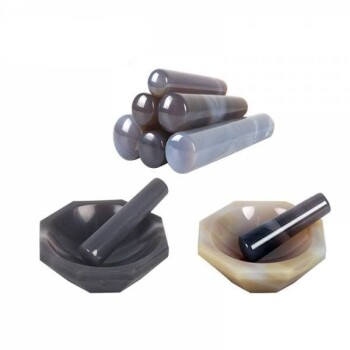
Tools like agate mortars are often utilized because of their hardness and chemical inertness. They prevent the introduction of metallic contaminants or impurities that could degrade the high-voltage performance of the Nb2O5 active material.
Managing Shear Forces
The mixing process uses shear force to create a homogeneous blend.
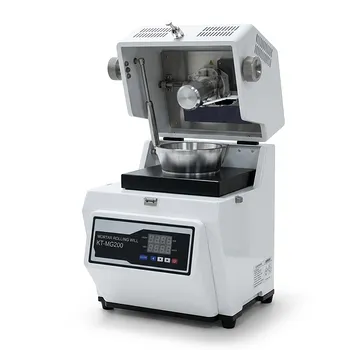
Whether using manual tools or automated systems like ball mixers, the goal is to generate enough energy to disperse the carbon nanofibers effectively without destroying the structure of the other particles.
Understanding the Trade-offs
The Risk of Over-Mixing
While sufficient energy is needed to form a network, excessive mechanical force can be detrimental.
Aggressive mixing can lead to the mechanochemical decomposition of sensitive solid electrolytes. LPSC (a sulfide electrolyte) is particularly prone to structural damage if the shear force is too high, which would permanently degrade ionic conductivity.
Balancing Contact vs. Integrity
There is a delicate balance between achieving intimate contact and maintaining particle integrity.
Insufficient mixing results in poor contact and high resistance, while over-processing can pulverize the active material or damage the crystallinity of the LPSC. The process must be tuned to provide just enough energy to bond the particles without altering their chemical properties.
Making the Right Choice for Your Goal
Selecting the correct mixing approach depends on whether you are prioritizing purity or throughput.
- If your primary focus is material purity and research precision: Utilize an agate mortar, as its inert nature prevents metallic contamination and offers precise, low-energy control to protect the LPSC structure.
- If your primary focus is scalability and homogeneity: utilize mechanical milling or twin-shaft mixers, but carefully calibrate the rotation speed (e.g., around 2000 rpm) to ensure dispersion without subjecting the sulfide electrolyte to decomposition.
The success of your composite cathode ultimately relies on using the mixing stage to maximize particle contact while strictly preserving the chemical stability of the solid electrolyte.
Summary Table:
| Component | Primary Role in Cathode | Mixing Requirement |
|---|---|---|
| Nb2O5 | Active Material | Uniform dispersion to prevent isolation |
| LPSC | Solid Electrolyte | Creation of tight interfaces without structural damage |
| CNF | Conductive Agent | Breaking up agglomerates for electron flow |
| Equipment | Microstructure Architect | Balancing mechanical force vs. material integrity |
Elevate Your Solid-State Battery Research with KINTEK
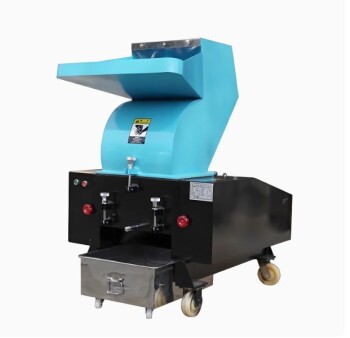
Precision in powder mixing is the difference between a high-performance cathode and a failed cell. KINTEK specializes in advanced laboratory equipment designed to meet the rigorous demands of battery material synthesis. Whether you need high-purity agate mortars for contamination-free research or robust crushing and milling systems to scale your production, our solutions ensure optimal particle contact and structural integrity.
From high-temperature furnaces and hydraulic presses for pellet preparation to specialized battery research tools and consumables, KINTEK provides the comprehensive portfolio you need to push the boundaries of energy storage technology.
Ready to optimize your composite cathode microstructure? Contact our technical experts today to find the perfect equipment for your Nb2O5 and LPSC research.
Related Products
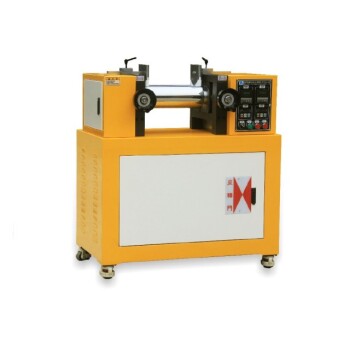
- Open Type Two Roll Mixing Mill Machine for Rubber Crusher
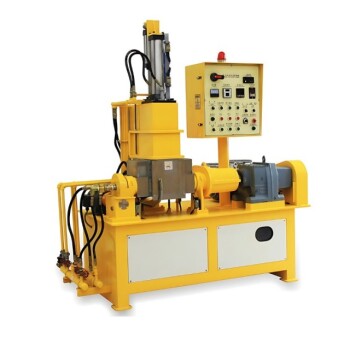
- Lab Internal Rubber Mixer Rubber Kneader Machine for Mixing and Kneading
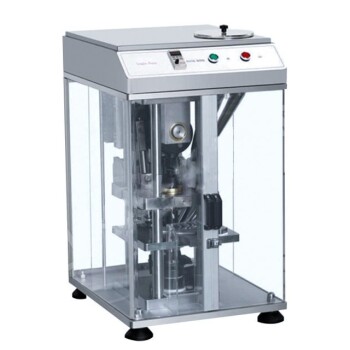
- Single Punch Electric Tablet Press Machine Laboratory Powder Tablet Punching TDP Tablet Press
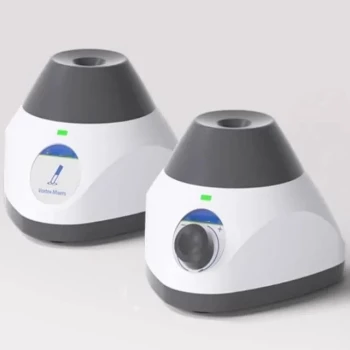
- Laboratory Disc Rotary Mixer for Efficient Sample Mixing and Homogenization
- Mini Planetary Ball Mill Machine for Laboratory Milling
People Also Ask
- What is a two roll mill for rubber compounding? A Foundational Tool for Polymer Processing
- What is the use of two roll mill? Essential for Polymer Mixing, R&D, and Quality Control
- What is the two roll mill mixing process? Master Polymer Compounding with High Shear
- What is the disadvantage of a two-roll mill? Limited Thickness Reduction Due to Roll Flattening
- What are the advantages of a two roll mill? Achieve Superior Polymer Mixing & Quality Control