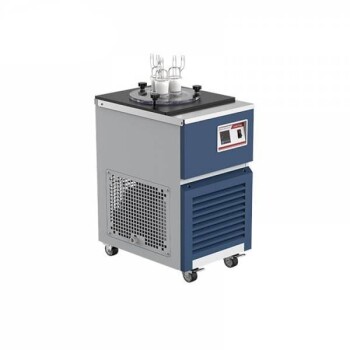
The condenser serves as the primary stabilization mechanism for residual fluids exiting a high-temperature rock core during dynamic simulation experiments. Its specific function is to rapidly cool high-pressure, high-temperature fluids down to room temperature immediately upon exit. This prevents phase changes that would otherwise distort the chemical composition of the sample.
By eliminating the risk of fluid flashing, the condenser maintains the precise ratio of solvent to solute, ensuring that subsequent measurements of dissolved minerals accurately represent the chemical reactions occurring within the rock.
Preserving Chemical Integrity
To understand the necessity of the condenser, one must look at the thermodynamic state of the fluid. The fluid exiting the core is often under significant heat and pressure, conditions that differ drastically from the collection environment.
Preventing Fluid Flashing
When high-temperature fluid exits a pressurized environment into a lower-pressure collection vessel, it naturally undergoes "flashing."
This is a phenomenon where a portion of the liquid instantaneously vaporizes. The condenser intervenes by reducing the fluid's temperature below its boiling point before it reaches this low-pressure zone.
Maintaining Correct Concentrations
If flashing occurs, water (the solvent) is lost to evaporation/vaporization.
This loss results in an artificial concentration of the remaining chemical components. The condenser ensures no water is lost, guaranteeing the sample remains representative of the fluid inside the core.
Ensuring Analytical Accuracy
The ultimate goal of fluid collection is quantitative analysis. The physical state of the collected fluid directly dictates the validity of the chemical data derived from it.
Validating Reaction Extent
Researchers often track specific markers, such as metal ions and soluble silicon content, to judge the extent of chemical stimulation.
These markers indicate how much the rock matrix has reacted with the stimulation fluid.
Data Reliability
If the fluid volume is altered by evaporation, calculations regarding the mass and concentration of these ions will be skewed.
The condenser freezes the sample's "chemical snapshot," ensuring the data reflects the actual reaction extent rather than post-experiment handling artifacts.
Common Pitfalls to Avoid
While the role of the condenser is straightforward, overlooking its efficiency can lead to significant experimental errors.
The Risk of Inadequate Cooling
Simply having a condenser is not enough; it must have sufficient capacity to bring the fluid to room temperature immediately.
If the fluid remains warm, slow evaporation may still occur in the open collection vessel over time.
Misinterpreting Concentration Spikes
Without proper condensation, researchers may observe artificially high levels of dissolved minerals.
This can lead to the false conclusion that the chemical stimulation was more effective or aggressive than it actually was.
Making the Right Choice for Your Goal
The condenser is not just plumbing; it is a data preservation device. How you view it depends on your specific analytical targets.
- If your primary focus is Quantitative Analysis: Ensure your cooling capacity prevents any vapor loss to guarantee accurate metal ion and silicon measurements.
- If your primary focus is Reaction Modeling: Use the condenser to stabilize the fluid state so that your output data accurately models the "downhole" reaction conditions.
The reliability of your entire chemical study hinges on this single thermal transition point.
Summary Table:
| Feature | Function in Fluid Collection | Impact on Data Accuracy |
|---|---|---|
| Temperature Control | Rapidly cools high-temperature fluids to room temperature. | Prevents phase changes and fluid flashing. |
| Solvent Preservation | Stops instantaneous vaporization (flashing) of water. | Maintains correct solvent-to-solute ratios. |
| Marker Stabilization | Preserves concentration of metal ions and soluble silicon. | Ensures valid quantification of reaction extent. |
| Thermal Transition | Acts as a data preservation device at the exit point. | Eliminates artificial concentration spikes. |
Maximize Your Research Precision with KINTEK
Don't let fluid flashing compromise your chemical stimulation data. KINTEK specializes in high-performance laboratory equipment designed to maintain the integrity of your most sensitive samples.
Whether you are conducting high-pressure rock core simulations or complex reaction modeling, our comprehensive range of high-temperature high-pressure reactors, autoclaves, and cooling solutions—including precision chillers and condensers—ensures your data reflects the true extent of the reaction.
Partner with KINTEK for:
- Advanced cooling solutions (ULT freezers, cold traps) to stabilize fluids instantly.
- Durable high-temperature reactors and specialized PTFE/ceramic consumables.
- Expertly engineered crushing, milling, and hydraulic press systems for sample preparation.
Ready to elevate your laboratory's analytical accuracy? Contact our technical specialists today to find the perfect solution for your research!
References
- Zhenpeng Cui, Bo Feng. Experimental Study on the Effect and Mechanism of Chemical Stimulation on Deep High-Temperature Granite. DOI: 10.3389/feart.2022.893969
This article is also based on technical information from Kintek Solution Knowledge Base .
Related Products
People Also Ask
- Why are precision Condensers and Cold Traps necessary at the collection end of a pyrolysis system? Maximize Yield & Purity
- Why is it necessary to configure efficient cold traps in membrane distillation? Ensure Flux Stability & Data Accuracy
- What is the purpose of connecting a cold trap at the reactor outlet? Protect Equipment and Analyze Liquid Products
- What is the role of glass condensation components in arsenic collection? Optimize Niccolite Roasting & Kinetics
- What is the function of a cold trap in bio-ethanol and methane reforming experiments? Optimize Purity & Protect Systems