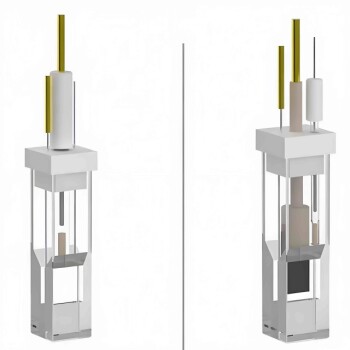
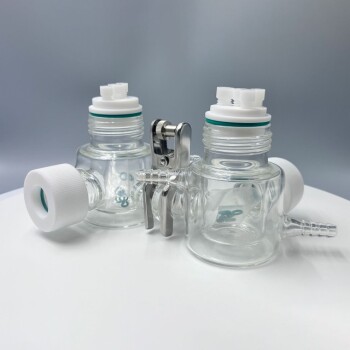
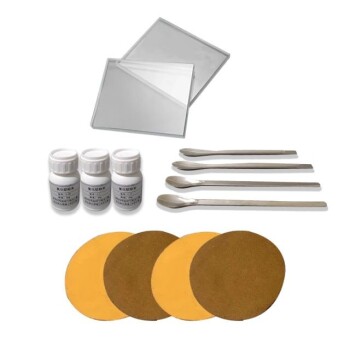
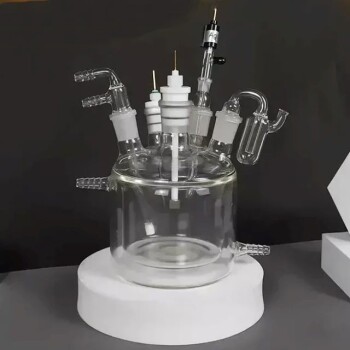
To operate the thin-layer spectroelectrochemical cell correctly, you must use a specific three-electrode configuration consisting of a Silver/Silver Chloride (Ag/AgCl) reference electrode, a Platinum (Pt) wire counter electrode, and a Platinum (Pt) mesh working electrode. Adhering to the precise diameter and dimension specifications is critical to ensure these components fit the PTFE lid and integrated quartz body.
Core Takeaway: This cell is engineered for a strict hardware specification: a 3.8mm Ag/AgCl reference, a 0.5mm Pt wire counter, and a 6x7mm Pt mesh working electrode are required to match the unit’s internal slit geometry.
Detailed Electrode Specifications
The Reference Electrode
For the reference potential, the system requires a Silver/Silver Chloride (Ag/AgCl) electrode.
The physical specification is non-negotiable: the electrode must have a 3.8mm diameter. This specific size ensures a proper seal and fit within the cell's polytetrafluoroethylene (PTFE) lid.
The Counter Electrode
The counter (or auxiliary) electrode must be a Platinum (Pt) wire.
The required diameter for this wire is 0.5mm. Platinum is utilized here for its high electrical conductivity and chemical inertness, which prevents the electrode from dissolving and contaminating the electrolyte during operation.
The Working Electrode
For the working electrode, the cell utilizes a Platinum (Pt) mesh.
The required dimensions for this mesh are 6mm by 7mm. The mesh structure is chosen to provide a sufficient surface area for the electrochemical reaction while accommodating the thin-layer configuration of the cell.
Cell Construction and Context
Physical Constraints
The electrodes must fit within a very specific internal volume. The cell features an internal slit with a depth of either 0.5mm or 1.0mm, depending on your specific configuration.
The external body is a 12mm by 12mm square made of integrated ground quartz. This construction allows for four-sided light transmission, which is the defining feature of spectroelectrochemical analysis.
Chemical Compatibility
The cell components, including the quartz body and PTFE lid, allow for operation in both aqueous and non-aqueous systems.
Because the body is manufactured without adhesives, it maintains high purity and resists solvent degradation, provided the electrodes are also chemically compatible with your chosen solvent.
Critical Trade-offs and Operational Risks
Voltage and Polarity Control
You must strictly control the applied voltage. Excessive voltage can cause the decomposition of the electrolyte or physical damage to the delicate electrode materials.
Furthermore, correct polarity is essential. Reversing the anode and cathode connections can lead to immediate experimental failure or hardware damage.
Handling and Maintenance
While the quartz construction offers excellent optical properties, it requires careful handling.
You must inspect the cell body for physical damage prior to every use. Between experiments, the body requires cleaning with a suitable solvent and distilled water to remove impurities that could alter spectroscopic readings.
Making the Right Choice for Your Experiment
How to Apply This to Your Project
- If your primary focus is hardware procurement: Ensure your reference electrode is exactly 3.8mm in diameter and your counter electrode is a 0.5mm Pt wire to guarantee a physical fit.
- If your primary focus is experimental setup: Verify that your Platinum mesh working electrode is oriented correctly within the 6x7mm allowance to prevent shorting against the quartz walls.
Summary: strict adherence to the 3.8mm reference, 0.5mm counter, and mesh working electrode specifications is the only way to ensure the mechanical fit and electrochemical fidelity of this cell.
Summary Table:
| Component | Electrode Type | Specification/Dimensions | Material |
|---|---|---|---|
| Reference Electrode | Ag/AgCl | 3.8mm Diameter | Silver/Silver Chloride |
| Counter Electrode | Wire | 0.5mm Diameter | Platinum (Pt) |
| Working Electrode | Mesh | 6mm x 7mm | Platinum (Pt) |
| Cell Body | Integrated Quartz | 12mm x 12mm (Ext) | Ground Quartz |
| Internal Slit | Thin-layer Gap | 0.5mm or 1.0mm | N/A |
Precision is paramount in spectroelectrochemistry. KINTEK specializes in high-performance laboratory equipment, providing the exact electrolytic cells and electrodes needed for high-fidelity research. Whether you require platinum mesh electrodes, integrated quartz cells, or specialized battery research tools, our team ensures your hardware meets rigorous experimental standards. Contact KINTEK today to source compatible consumables and advanced systems for your laboratory.
Related Products
- Electrode Fixture for Electrochemical Experiments
- Side Window Optical Electrolytic Electrochemical Cell
- Thin-Layer Spectral Electrolysis Electrochemical Cell
- Electrolytic Electrochemical Cell Gas Diffusion Liquid Flow Reaction Cell
- H Type Electrolytic Cell Triple Electrochemical Cell
People Also Ask
- What criteria are used during the visual inspection of electrodes? Essential Quality Assessment for Your Lab
- How should an electrode holder be cleaned as part of regular maintenance? Ensure Reliable Electrochemical Measurements
- What is a critical precaution regarding electrolyte contact when using an electrode holder? Ensure Accurate and Safe Electrochemical Measurements
- What are the proper procedures for post-treatment and storage of an electrode holder after an experiment? Ensure Accuracy and Longevity
- What maintenance check is required for the electrical connections of an electrode holder? Ensure Reliable Data and Lab Safety