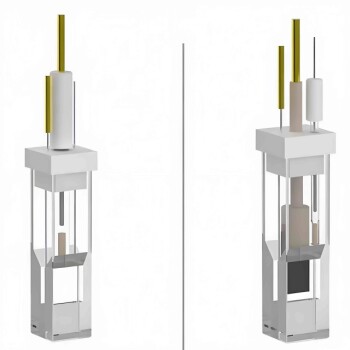
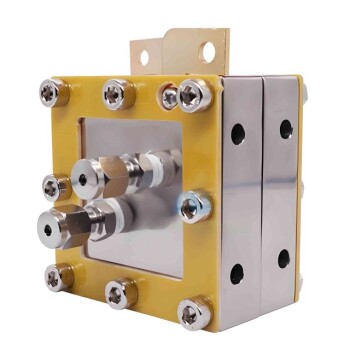
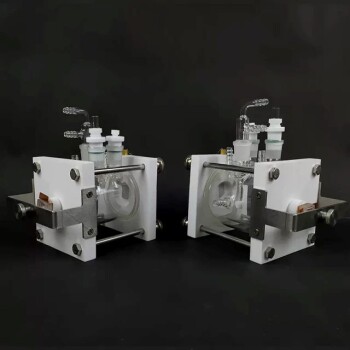
The standard thin-layer spectroelectrochemical cell features a square external body measuring precisely 12 mm by 12 mm. Regarding the internal volume, the slit dimensions are available in two specific configurations: 10 mm by 8 mm with a depth of either 0.5 mm or 1.0 mm.
Core Takeaway The cell's standardized 12 mm external profile ensures compatibility with typical holders, while the internal slit depth (0.5 mm or 1.0 mm) dictates the optical path length and solution volume for your thin-layer electrolysis experiments.
Physical Construction and Specifications
External Body Dimensions
The external body adheres to a 12 mm by 12 mm square footprint. This standard size allows the cell to fit securely into most commercial spectrophotometer cell holders without requiring specialized adapters.
Internal Slit Configurations
You must choose between two internal geometries based on your experimental needs. Both options feature a 10 mm height and 8 mm width, but differ in optical path length: 0.5 mm or 1.0 mm.
Material Integrity
The body is manufactured from integrated ground quartz. This construction provides four-sided light transmission, which is critical for simultaneous spectral and electrochemical measurements.
Adhesive-Free Assembly
The quartz design avoids the use of adhesives. This ensures high purity and chemical resistance, preventing sample contamination that can occur with glued components.
Component Compatibility and Setup
Electrode Integration
The internal dimensions dictate which electrodes can be used. The system is designed for a platinum (Pt) mesh working electrode measuring 6 mm by 7 mm, which fits comfortably within the 10 mm by 8 mm internal slit.
Reference and Counter Electrodes
For the remaining connections, the cell accommodates a silver/silver chloride (Ag/AgCl) reference electrode with a 3.8 mm diameter. The counter electrode is typically a platinum (Pt) wire with a 0.5 mm diameter.
Lid and Chemical Resistance
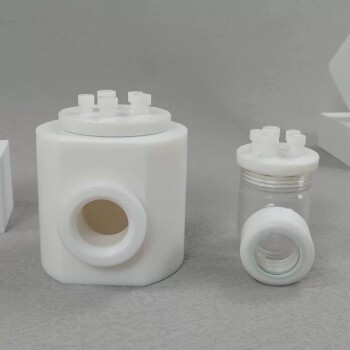
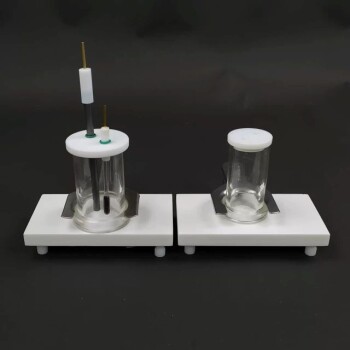
The cell utilizes a lid made from polytetrafluoroethylene (PTFE). This material is selected for its high chemical resistance, making the cell suitable for both aqueous and non-aqueous electrochemical systems.
Understanding the Operational Trade-offs
Voltage Control and Decomposition
You must strictly control the applied voltage. Excessive voltage can lead to electrolyte decomposition or physical damage to the electrodes, particularly within the confined volume of the thin layer.
Connection Risks
The design requires precise connection of the anode and cathode. Reversing the polarity can rapidly damage the specialized electrodes or the cell interface.
Cleaning Rigor
Because the cell relies on integrated quartz rather than disposable parts, post-experiment maintenance is demanding. You must drain the electrolyte immediately and rinse multiple times with distilled water to prevent cross-contamination or residue buildup.
Making the Right Choice for Your Goal
To ensure your experimental setup yields valid data, consider the following configurations:
- If your primary focus is varying the optical path length: Select the internal slit depth (0.5 mm vs. 1.0 mm) that best balances your signal sensitivity requirements with the available sample volume.
- If your primary focus is preventing contamination: Leverage the adhesive-free quartz body and PTFE lid, ensuring rigorous solvent cleaning and distilled water rinsing before every use.
- If your primary focus is electrochemical precision: Verify that your working electrode dimensions do not exceed 6 mm by 7 mm to ensure proper fitment and current distribution within the slit.
By matching the internal slit depth to your specific analytical requirements, you optimize the cell for accurate spectroelectrochemical analysis.
Summary Table:
| Feature | Specification |
|---|---|
| External Dimensions | 12 mm x 12 mm |
| Internal Slit (H x W) | 10 mm x 8 mm |
| Available Slit Depths | 0.5 mm or 1.0 mm |
| Body Material | Integrated Ground Quartz (Adhesive-Free) |
| Lid Material | Polytetrafluoroethylene (PTFE) |
| Electrode Compatibility | Pt Mesh (6x7mm), Ag/AgCl (3.8mm), Pt Wire (0.5mm) |
Elevate Your Electrochemical Research with KINTEK
Precision is the foundation of reliable spectroelectrochemical data. KINTEK specializes in high-performance laboratory equipment, providing researchers with the integrated quartz cells, electrolytic cells and electrodes, and advanced thermal solutions needed for demanding analysis.
Whether you require specialized high-temperature furnaces, hydraulic presses for sample prep, or chemical-resistant PTFE consumables, our experts are ready to support your workflow.
Contact KINTEK today to find the perfect cell configuration for your lab!
Related Products
- Thin-Layer Spectral Electrolysis Electrochemical Cell
- Quartz Electrolytic Electrochemical Cell for Electrochemical Experiments
- FS Electrochemical Hydrogen Fuel Cells for Diverse Applications
- Side Window Optical Electrolytic Electrochemical Cell
- PTFE Electrolytic Cell Electrochemical Cell Corrosion-Resistant Sealed and Non-Sealed
People Also Ask
- What are the recommended post-experiment procedures for cleaning and storing the thin-layer spectroelectrochemical cell?
- What preparation steps are required before initiating an experiment with the thin-layer spectroelectrochemical cell?
- What operational environments and sealing options are available for the thin-layer spectroelectrochemical cell?
- For what types of systems, temperature ranges, and sealing configurations is the thin-layer spectroelectrochemical cell designed? Ideal for Aqueous and Non-Aqueous Analysis
- What are the necessary preparation steps before using a thin-layer spectroelectrochemical cell? A Guide to Reliable Results